
基于氨基酸衍生表面活性剂的两亲组装体的聚集行为、抗菌活性和生物相容性。
Aggregation Behavior, Antibacterial Activity and Biocompatibility of Catanionic Assemblies Based on Amino Acid-Derived Surfactants.
机构信息
Department of Surfactants and Nanobiotechnology, IQAC-CSIC, c/ Jordi Girona, 18-26, 08034 Barcelona, Spain.
Department of Biochemistry and Physiology-Physiology Section, Faculty of Pharmacy and Food Science- University of Barcelona, Avda. Joan XXIII, 27-31, 08028 Barcelona, Spain.
出版信息
Int J Mol Sci. 2020 Nov 24;21(23):8912. doi: 10.3390/ijms21238912.
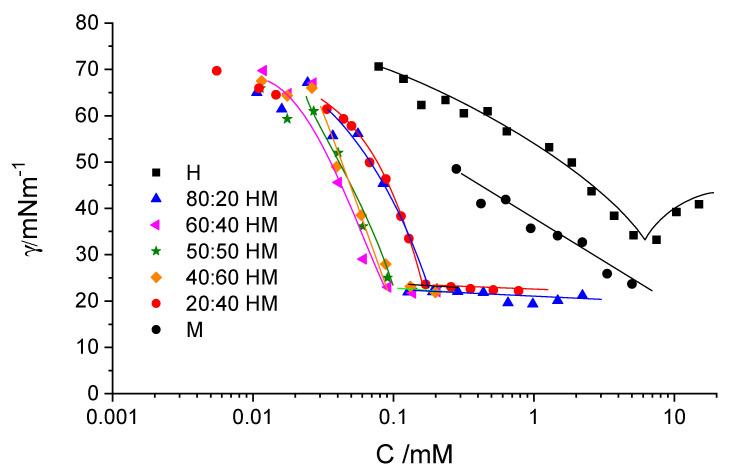
The surface activity, aggregates morphology, size and charge characteristics of binary catanionic mixtures containing a cationic amino acid-derived surfactant N(π), N(τ)-bis(methyl)-L-Histidine tetradecyl amide (DMHNHC) and an anionic surfactant (the lysine-based surfactant N-lauroyl-Nacetyl lysine (CCL) or sodium myristate) were investigated for the first time. The cationic surfactant has an acid proton which shows a strong pK shift irrespective of aggregation. The resulting catanionic mixtures exhibited high surface activity and low critical aggregation concentration as compared with the pure constituents. Catanionic vesicles based on DMHNHC/sodium myristate showed a monodisperse population of medium-size aggregates and good storage stability. According to Small-Angle X-Ray Scattering (SAXS), the characteristics of the bilayers did not depend strongly on the system composition for the positively charged vesicles. Negatively charged vesicles (cationic surfactant:myristate ratio below 1:2) had similar bilayer composition but tended to aggregate. The DMHNHC-rich vesicles exhibited good antibacterial activity against Gram-positive bacteria and their bactericidal effectivity declined with the decrease of the cationic surfactant content in the mixtures. The hemolytic activity and cytotoxicity of these catanionic formulations against non-tumoral (3T3, HaCaT) and tumoral (HeLa, A431) cell lines also improved by increasing the ratio of cationic surfactant in the mixture. These results indicate that the biological activity of these systems is mainly governed by the cationic charge density, which can be modulated by changing the cationic/anionic surfactant ratio in the mixtures. Remarkably, the incorporation of cholesterol in those catanionic vesicles reduces their cytotoxicity and increases the safety of future biomedical applications of these systems.
首次研究了包含阳离子氨基酸衍生表面活性剂 N(π)、N(τ)-双(甲基)-L-组氨酸十四酰胺(DMHNHC)和阴离子表面活性剂(赖氨酸基表面活性剂 N-月桂酰基-N-乙酰赖氨酸(CCL)或肉豆蔻酸钠)的二元双离子混合物的表面活性、聚集形态、大小和电荷特性。阳离子表面活性剂具有一个酸性质子,无论聚集状态如何,其 pK 值都会发生强烈偏移。与纯组分相比,所得的双离子混合物表现出高表面活性和低临界聚集浓度。基于 DMHNHC/肉豆蔻酸钠的双离子囊泡表现出中等大小聚集物的单分散群体和良好的储存稳定性。根据小角 X 射线散射(SAXS),对于带正电的囊泡,双层的特性与体系组成关系不大。带负电的囊泡(阳离子表面活性剂:肉豆蔻酸盐的比例低于 1:2)具有相似的双层组成,但倾向于聚集。DMHNHC 丰富的囊泡对革兰氏阳性菌表现出良好的抗菌活性,其杀菌效果随着混合物中阳离子表面活性剂含量的降低而降低。这些双离子制剂对非肿瘤(3T3、HaCaT)和肿瘤(HeLa、A431)细胞系的溶血活性和细胞毒性也随着混合物中阳离子表面活性剂比例的增加而提高。这些结果表明,这些系统的生物学活性主要受阳离子电荷密度控制,通过改变混合物中阳离子/阴离子表面活性剂的比例可以调节其阳离子电荷密度。值得注意的是,胆固醇的掺入降低了这些双离子囊泡的细胞毒性,并增加了这些系统未来在生物医学应用中的安全性。




 Zotero 插件