
卡泊芬净联合 TMP/SMZ 作为人类免疫缺陷病毒感染患者中中重度 PCP 的一线治疗。
Caspofungin combined with TMP/SMZ as a first-line therapy for moderate-to-severe PCP in patients with human immunodeficiency virus infection.
机构信息
The Third People's Hospital of Guilin, Guangxi, China.
The First Hospital of Jiaxing, Zhejiang, China.
出版信息
HIV Med. 2021 Apr;22(4):307-313. doi: 10.1111/hiv.13013. Epub 2020 Dec 4.
OBJECTIVES
The effectiveness of trimethoprim/sulfamethoxazole (TMP/SMZ) for pneumocystis pneumonia (PCP) is limited with adverse events. Caspofungin, by inhibiting the cyst form of Pneumocystis jirovecii, may be an alternative therapy for PCP. However, the availability of clinical data about caspofungin combined with TMP/SMZ in the treatment of PCP in HIV-infected patients is limited. Thus, we aimed to examine the clinical effectiveness and safety of caspofungin combined with TMP/SMZ as a first-line therapy for moderate-to-severe PCP in HIV-infected patients.
METHODS
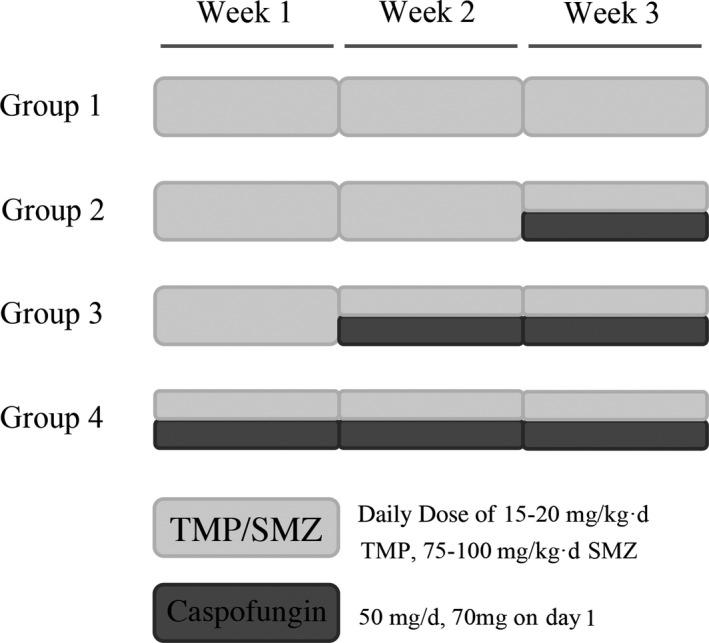
From January 2017 to December 2019, data of HIV-infected patients with moderate-to-severe PCP who received either TMP/SMZ alone or caspofungin combined with TMP/SMZ as first-line therapy were retrospectively reviewed to assess the effectiveness and safety of each regimen. The Kaplan-Meier curve and log-rank test were used for survival analysis.
RESULTS
A total of 278 patients met the criteria. The overall positive response rate of PCP treatment was 48.92%, and the overall all-cause in-hospital mortality rate was 33.09%. Patients who received combination therapy consisting of caspofungin and TMP/SMZ had a better positive response rate (59.44% vs. 37.78%, P < 0.001) and lower all-cause in-hospital mortality rate (24.48% vs. 42.22%, P = 0.003). Also, patients who received combination therapy had higher survival rate during a hospital stay (75.52% vs. 57.78%, P = 0.004), and those who received longer combination therapy were more likely to have higher survival rate (P = 0.042). We found that age (P = 0.019), CD4 cell count (P = 0.001) and therapeutic regimen (P = 0.002) were significant risk factors for all-cause in-hospital mortality rate in univariate analysis. In multivariate analysis, only CD4 cell count and therapeutic regimen were statistically significant factors associated with all-cause in-hospital mortality rate. Patients with a CD4 count of > 30 cells/µL and patients who received combination therapy consisting of caspofungin and TMP/SMZ were more likely to survive from PCP (P = 0.011 and P = 0.002, respectively). There were no additional severe adverse events caused by adding caspofungin.
CONCLUSIONS
For HIV-infected patients with moderate-to-severe PCP, combination therapy with caspofungin and TMP/SMZ is an effective and promising first-line therapy with no greater number of adverse events compared with TMP/SMZ monotherapy. Patients who received caspofungin had better positive response rates and lower all-cause in-hospital mortality rates. Also, we recommend early initiation of caspofungin.
目的
复方磺胺甲噁唑(TMP/SMZ)治疗肺孢子菌肺炎(PCP)的疗效有限,且不良反应发生率较高。棘白菌素类药物(如卡泊芬净)可抑制卡氏肺孢子虫的囊前期,有望成为治疗 PCP 的替代药物。然而,有关 HIV 感染者中卡泊芬净联合 TMP/SMZ 治疗 PCP 的临床数据有限。因此,本研究旨在评估卡泊芬净联合 TMP/SMZ 作为 HIV 感染者中中重度 PCP 的一线治疗方案的临床疗效和安全性。
方法
本研究回顾性分析了 2017 年 1 月至 2019 年 12 月间接受 TMP/SMZ 单药治疗或卡泊芬净联合 TMP/SMZ 作为一线治疗的中重度 PCP 的 HIV 感染者的数据,以评估两种方案的疗效和安全性。采用 Kaplan-Meier 曲线和对数秩检验进行生存分析。
结果
共纳入 278 例患者。PCP 治疗的总有效率为 48.92%,总全因住院死亡率为 33.09%。接受卡泊芬净联合 TMP/SMZ 治疗的患者有效率更高(59.44% vs. 37.78%,P<0.001),全因住院死亡率更低(24.48% vs. 42.22%,P=0.003)。此外,接受联合治疗的患者在住院期间的生存率更高(75.52% vs. 57.78%,P=0.004),且接受联合治疗时间较长的患者生存率更高(P=0.042)。单因素分析显示,年龄(P=0.019)、CD4 细胞计数(P=0.001)和治疗方案(P=0.002)是全因住院死亡率的显著危险因素。多因素分析显示,只有 CD4 细胞计数和治疗方案是与全因住院死亡率相关的统计学显著因素。CD4 计数>30 个/µL 的患者和接受卡泊芬净联合 TMP/SMZ 治疗的患者更有可能从 PCP 中存活(P=0.011 和 P=0.002)。加用卡泊芬净无其他严重不良反应。
结论
对于中重度 PCP 的 HIV 感染者,卡泊芬净联合 TMP/SMZ 是一种有效的、有前景的一线治疗方法,与 TMP/SMZ 单药治疗相比,不良反应发生率无增加。接受卡泊芬净治疗的患者有效率更高,全因住院死亡率更低。同时,我们建议尽早开始卡泊芬净治疗。


 Zotero 插件