
用于光动力消融宫颈癌细胞的各向异性铜铁氧体-聚合物核壳纳米颗粒的制备
Fabrication of Anisotropic Cu Ferrite-Polymer Core-Shell Nanoparticles for Photodynamic Ablation of Cervical Cancer Cells.
作者信息
Kuo Shuo-Hsiu, Wu Po-Ting, Huang Jing-Yin, Chiu Chin-Pao, Yu Jiashing, Liao Mei-Yi
机构信息
Department of Chemical Engineering, National Taiwan University, Taipei 10617, Taiwan.
Department of Applied Chemistry, National Pingtung University, Pingtung 90003, Taiwan.
出版信息
Nanomaterials (Basel). 2020 Dec 4;10(12):2429. doi: 10.3390/nano10122429.
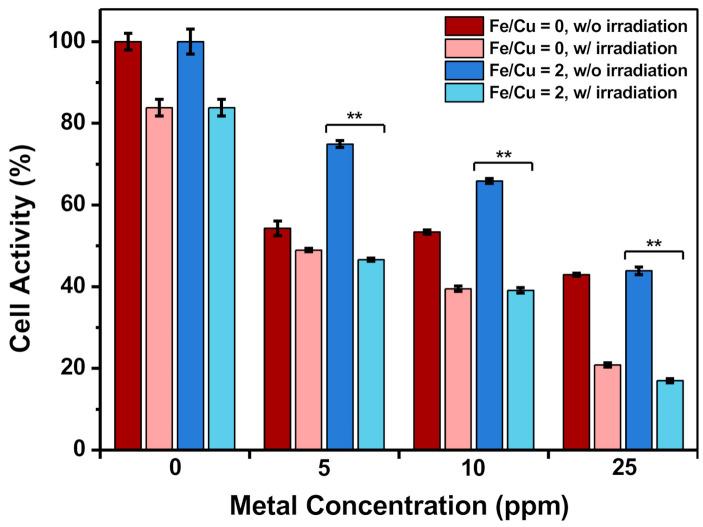
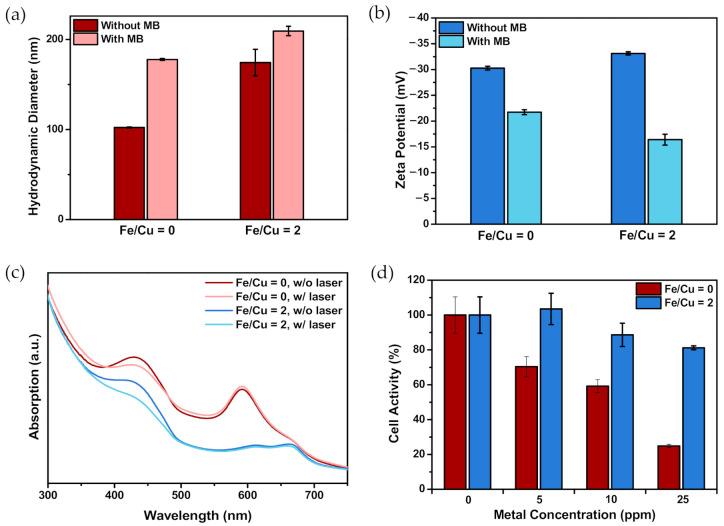
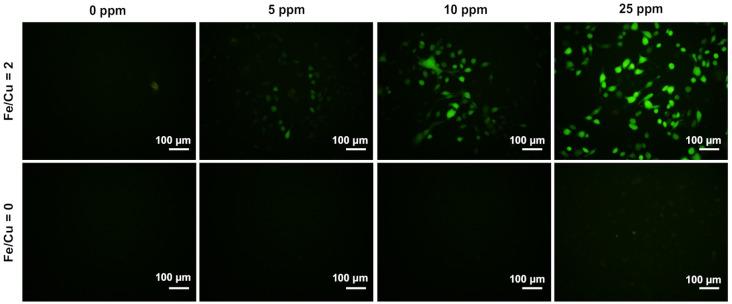
In this work we developed methylene blue-immobilized copper-iron nanoparticles (MB-CuFe NPs) through a facile one-step hydrothermal reaction to achieve a better phototherapeutic effect. The Fe/Cu ratio of the CuFe NPs was controllable by merely changing the loading amount of iron precursor concentration. The CuFe NPs could serve as a Fenton catalyst to convert hydrogen peroxide (HO) into reactive oxygen species (ROS), while the superparamagnetic properties also suggest magnetic resonance imaging (MRI) potential. Furthermore, the Food and Drug Administration (FDA)-approved MB photosensitizer could strongly adsorb onto the surface of CuFe NPs to facilitate the drug delivery into cells and improve the photodynamic therapy at 660 nm via significant generation of singlet oxygen species, leading to enhanced cancer cell-damaging efficacy. An MTT (thiazolyl blue tetrazolium bromide) assay proved the low cytotoxicity of the CuFe NPs to cervical cancer cells (HeLa cells), namely above 80% at 25 ppm of the sample dose. A slight dissolution of Cu and Fe ions from the CuFe NPs in an acidic environment was obtained, providing direct evidence for CuFe NPs being degradable without the risk of long-term retention in the body. Moreover, the tremendous photo-to-thermal conversion of CuFe NPs was examined, which might be combined with photodynamic therapy (PDT) for promising development in the depletion of cancer cells after a single pulse of deep-red light irradiation at high laser power.
在这项工作中,我们通过简便的一步水热反应制备了固定有亚甲蓝的铜铁纳米颗粒(MB-CuFe NPs),以实现更好的光热治疗效果。通过仅改变铁前驱体浓度的负载量,就可以控制CuFe NPs的铁/铜比例。CuFe NPs可以作为芬顿催化剂,将过氧化氢(H₂O₂)转化为活性氧(ROS),同时其超顺磁性也显示出磁共振成像(MRI)的潜力。此外,美国食品药品监督管理局(FDA)批准的MB光敏剂可以强烈吸附在CuFe NPs的表面,促进药物进入细胞,并通过大量产生单线态氧显著改善660nm处的光动力疗法,从而提高癌细胞损伤疗效。MTT(噻唑蓝四氮唑溴盐)试验证明了CuFe NPs对宫颈癌细胞(HeLa细胞)的低细胞毒性,即在25ppm的样品剂量下细胞存活率高于80%。在酸性环境中,CuFe NPs会轻微溶解出铜离子和铁离子,这为CuFe NPs可降解且不会在体内长期留存提供了直接证据。此外,还研究了CuFe NPs巨大的光热转换性能,在高激光功率下进行单脉冲深红色光照射后,其可与光动力疗法(PDT)结合,有望在癌细胞清除方面取得进展。


 Zotero 插件