
急性 HIV-1 感染中外周和结肠 CD161+CD4 T 细胞功能障碍的纵向分析及早期治疗干预的影响
Longitudinal Analysis of Peripheral and Colonic CD161 CD4 T Cell Dysfunction in Acute HIV-1 Infection and Effects of Early Treatment Initiation.
机构信息
U.S. Military HIV Research Program, Walter Reed Army Institute of Research, Silver Spring, MD 20910, USA.
Henry M. Jackson Foundation for the Advancement of Military Medicine Inc., Bethesda, MD 20817, USA.
出版信息
Viruses. 2020 Dec 11;12(12):1426. doi: 10.3390/v12121426.
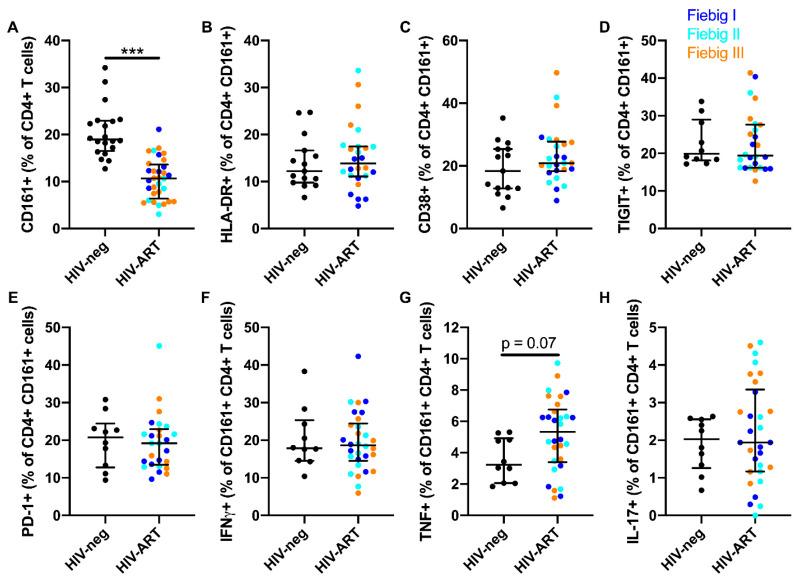
CD161 expression on CD4 T cells is associated with a Th17 functional phenotype, as well as with an innate capacity to respond to interleukin (IL)-12 and IL-18 without T cell receptor (TCR) stimulation. Chronic HIV-1 infection is associated with loss of the CD161 CD4 T cell population, and non-human primate studies suggest that their depletion is associated with disease progression. However, the dynamics of the CD161 CD4 T cell population during acute HIV-1 infection remains unknown. In this study, we characterize peripheral blood CD161 CD4 T cells in detail, and examine how they are affected during the earliest stages of HIV-1 infection. Unbiased surface proteome screening and principal component analysis indicated that CD161 CD4 T cells are relatively phenotypically homogeneous between donors, and are intermediates between conventional CD4 T cells and innate-like T cells. In acute untreated HIV-1 infection, the circulating CD161 CD4 T cell population decreased in frequency, as did absolute cell counts starting from peak viral load, with elevated levels of activation and exhaustion markers expressed throughout acute HIV-1 infection. The capacity of these cells to respond to stimulation with IL-12 and IL-18 was also reduced. Early initiation of anti-retroviral treatment (ART) during acute HIV-1 infection restored the functionality of peripheral blood CD161 CD4 T cells, but not their frequency. In contrast, early ART initiation prevented the decline of colonic CD161 CD4 T cells that otherwise started during acute infection. Furthermore, loss of peripheral and colonic CD161 CD4 T cells in untreated infection was associated with levels of viral load. These results suggest that acute HIV-1 infection has profound effects on the CD161 CD4 T cell population that could not be completely prevented by the initiation of ART.
CD161 表达在 CD4 T 细胞上与 Th17 功能表型相关,并且具有在没有 T 细胞受体 (TCR) 刺激的情况下对白细胞介素 (IL)-12 和 IL-18 产生先天反应的能力。慢性 HIV-1 感染与 CD161 CD4 T 细胞群的丧失有关,而非人类灵长类动物研究表明,其耗竭与疾病进展有关。然而,急性 HIV-1 感染期间 CD161 CD4 T 细胞群的动态仍然未知。在这项研究中,我们详细描述了外周血 CD161 CD4 T 细胞,并研究了它们在 HIV-1 感染的最早阶段是如何受到影响的。无偏见的表面蛋白质组筛选和主成分分析表明,CD161 CD4 T 细胞在供体之间具有相对表型均匀性,并且是传统 CD4 T 细胞和固有样 T 细胞之间的中间体。在未经治疗的急性 HIV-1 感染中,循环 CD161 CD4 T 细胞群的频率降低,从峰值病毒载量开始,绝对细胞计数也降低,在整个急性 HIV-1 感染过程中表达的激活和衰竭标志物水平升高。这些细胞对 IL-12 和 IL-18 刺激的反应能力也降低了。在急性 HIV-1 感染期间早期开始抗逆转录病毒治疗 (ART) 可以恢复外周血 CD161 CD4 T 细胞的功能,但不能恢复其频率。相比之下,早期 ART 启动可防止未经治疗的急性感染期间开始的结肠 CD161 CD4 T 细胞下降。此外,未经治疗的感染中,外周血和结肠 CD161 CD4 T 细胞的丧失与病毒载量水平相关。这些结果表明,急性 HIV-1 感染对 CD161 CD4 T 细胞群有深远的影响,ART 的启动并不能完全预防这种影响。


 Zotero 插件