
嗅鞘细胞静脉移植减轻脊髓损伤后神经炎症:白细胞介素-1 受体拮抗剂。
Intravenous transplantation of olfactory ensheathing cells reduces neuroinflammation after spinal cord injury interleukin-1 receptor antagonist.
机构信息
Department of Neurosurgery, General Hospital of Ningxia Medical University, Yinchuan, Ningxia, China.
Department of Neurosurgery, Affiliated Hospital of Hebei University, Baoding, Hebei, China.
出版信息
Theranostics. 2021 Jan 1;11(3):1147-1161. doi: 10.7150/thno.52197. eCollection 2021.
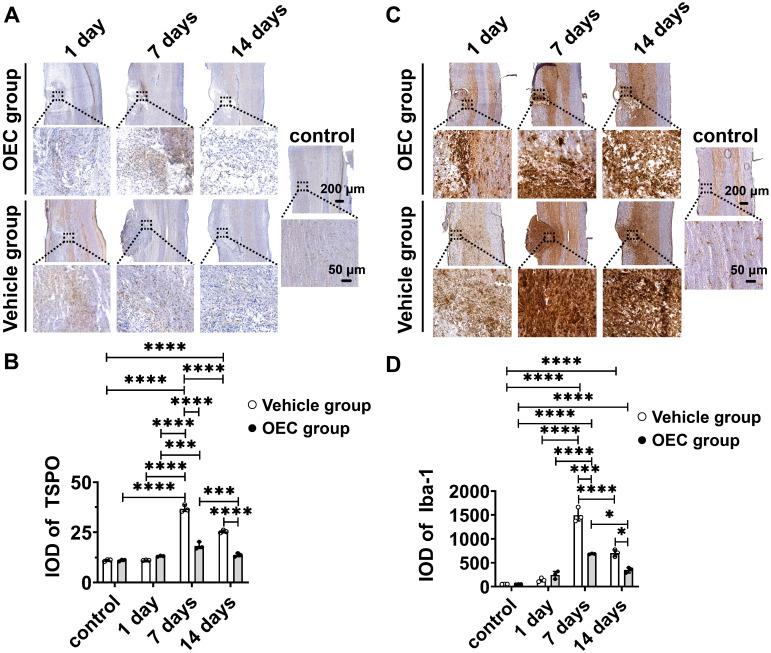
Olfactory ensheathing cell (OEC) transplantation has emerged as a promising therapy for spinal cord injury (SCI) repair. In the present study, we explored the possible mechanisms of OECs transplantation underlying neuroinflammation modulation. Spinal cord inflammation after intravenous OEC transplantation was detected and by translocator protein PET tracer [F]F-DPA. To track transplanted cells, OECs were transduced with enhanced green fluorescent protein (eGFP) and HSV1-39tk using lentiviral vector and were monitored by fluorescence imaging and [F]FHBG study. Protein microarray analysis and ELISA studies were employed to analyze differential proteins in the injured spinal cord after OEC transplantation. The anti-inflammation function of the upregulated protein was also proved by gene knocking down experiments and OECs/microglia co-culture experiment. The inflammation in the spinal cord was decreased after OEC intravenous transplantation. The HSV1-39tk-eGFP-transduced OECs showed no accumulation in major organs and were found at the injury site. After OEC transplantation, in the spinal cord tissues, the interleukin-1 receptor antagonist (IL-1Ra) was highly upregulated while many chemokines, including pro-inflammatory chemokines IL-1α, IL-1β were downregulated. studies confirmed that lipopolysaccharide (LPS) stimulus triggered OECs to secrete IL-1Ra. OECs significantly suppressed LPS-stimulated microglial activity, whereas IL-1Ra gene knockdown significantly reduced their ability to modulate microglial activity. The OECs that reached the lesion site were activated by the release of pro-inflammatory cytokines from activated microglia in the lesion site and secreted IL-1Ra to reduce neuroinflammation. Intravenous transplantation of OECs has high therapeutic effectiveness for the treatment of SCI the secretion of IL-1Ra to reduce neuroinflammation.
嗅鞘细胞(OEC)移植已成为治疗脊髓损伤(SCI)的一种有前途的方法。在本研究中,我们探讨了 OEC 移植调节神经炎症的可能机制。通过转位蛋白 PET 示踪剂 [F]F-DPA 检测到 OEC 静脉移植后的脊髓炎症。为了追踪移植细胞,我们使用慢病毒载体将 OEC 转导为增强型绿色荧光蛋白(eGFP)和 HSV1-39tk,并通过荧光成像和 [F]FHBG 研究进行监测。蛋白质微阵列分析和 ELISA 研究用于分析 OEC 移植后损伤脊髓中的差异蛋白。通过基因敲低实验和 OEC/小胶质细胞共培养实验也证明了上调蛋白的抗炎功能。OEC 静脉移植后,脊髓炎症减轻。HSV1-39tk-eGFP 转导的 OEC 在主要器官中没有积累,而是在损伤部位被发现。OEC 移植后,在脊髓组织中,白细胞介素 1 受体拮抗剂(IL-1Ra)高度上调,而许多趋化因子,包括促炎趋化因子 IL-1α、IL-1β 下调。研究证实脂多糖(LPS)刺激触发 OEC 分泌 IL-1Ra。OEC 显著抑制 LPS 刺激的小胶质细胞活性,而 IL-1Ra 基因敲低显著降低了其调节小胶质细胞活性的能力。到达病变部位的 OEC 被病变部位激活的小胶质细胞释放的促炎细胞因子激活,并分泌 IL-1Ra 以减轻神经炎症。OEC 的静脉移植对 SCI 的治疗具有很高的疗效,通过释放促炎细胞因子减少神经炎症。




 Zotero 插件