
螺旋-螺旋结构在核纤层蛋白 A/C 中的分离是细丝伸长所必需的。
Separation of Coiled-Coil Structures in Lamin A/C Is Required for the Elongation of the Filament.
机构信息
Department of Agricultural Biotechnology, Centre for Food and Bioconvergence, and Research Institute for Agriculture and Life Sciences, CALS, Seoul National University, Seoul 08826, Korea.
Department of Molecular Biology, College of Natural Science, Pusan National University, Busan 46241, Korea.
出版信息
Cells. 2020 Dec 31;10(1):55. doi: 10.3390/cells10010055.
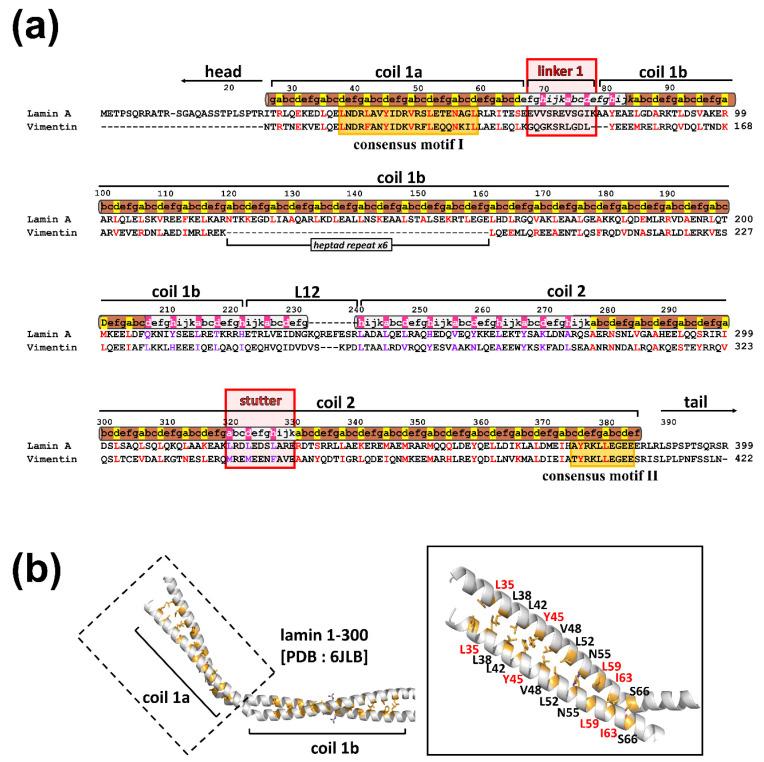
Intermediate filaments (IFs) commonly have structural elements of a central α-helical coiled-coil domain consisting of coil 1a, coil 1b, coil 2, and their flanking linkers. Recently, the crystal structure of a long lamin A/C fragment was determined and showed detailed features of a tetrameric unit. The structure further suggested a new binding mode between tetramers, designated eA22, where a parallel overlap of coil 1a and coil 2 is the critical interaction. This study investigated the biochemical effects of genetic mutations causing human diseases, focusing on the eA22 interaction. The mutant proteins exhibited either weakened or augmented interactions between coil 1a and coil 2. The ensuing biochemical results indicated that the interaction requires the separation of the coiled-coils in the N-terminal of coil 1a and the C-terminal of coil 2, coupled with the structural transition in the central α-helical rod domain. This study provides insight into the role of coil 1a as a molecular regulator in the elongation of IF proteins.
中间丝(IFs)通常具有中央α-螺旋卷曲螺旋结构域的结构元件,由 coil 1a、coil 1b、coil 2 及其侧翼连接子组成。最近,确定了长层粘连蛋白 A/C 片段的晶体结构,显示了四聚体单元的详细特征。该结构进一步提出了四聚体之间的新结合模式,称为 eA22,其中 coil 1a 和 coil 2 的平行重叠是关键相互作用。本研究调查了导致人类疾病的基因突变的生化效应,重点研究了 eA22 相互作用。突变蛋白表现出 coil 1a 和 coil 2 之间相互作用减弱或增强。随后的生化结果表明,这种相互作用需要 coil 1a 的 N 端和 coil 2 的 C 端卷曲螺旋的分离,以及中央α-螺旋杆域的结构转变。这项研究提供了关于 coil 1a 作为 IF 蛋白伸长的分子调节剂的作用的见解。



 Zotero 插件