
在体外模型中,对黏膜下剥离后移植到猪离体食管上的人角质形成细胞片进行评估。
Evaluation of human keratinocyte sheets transplanted onto porcine excised esophagus after submucosal dissection in an ex vivo model.
作者信息
Kawai Yosuke, Takagi Ryo, Ohki Takeshi, Yamamoto Masakazu, Yamato Masayuki
机构信息
Department of Surgery, Institute of Gastroenterology, Tokyo Women's Medical University, Japan.
Institute of Advanced Biomedical Engineering and Science, Tokyo Women's Medical University, Japan.
出版信息
Regen Ther. 2020 Dec 10;15:323-331. doi: 10.1016/j.reth.2020.11.004. eCollection 2020 Dec.
BACKGROUND
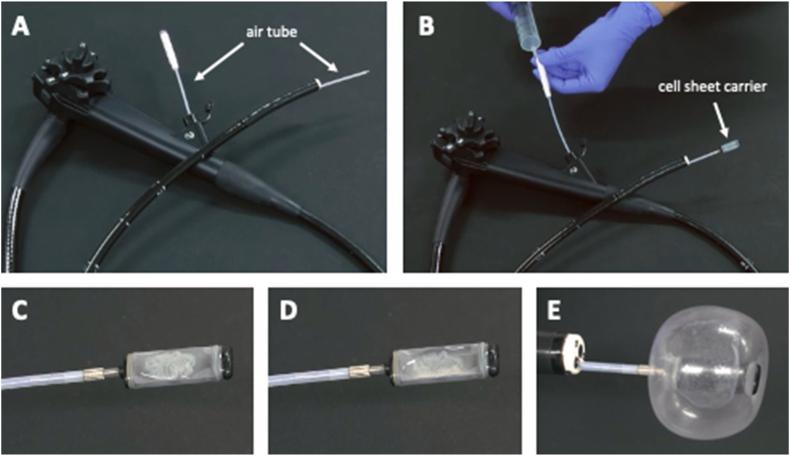
The utility of endoscopic transplantation of epithelial cell sheets to ulcer sites after endoscopic submucosal dissection (ESD) has been shown to prevent scar stenosis after ESD of early esophageal cancer. Previously, our group reported use of an endoscopic transplantation device fabricated with a 3-dimensional printer. Cell sheets are transplanted to the esophageal wound site with the following procedure: first, a cell sheet harvested from temperature-responsive culture dishes is placed on the device's deflated balloon surface and transported to the wound site with endoscopic forceps; second, by applying pressure from inflating the balloon locally at the wound site, the cell sheet is successfully transferred and adhered to the wound tissue; third, the balloon is deflated, and the device is removed. By repeating the procedure, several cell sheets can be safely transplanted to a wider ESD area. Nonetheless, possible damage to cell sheets using this procedure has not yet been assessed.
OBJECTIVE
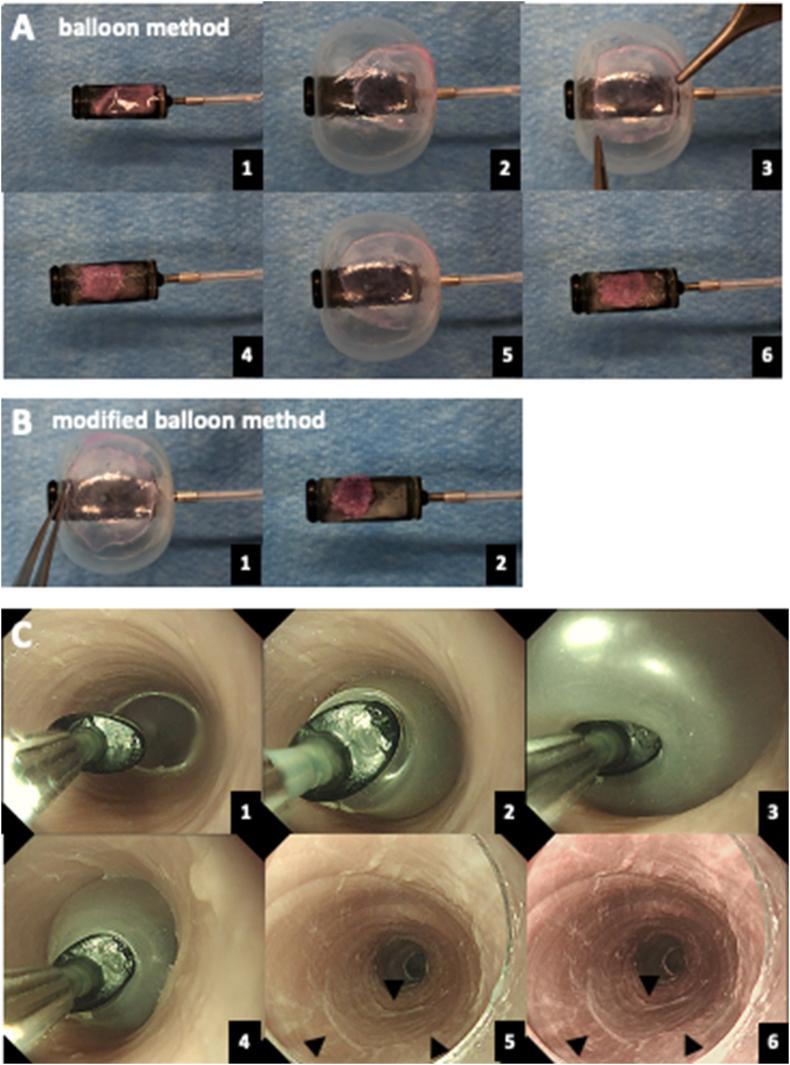
Effects of endoscopic transplantation balloon inflation on cell viability and damage of normal human epidermal keratinocyte sheets resident on the device's balloon surface were evaluated by histology after sheet placement onto lumenal surfaces in the ex vivo porcine submucosal dissection esophagus model. Endoscopic transplantation of these same cell sheets with conventional methods using a polyvinylidene fluoride (PVDF) cell sheet support membrane, balloon device transfer, and also using a novel modified balloon transfer procedure was also examined. Cell sheet transfer results obtained with these three procedures were compared.
METHOD
Normal human epidermal keratinocyte sheets were fabricated on temperature-responsive culture inserts. By temperature reduction to 20 °C, all cells were harvested as a single contiguous cell sheet. Freshly excised porcine esophagi purchased in a slaughter house were turned inside-out, and the exposed lumenal mucosa and submucosal layers were removed by Cooper scissors. This luminal surface was then utilized as a transplantation bed in ex vivo cell sheet experiments. Cell sheets were adhered to the endoscopic transfer device balloon, expanded by balloon inflation and resulting cell viability was evaluated by trypan blue exclusion test after cell sheet trypsinization and dispersion. Cell sheets were transferred onto the esophagus lumen ex vivo using forceps and the balloon device, and also using a modified balloon transfer method. The obtained results were compared with those without balloon expansion, and evaluated for sheet thickness and lumenal histology. Finally, TUNEL staining was performed to examine cell apoptosis.
RESULT
Cell sheets thinned after cell sheet balloon expansion, but no apoptosis was observed after these procedures.
CONCLUSION
Expanding keratinocyte cell sheets on a balloon endoscopic transfer device did not damage the cell sheets. This sheet transplantation method using the endoscopic balloon transfer device may be considered as a future standard cell sheet endoscopic transplantation procedure for repairing the esophagus.
背景
内镜下将上皮细胞片移植到内镜黏膜下剥离术(ESD)后的溃疡部位,已被证明可预防早期食管癌ESD术后的瘢痕狭窄。此前,我们团队报道了使用3D打印机制造的内镜移植装置。细胞片通过以下步骤移植到食管伤口部位:首先,将从温度响应培养皿中收获的细胞片放置在装置的瘪气球表面,并用内镜钳将其运送到伤口部位;其次,通过在伤口部位局部充气使气球施压,细胞片成功转移并粘附到伤口组织上;第三,将气球放气,移除装置。通过重复该过程,可以将几片细胞片安全地移植到更广泛的ESD区域。尽管如此,尚未评估使用该方法对细胞片可能造成的损伤。
目的
在体外猪黏膜下剥离食管模型中,将细胞片放置在管腔表面后,通过组织学评估内镜移植气球充气对驻留在装置气球表面的正常人表皮角质形成细胞片的细胞活力和损伤的影响。还研究了使用聚偏二氟乙烯(PVDF)细胞片支撑膜、气球装置转移等传统方法以及一种新型改良气球转移方法对这些相同细胞片进行内镜移植的情况。比较了这三种方法获得的细胞片转移结果。
方法
在温度响应培养插入物上制备正常人表皮角质形成细胞片。通过将温度降至20°C,所有细胞作为单个连续的细胞片收获。在屠宰场购买的新鲜切除的猪食管翻转过来,用库珀剪刀去除暴露的管腔黏膜和黏膜下层。然后将该管腔表面用作体外细胞片实验的移植床。将细胞片粘附到内镜转移装置的气球上,通过气球充气使其扩张,在细胞片胰蛋白酶消化和分散后,通过台盼蓝排斥试验评估所得细胞活力。使用镊子和气球装置,以及改良的气球转移方法,将细胞片体外转移到食管管腔上。将获得的结果与未进行气球扩张的结果进行比较,并评估细胞片厚度和管腔组织学。最后,进行TUNEL染色以检查细胞凋亡。
结果
细胞片在气球扩张后变薄,但这些操作后未观察到细胞凋亡。
结论
在内镜气球转移装置上扩张角质形成细胞片不会损伤细胞片。这种使用内镜气球转移装置的细胞片移植方法可被视为未来修复食管的标准细胞片内镜移植程序。





 Zotero 插件