
CAG/CTG 重复不稳定的修饰因子:来自哺乳动物模型的见解。
Modifiers of CAG/CTG Repeat Instability: Insights from Mammalian Models.
机构信息
Molecular Neurogenetics Unit, Center for Genomic Medicine, Massachusetts General Hospital, Boston, MA, USA.
Department of Neurology, Harvard Medical School, Boston, MA, USA.
出版信息
J Huntingtons Dis. 2021;10(1):123-148. doi: 10.3233/JHD-200426.
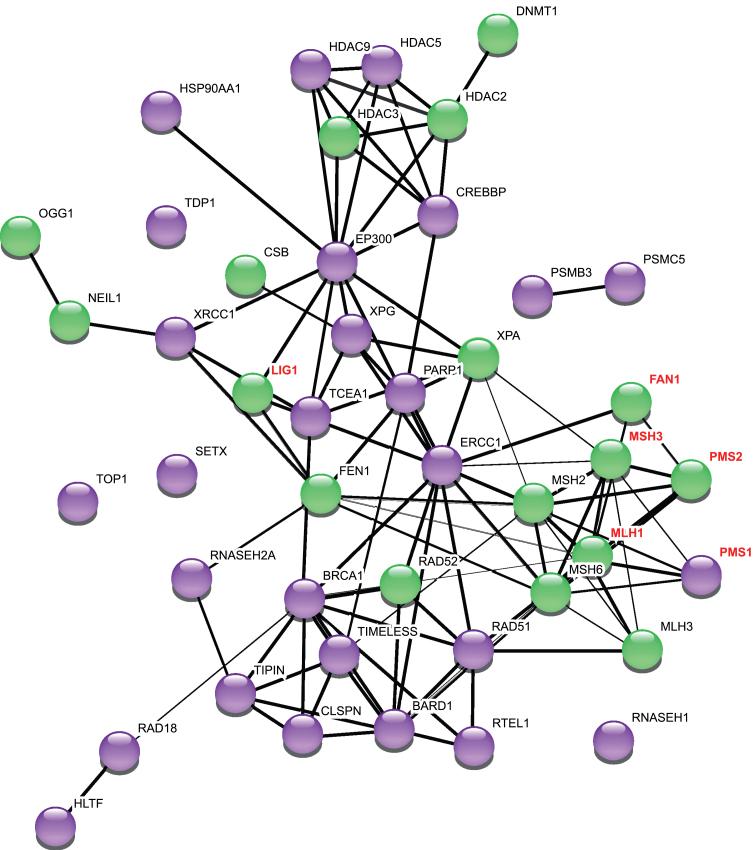
At fifteen different genomic locations, the expansion of a CAG/CTG repeat causes a neurodegenerative or neuromuscular disease, the most common being Huntington's disease and myotonic dystrophy type 1. These disorders are characterized by germline and somatic instability of the causative CAG/CTG repeat mutations. Repeat lengthening, or expansion, in the germline leads to an earlier age of onset or more severe symptoms in the next generation. In somatic cells, repeat expansion is thought to precipitate the rate of disease. The mechanisms underlying repeat instability are not well understood. Here we review the mammalian model systems that have been used to study CAG/CTG repeat instability, and the modifiers identified in these systems. Mouse models have demonstrated prominent roles for proteins in the mismatch repair pathway as critical drivers of CAG/CTG instability, which is also suggested by recent genome-wide association studies in humans. We draw attention to a network of connections between modifiers identified across several systems that might indicate pathway crosstalk in the context of repeat instability, and which could provide hypotheses for further validation or discovery. Overall, the data indicate that repeat dynamics might be modulated by altering the levels of DNA metabolic proteins, their regulation, their interaction with chromatin, or by direct perturbation of the repeat tract. Applying novel methodologies and technologies to this exciting area of research will be needed to gain deeper mechanistic insight that can be harnessed for therapies aimed at preventing repeat expansion or promoting repeat contraction.
在 15 个不同的基因组位置,CAG/CTG 重复扩展会导致神经退行性或神经肌肉疾病,最常见的是亨廷顿病和 1 型肌强直性营养不良。这些疾病的特征是生殖系和体细胞中致病的 CAG/CTG 重复突变的不稳定性。生殖系中的重复延长或扩展导致下一代发病年龄更早或症状更严重。在体细胞中,重复扩展被认为会加速疾病的发生。重复不稳定性的机制尚未完全了解。在这里,我们回顾了用于研究 CAG/CTG 重复不稳定性的哺乳动物模型系统,以及在这些系统中鉴定的修饰因子。小鼠模型表明,错配修复途径中的蛋白质在 CAG/CTG 不稳定性中起着关键作用,这也被最近人类全基因组关联研究所证实。我们提请注意,在几个系统中鉴定的修饰因子之间存在一个网络连接,这可能表明在重复不稳定性的情况下存在途径串扰,并为进一步验证或发现提供假说。总的来说,数据表明重复动态可能通过改变 DNA 代谢蛋白的水平、它们的调节、它们与染色质的相互作用,或者通过直接干扰重复片段来调节。将新的方法和技术应用于这一令人兴奋的研究领域,将需要获得更深入的机制见解,这些见解可以用于开发旨在预防重复扩展或促进重复收缩的治疗方法。



 Zotero 插件