
新冠疫苗接种计划能确保恢复到疫情前的生活方式吗?
Can a COVID-19 vaccination program guarantee the return to a pre-pandemic lifestyle?
作者信息
Yang Juan, Marziano Valentina, Deng Xiaowei, Guzzetta Giorgio, Zhang Juanjuan, Trentini Filippo, Cai Jun, Poletti Piero, Zheng Wen, Wang Wei, Wu Qianhui, Zhao Zeyao, Dong Kaige, Zhong Guangjie, Viboud Cécile, Merler Stefano, Ajelli Marco, Yu Hongjie
机构信息
School of Public Health, Fudan University, Key Laboratory of Public Health Safety, Ministry of Education, Shanghai, China.
Bruno Kessler Foundation, Trento, Italy.
出版信息
Res Sq. 2021 Feb 9:rs.3.rs-200069. doi: 10.21203/rs.3.rs-200069/v1.
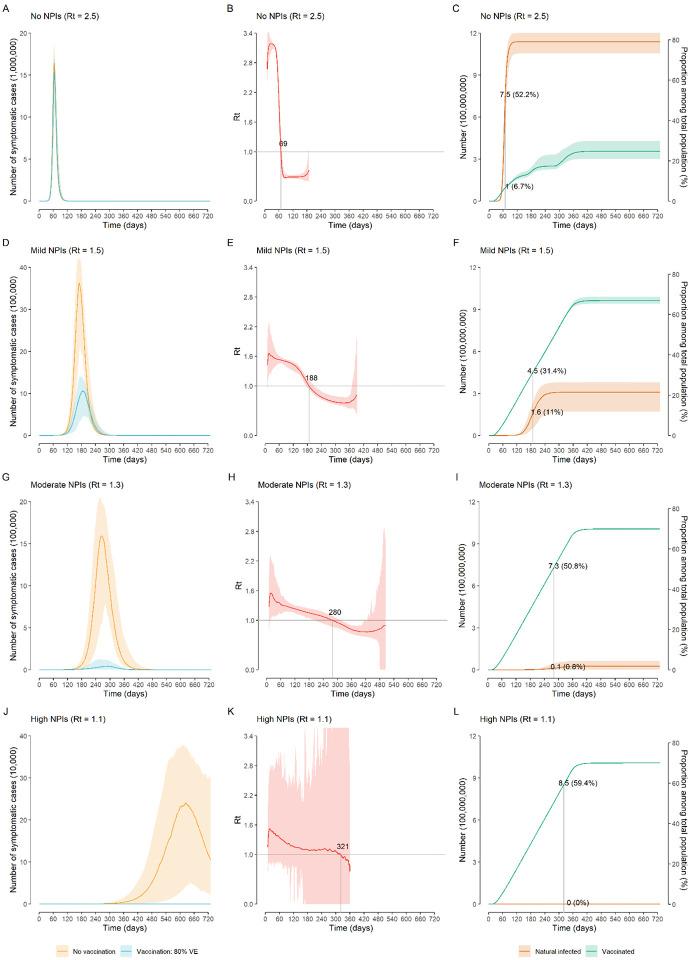
COVID-19 vaccination programs have been initiated in several countries to control SARS-CoV-2 transmission and return to a pre-pandemic lifestyle. However, understanding when non-pharmaceutical interventions (NPIs) can be lifted as vaccination builds up and how to update priority groups for vaccination in real-time remain key questions for policy makers. To address these questions, we built a data-driven model of SARS-CoV-2 transmission for China. We estimated that, to prevent local outbreaks to escalate to major widespread epidemics, stringent NPIs need to remain in place at least one year after the start of vaccination. Should NPIs be capable to keep the reproduction number (R) around 1.3, a vaccination program could reduce up to 99% of COVID-19 burden and bring R below the epidemic threshold in about 9 months. Maintaining strict NPIs throughout 2021 is of paramount importance to reduce COVID-19 burden while vaccines are distributed to the population, especially in large populations with little natural immunity.
为控制严重急性呼吸综合征冠状病毒2(SARS-CoV-2)传播并回归到大流行前的生活方式,多个国家已启动了2019冠状病毒病(COVID-19)疫苗接种计划。然而,随着疫苗接种的推进,何时可以取消非药物干预措施(NPIs)以及如何实时更新疫苗接种的优先群体,仍然是政策制定者面临的关键问题。为解决这些问题,我们构建了一个针对中国的SARS-CoV-2传播数据驱动模型。我们估计,为防止局部疫情升级为大规模流行,在疫苗接种开始后,严格的NPIs至少需要维持一年。如果NPIs能够将繁殖数(R)维持在1.3左右,疫苗接种计划可以减少高达99%的COVID-19负担,并在约9个月内使R降至疫情阈值以下。在2021年全年维持严格的NPIs对于在向人群分发疫苗时减轻COVID-19负担至关重要,尤其是在自然免疫力较低的大量人群中。



 Zotero 插件