
用于电子放射治疗的钨橡胶皮肤准直的剂量学评估:一项蒙特卡洛研究。
Dosimetric evaluation of skin collimation with tungsten rubber for electron radiotherapy: A Monte Carlo study.
作者信息
Wakabayashi Kazuki, Monzen Hajime, Tamura Mikoto, Matsumoto Kenji, Takei Yoshiki, Nishimura Yasumasa
机构信息
Department of Medical Physics, Graduate School of Medical Sciences, Kindai University, Osaka, Japan.
Department of Central Radiology, Kindai University Hospital, Osaka, Japan.
出版信息
J Appl Clin Med Phys. 2021 Apr;22(4):63-70. doi: 10.1002/acm2.13210. Epub 2021 Feb 26.
PURPOSE
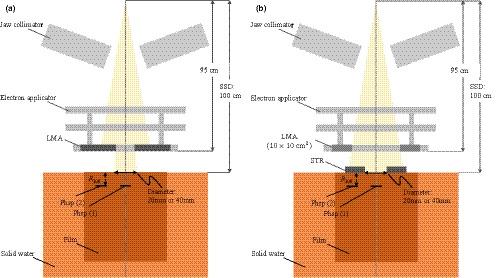
Skin collimation provides a sharp penumbra for electron beams, while the effect of bremsstrahlung from shielding materials is a concern. This phantom study was conducted to evaluate the safety and efficacy of a real-time variable shape rubber containing-tungsten (STR) that can be placed on a patient's skin.
METHODS
Electron beam profiles were acquired with the STR placed on a water-equivalent phantom and low melting-point alloy (LMA) placed at the applicator according to commonly used procedures (field sizes: 20- and 40-mm diameters). Depth and lateral dose profiles for 6- and 12-MeV electron beams were obtained by Monte Carlo (MC) simulations and were benchmarked against film measurements. The width of the off-axis distance between 80% and 20% doses (P ) and the maximum dose were obtained from the lateral dose profiles. Bremsstrahlung emission was analyzed by MC simulations at the depth of maximum dose (R ).
RESULTS
The depth dose profiles calculated by the MC simulations were consistently within 2% of the measurements. The P at R for 20- and 40-mm diameters were 4.0 mm vs. 7.6 mm (STR vs. LMA) and 4.5 mm vs. 9.2 mm, respectively, for the 6-MeV electron beam with 7.0-mm-thick STR, and 2.7 mm vs. 5.6 mm and 4.5 mm vs. 7.1 mm, respectively, for the 12-MeV electron beam with 12.0-mm-thick STR. A hotspot was not observed on the lateral dose profiles obtained with the STR at R . The bremsstrahlung emission under the region shielded by the STR was comparable to that obtained with the LMA, even though the STR was placed on the surface of the phantom.
CONCLUSIONS
Skin collimator with STR provided superior dosimetric characteristics and comparable bremsstrahlung emission to LMA collimator at the applicator. STR could be a new tool for the safe and efficient delivery of electron radiotherapy.
目的
皮肤准直可为电子束提供清晰的半影,而屏蔽材料产生的轫致辐射效应则是一个需要关注的问题。本体模研究旨在评估一种可置于患者皮肤上的实时可变形状含钨橡胶(STR)的安全性和有效性。
方法
按照常用程序,将STR置于水等效体模上,并在施源器处放置低熔点合金(LMA),采集电子束轮廓(射野尺寸:直径20和40 mm)。通过蒙特卡罗(MC)模拟获得6和12 MeV电子束的深度和侧向剂量分布,并与胶片测量结果进行比对。从侧向剂量分布中获取80%和20%剂量之间的离轴距离宽度(P)以及最大剂量。在最大剂量深度(R)处通过MC模拟分析轫致辐射发射。
结果
MC模拟计算得到的深度剂量分布与测量结果始终在2%以内。对于6 MeV电子束,使用7.0 mm厚的STR时,直径20和40 mm的R处P分别为4.0 mm对7.6 mm(STR对LMA)和4.5 mm对9.2 mm;对于12 MeV电子束,使用12.0 mm厚的STR时,分别为2.7 mm对5.6 mm和4.5 mm对7.1 mm。在R处使用STR获得的侧向剂量分布上未观察到热点。即使STR置于体模表面,STR屏蔽区域下的轫致辐射发射与LMA获得的相当。
结论
含STR的皮肤准直器在施源器处具有优于LMA准直器的剂量学特性和相当的轫致辐射发射。STR可能是安全、高效实施电子放射治疗的一种新工具。



 Zotero 插件