
从黑水虻中分离几丁质及其在金属吸附中的应用。
Isolation of Chitin from Black Soldier Fly () and Its Usage to Metal Sorption.
作者信息
Złotko Katarzyna, Waśko Adam, Kamiński Daniel M, Budziak-Wieczorek Iwona, Bulak Piotr, Bieganowski Andrzej
机构信息
Institute of Agrophysics, Polish Academy of Sciences, Doświadczalna 4, 20-290 Lublin, Poland.
Department of Biotechnology, Microbiology and Human Nutrition, University of Life Sciences in Lublin, Skromna, 20-950 Lublin, Poland.
出版信息
Polymers (Basel). 2021 Mar 7;13(5):818. doi: 10.3390/polym13050818.
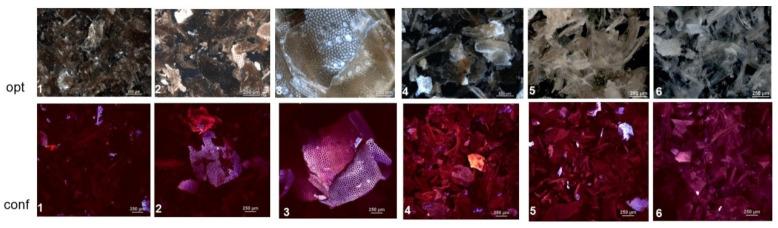
Chitin has become a desirable raw material used in various areas of life. The black soldier fly () can be a source of this substance. In the literature, there are many methods of obtaining chitin but there is no one universal method of isolating it. In this publication, we present various procedures for the isolation of chitin from pupal exuviae. The obtained chitin variants were characterized using different techniques (optical and confocal microscopy, FTIR, XRD, EDX, thermogravimetric analysis). The tested chitin isolated with an efficiency of 5.69-7.95% was the α form with a crystallinity degree of 60% and maximum degradation temperature of 392 °C. Furthermore, we characterized the nickel ion biosorption process on chitin and proposed the mechanism of this process to be ion exchange and complexation. There have been no such studies thus far on the isolation of chitin from exuviae or on the biosorption of nickel ions on this type of biosorbent. The conducted research can be used to develop the application of chitin as a metal biosorbent that can be obtained with relatively high efficiency and good sorption properties.
几丁质已成为生活各个领域中一种理想的原材料。黑水虻()可以成为这种物质的一个来源。在文献中,有许多获取几丁质的方法,但没有一种通用的分离方法。在本出版物中,我们展示了从蛹蜕中分离几丁质的各种程序。使用不同技术(光学和共聚焦显微镜、傅里叶变换红外光谱、X射线衍射、能谱分析、热重分析)对获得的几丁质变体进行了表征。所测试的几丁质分离效率为5.69 - 7.95%,为α型,结晶度为60%,最大降解温度为392℃。此外,我们对几丁质上的镍离子生物吸附过程进行了表征,并提出该过程的机制为离子交换和络合。迄今为止,尚未有关于从蛹蜕中分离几丁质或这种类型生物吸附剂对镍离子生物吸附的此类研究。所进行的研究可用于开发几丁质作为金属生物吸附剂的应用,这种生物吸附剂能够以相对较高的效率和良好的吸附性能获得。



 Zotero 插件