
基因共表达网络分析揭示了中国白菜(芸薹属)春化过程中的关键途径和枢纽基因。
Gene co-expression network analysis reveals key pathways and hub genes in Chinese cabbage (Brassica rapa L.) during vernalization.
机构信息
Institute of Vegetables and Flowers, Chinese Academy of Agricultural Sciences, Beijing, 100081, China.
College of Horticulture, Vegetable Genetics and Breeding Laboratory, Anhui Agricultural University, Changjiang West Road, NO.130, Hefei, 230036, Anhui, China.
出版信息
BMC Genomics. 2021 Apr 6;22(1):236. doi: 10.1186/s12864-021-07510-8.
BACKGROUND
Vernalization is a type of low temperature stress used to promote rapid bolting and flowering in plants. Although rapid bolting and flowering promote the reproduction of Chinese cabbages (Brassica rapa L. ssp. pekinensis), this process causes their commercial value to decline. Clarifying the mechanisms of vernalization is essential for its further application. We performed RNA sequencing of gradient-vernalization in order to explore the reasons for the different bolting process of two Chinese cabbage accessions during vernalization.
RESULTS
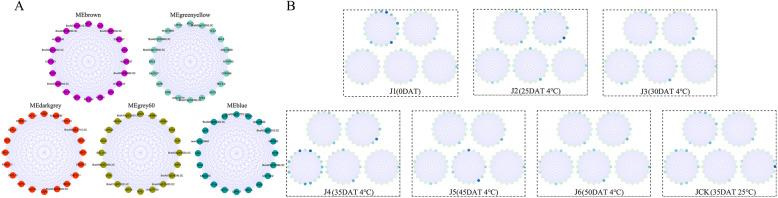
There was considerable variation in gene expression between different-bolting Chinese cabbage accessions during vernalization. Comparative transcriptome analysis and weighted gene co-expression network analysis (WGCNA) were performed for different-bolting Chinese cabbage during different vernalization periods. The biological function analysis and hub gene annotation of highly relevant modules revealed that shoot system morphogenesis and polysaccharide and sugar metabolism caused early-bolting 'XBJ' to bolt and flower faster; chitin, ABA and ethylene-activated signaling pathways were enriched in late-bolting 'JWW'; and leaf senescence and carbohydrate metabolism enrichment were found in the two Chinese cabbage-related modules, indicating that these pathways may be related to bolting and flowering. The high connectivity of hub genes regulated vernalization, including MTHFR2, CPRD49, AAP8, endoglucanase 10, BXLs, GATLs, and WRKYs. Additionally, five genes related to flower development, BBX32 (binds to the FT promoter), SUS1 (increases FT expression), TSF (the closest homologue of FT), PAO and NAC029 (plays a role in leaf senescence), were expressed in the two Chinese cabbage accessions.
CONCLUSION
The present work provides a comprehensive overview of vernalization-related gene networks in two different-bolting Chinese cabbages during vernalization. In addition, the candidate pathways and hub genes related to vernalization identified here will serve as a reference for breeders in the regulation of Chinese cabbage production.
背景
春化作用是一种低温胁迫,用于促进植物的快速抽薹和开花。虽然快速抽薹和开花促进了中国白菜( Brassica rapa L. ssp. pekinensis )的繁殖,但这一过程导致其商业价值下降。阐明春化作用的机制对于其进一步应用至关重要。我们对梯度春化处理的中国白菜进行了 RNA 测序,以探讨两个不同春化进程的中国白菜品种在春化过程中不同的抽薹机制。
结果
在春化过程中,不同抽薹的中国白菜品种之间的基因表达存在很大差异。对不同春化时期的不同抽薹中国白菜进行比较转录组分析和加权基因共表达网络分析(WGCNA)。高度相关模块的生物功能分析和枢纽基因注释表明, shoot system morphogenesis 和多糖和糖代谢导致早抽薹的 'XBJ' 更快地抽薹和开花;chitin、ABA 和乙烯激活信号通路在晚抽薹的 'JWW' 中富集;而在两个中国白菜相关模块中发现了叶片衰老和碳水化合物代谢富集,表明这些通路可能与抽薹和开花有关。春化调控的枢纽基因高连接性,包括 MTHFR2、CPRD49、AAP8、内切葡聚糖酶 10、BXLs、GATLs 和 WRKYs。此外,两个中国白菜品种中表达了与花发育相关的五个基因,包括 BBX32(与 FT 启动子结合)、SUS1(增加 FT 表达)、TSF(FT 的最接近同源物)、PAO 和 NAC029(在叶片衰老中起作用)。
结论
本研究提供了两个不同抽薹的中国白菜在春化过程中与春化相关的基因网络的全面概述。此外,本研究中鉴定的与春化作用相关的候选途径和枢纽基因将为白菜生产者的调控提供参考。




 Zotero 插件