
使用支持向量机算法通过热重分析表征生物质热解行为实现生物质自动分类:烟草案例研究
Auto-classification of biomass through characterization of their pyrolysis behaviors using thermogravimetric analysis with support vector machine algorithm: case study for tobacco.
作者信息
Yin Chao, Deng Xiaohua, Yu Zhiqiang, Liu Zechun, Zhong Hongxiang, Chen Ruting, Cai Guohua, Zheng Quanxing, Liu Xiucai, Zhong Jiawei, Ma Pengfei, He Wei, Lin Kai, Li Qiaoling, Wu Anan
机构信息
Fujian Provincial Key Laboratory for Theoretical and Computational Chemistry, College of Chemistry and Chemical Engineering, Xiamen University, Xiamen, 361005, Fujian, China.
Technology Center, China Tobacco Fujian Industrial Co., Ltd, Xiamen, 361021, Fujian, China.
出版信息
Biotechnol Biofuels. 2021 Apr 27;14(1):106. doi: 10.1186/s13068-021-01942-w.
BACKGROUND
During the biomass-to-bio-oil conversion process, many studies focus on studying the association between biomass and bio-products using near-infrared spectra (NIR) and chemical analysis methods. However, the characterization of biomass pyrolysis behaviors using thermogravimetric analysis (TGA) with support vector machine (SVM) algorithm has not been reported. In this study, tobacco was chosen as the object for biomass, because the cigarette smoke (including water, tar, and gases) released by tobacco pyrolysis reactions decides the sensory quality, which is similar to biomass as a renewable resource through the pyrolysis process.
RESULTS
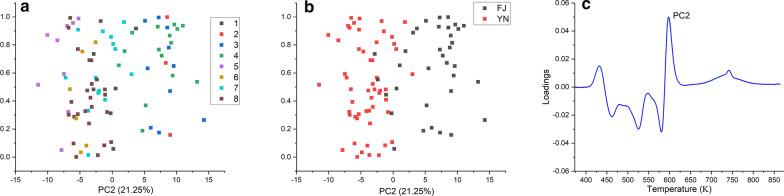
SVM algorithm has been employed to automatically classify the planting area and growing position of tobacco leaves using thermogravimetric analysis data as the information source for the first time. Eighty-eight single-grade tobacco samples belonging to four grades and eight categories were split into the training, validation, and blind testing sets. Our model showed excellent performances in both the training and validation set as well as in the blind test, with accuracy over 91.67%. Throughout the whole dataset of 88 samples, our model not only provides precise results on the planting area of tobacco leave, but also accurately distinguishes the major grades among the upper, lower, and middle positions. The error only occurs in the classification of subgrades of the middle position.
CONCLUSIONS
From the case study of tobacco, our results validated the feasibility of using TGA with SVM algorithm as an objective and fast method for auto-classification of tobacco planting area and growing position. In view of the high similarity between tobacco and other biomasses in the compositions and pyrolysis behaviors, this new protocol, which couples the TGA data with SVM algorithm, can potentially be extrapolated to the auto-classification of other biomass types.
背景
在生物质向生物油的转化过程中,许多研究致力于利用近红外光谱(NIR)和化学分析方法研究生物质与生物产品之间的关联。然而,尚未有使用热重分析(TGA)结合支持向量机(SVM)算法对生物质热解行为进行表征的报道。在本研究中,选择烟草作为生物质对象,因为烟草热解反应释放的香烟烟雾(包括水、焦油和气体)决定了感官品质,这与生物质通过热解过程作为可再生资源的情况相似。
结果
首次采用支持向量机算法,以热重分析数据为信息源,对烟叶的种植区域和生长位置进行自动分类。将属于四个等级和八个类别的88个单级烟草样品分为训练集、验证集和盲测集。我们的模型在训练集、验证集以及盲测中均表现出色,准确率超过91.67%。在整个88个样品的数据集中,我们的模型不仅能准确给出烟叶种植区域的结果,还能精确区分上部、下部和中部位置的主要等级。仅在中部位置的亚等级分类中出现误差。
结论
通过烟草的案例研究,我们的结果验证了使用TGA结合SVM算法作为客观、快速的烟草种植区域和生长位置自动分类方法的可行性。鉴于烟草与其他生物质在成分和热解行为上具有高度相似性,这种将TGA数据与SVM算法相结合的新方案有可能推广到其他生物质类型的自动分类中。




 Zotero 插件