
环尼日尔基-尼日尔糖作为氧纳米载体,保护细胞模型免受缺氧/再氧合损伤:体外模型的意义。
Cyclic Nigerosyl-Nigerose as Oxygen Nanocarrier to Protect Cellular Models from Hypoxia/Reoxygenation Injury: Implications from an In Vitro Model.
机构信息
Department of Clinical and Biological Sciences, University of Turin, 10043 Turin, Italy.
Department of Medical Sciences, University of Turin, 10126 Turin, Italy.
出版信息
Int J Mol Sci. 2021 Apr 19;22(8):4208. doi: 10.3390/ijms22084208.
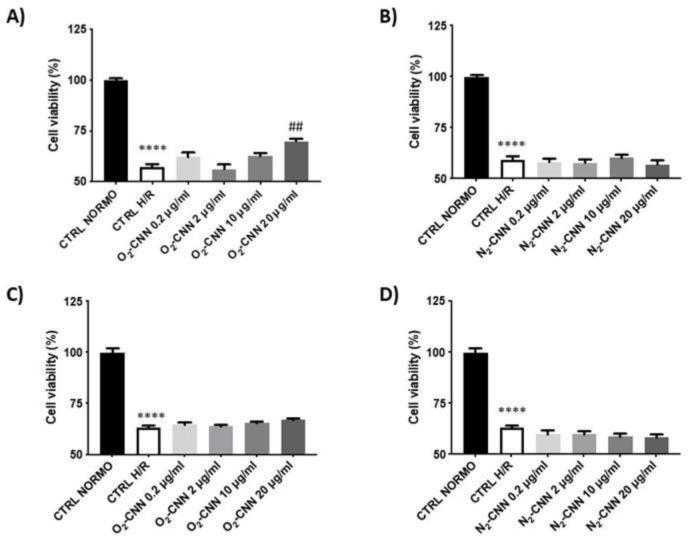
Heart failure (HF) prevalence is increasing among the aging population, and the mortality rate remains unacceptably high despite improvements in therapy. Myocardial ischemia (MI) and, consequently, ischemia/reperfusion injury (IRI), are frequently the basis of HF development. Therefore, cardioprotective strategies to limit IRI are mandatory. Nanocarriers have been proposed as alternative therapy for cardiovascular disease. Controlled reoxygenation may be a promising strategy. Novel nanocarriers, such as cyclic nigerosyl-nigerose (CNN), can be innovative tools for oxygen delivery in a controlled manner. In this study we analyzed new CNN-based formulations as oxygen nanocarriers (O-CNN), and compared them with nitrogen CNN (N-CNN). These different CNN-based formulations were tested using two cellular models, namely, cardiomyoblasts (H9c2), and endothelial (HMEC) cell lines, at different concentrations. The effects on the growth curve during normoxia (21% O, 5% CO and 74% N) and their protective effects during hypoxia (1% O, 5% CO and 94% N) and reoxygenation (21% O, 5% CO and 74% N) were studied. Neither O-CNN nor N-CNN has any effect on the growth curve during normoxia. However, O-CNN applied before hypoxia induces a 15-30% reduction in cell mortality after hypoxia/re-oxygenation when compared to N-CNN. O-CNN showed a marked efficacy in controlled oxygenation, which suggests an interesting potential for the future medical application of soluble nanocarrier systems for MI treatment.
心力衰竭(HF)在老年人群中的患病率正在增加,尽管治疗有所改善,但死亡率仍然高得令人无法接受。心肌缺血(MI),以及由此产生的缺血/再灌注损伤(IRI),通常是 HF 发展的基础。因此,限制 IRI 的心脏保护策略是强制性的。纳米载体已被提议作为心血管疾病的替代治疗方法。控制性再氧合可能是一种有前途的策略。新型纳米载体,如环状奈格尔基-奈格尔糖(CNN),可以成为以受控方式输送氧气的创新工具。在这项研究中,我们分析了新型基于 CNN 的制剂作为氧纳米载体(O-CNN),并将其与氮 CNN(N-CNN)进行了比较。使用两种细胞模型,即心肌细胞(H9c2)和内皮细胞(HMEC)系,在不同浓度下对这些不同的基于 CNN 的制剂进行了测试。研究了它们在常氧(21% O、5% CO 和 74% N)下的生长曲线的影响及其在缺氧(1% O、5% CO 和 94% N)和再氧合(21% O、5% CO 和 74% N)期间的保护作用。O-CNN 和 N-CNN 均不会影响常氧下的生长曲线。然而,与 N-CNN 相比,O-CNN 在缺氧前施加会导致缺氧/再氧合后细胞死亡率降低 15-30%。O-CNN 显示出在控制性氧合方面的显著疗效,这表明可溶性纳米载体系统在 MI 治疗中的未来医学应用具有很大的潜力。



 Zotero 插件