
利用基于偶极子的磁刺激轮廓方法快速计算 TMS 诱导的 E 场。
Rapid computation of TMS-induced E-fields using a dipole-based magnetic stimulation profile approach.
机构信息
Athinoula A. Martinos Center for Biomedical Imaging, Department of Radiology, Harvard Medical School, Massachusetts General Hospital, Charlestown, MA, USA.
Athinoula A. Martinos Center for Biomedical Imaging, Department of Radiology, Harvard Medical School, Massachusetts General Hospital, Charlestown, MA, USA; Department of Electrical and Computer Engineering, Worcester Polytechnic Institute, Worcester, MA, USA.
出版信息
Neuroimage. 2021 Aug 15;237:118097. doi: 10.1016/j.neuroimage.2021.118097. Epub 2021 Apr 30.
BACKGROUND
TMS neuronavigation with on-line display of the induced electric field (E-field) has the potential to improve quantitative targeting and dosing of stimulation, but present commercially available solutions are limited by simplified approximations.
OBJECTIVE
Developing a near real-time method for accurate approximation of TMS induced E-fields with subject-specific high-resolution surface-based head models that can be utilized for TMS navigation.
METHODS
Magnetic dipoles are placed on a closed surface enclosing an MRI-based head model of the subject to define a set of basis functions for the incident and total E-fields that define the subject's Magnetic Stimulation Profile (MSP). The near real-time speed is achieved by recognizing that the total E-field of the coil only depends on the incident E-field and the conductivity boundary geometry. The total E-field for any coil position can be obtained by matching the incident field of the stationary dipole basis set with the incident E-field of the moving coil and applying the same basis coefficients to the total E-field basis functions.
RESULTS
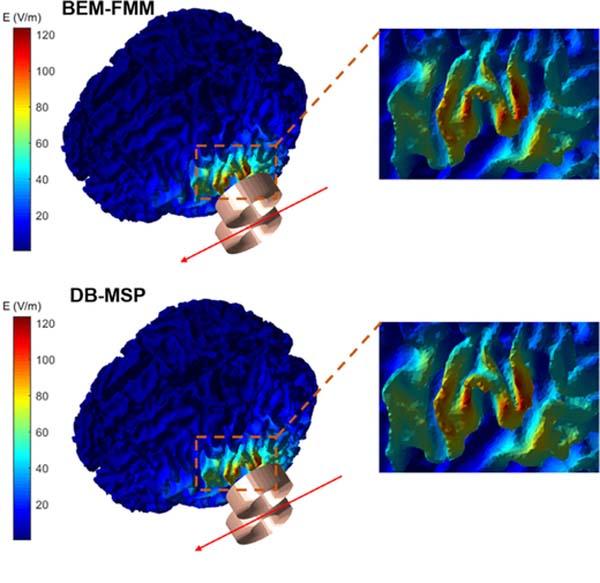
Comparison of the MSP-based approximation with an established TMS solver shows great agreement in the E-field amplitude (relative maximum error around 5%) and the spatial distribution patterns (correlation >98%). Computation of the E-field took ~100 ms on a cortical surface mesh with 120k facets.
CONCLUSION
The numerical accuracy and speed of the MSP approximation method make it well suited for a wide range of computational tasks including interactive planning, targeting, dosing, and visualization of the intracranial E-fields for near real-time guidance of coil positioning.
背景
TMS 神经元导航与在线显示感应电场(E 场)相结合,有可能改善刺激的定量靶向和剂量,但目前市售的解决方案受到简化近似的限制。
目的
开发一种用于准确逼近 TMS 感应 E 场的近实时方法,该方法使用基于个体的高分辨率表面头部模型,可用于 TMS 导航。
方法
将磁偶极子放置在封闭的表面上,该表面包围基于 MRI 的主体头部模型,以定义用于入射和总 E 场的一组基函数,这些基函数定义了主体的磁刺激分布(MSP)。通过认识到线圈的总 E 场仅取决于入射 E 场和电导率边界几何形状,可以实现近实时速度。可以通过将固定偶极子基集的入射场与移动线圈的入射 E 场匹配,并将相同的基系数应用于总 E 场基函数,来获得任何线圈位置的总 E 场。
结果
基于 MSP 的逼近与成熟的 TMS 求解器的比较显示,E 场幅度(相对最大误差约为 5%)和空间分布模式(相关性>98%)非常吻合。在具有 120k 面的皮质表面网格上,E 场的计算时间约为 100ms。
结论
MSP 逼近方法的数值精度和速度使其非常适合广泛的计算任务,包括交互式规划、靶向、剂量计算以及颅内 E 场的可视化,以实现对线圈位置的实时指导。



 Zotero 插件