
在 COVID-19 大流行期间,不同收入水平国家层面的遏制和关闭政策的效果:对 113 个国家的分析。
The effectiveness of national-level containment and closure policies across income levels during the COVID-19 pandemic: an analysis of 113 countries.
机构信息
Department of Health Sciences, William & Mary, 251 Ukrop Way, Williamsburg, VA 23185, USA.
Department of Applied Math and Economics, William & Mary, 251 Ukrop Way, Williamsburg, VA 23185, USA.
出版信息
Health Policy Plan. 2021 Aug 12;36(7):1152-1162. doi: 10.1093/heapol/czab054.
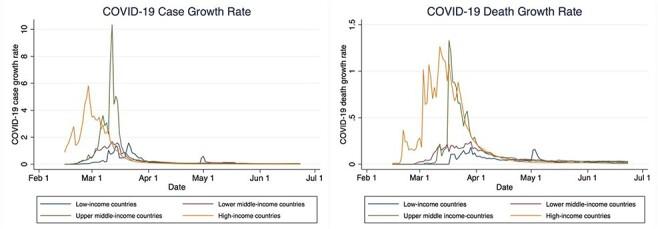
Despite heterogeneity in income levels, countries implemented similarly strict containment and closure policies to mitigate the COVID-19 pandemic. This research assesses the effectiveness of these containment and closure policies, which we defined as larger decreases in mobility and smaller COVID-19 case and death growth rates. Using daily data for 113 countries on mobility and cumulative COVID-19 case and death counts over the 130 days between February 15, 2020 and June 23, 2020, we examined changes in mobility, morbidity, and mortality growth rates across the World Bank's income group classifications. Containment policies correlated with the largest declines in mobility in higher income countries. High-income countries also achieved lower COVID-19 case and death growth rates than low-income countries. This study finds better epidemiological outcomes of containment and closure policies for higher income countries than lower income countries. These findings urge policymakers to consider contextual differences, including levels of economic activity and the structure of the economy, when crafting policies in response to public health emergencies.
尽管各国的收入水平存在差异,但都采取了类似的严格遏制和封锁政策来缓解 COVID-19 大流行。本研究评估了这些遏制和封锁政策的有效性,我们将这些政策定义为流动性下降幅度更大,COVID-19 病例和死亡率增长率更小。使用 2020 年 2 月 15 日至 2020 年 6 月 23 日期间 113 个国家的每日移动性和累计 COVID-19 病例和死亡人数数据,我们研究了世界银行收入群体分类中流动性、发病率和死亡率增长率的变化。遏制政策与高收入国家流动性的最大降幅相关。高收入国家的 COVID-19 病例和死亡率增长率也低于低收入国家。本研究发现,对于高收入国家而言,遏制和封锁政策的流行病学结果优于低收入国家。这些发现敦促政策制定者在制定应对公共卫生紧急情况的政策时,考虑到包括经济活动水平和经济结构在内的背景差异。

 Zotero 插件