
伊朗南部基于实验室和非实验室的弗雷明汉风险评分之间的一致性。
Agreement between laboratory-based and non-laboratory-based Framingham risk score in Southern Iran.
机构信息
Student Research Committee, Shiraz University of Medical Sciences, Shiraz, Iran.
Department of Epidemiology, School of Health, Shiraz University of Medical Sciences, Shiraz, Iran.
出版信息
Sci Rep. 2021 May 24;11(1):10767. doi: 10.1038/s41598-021-90188-5.
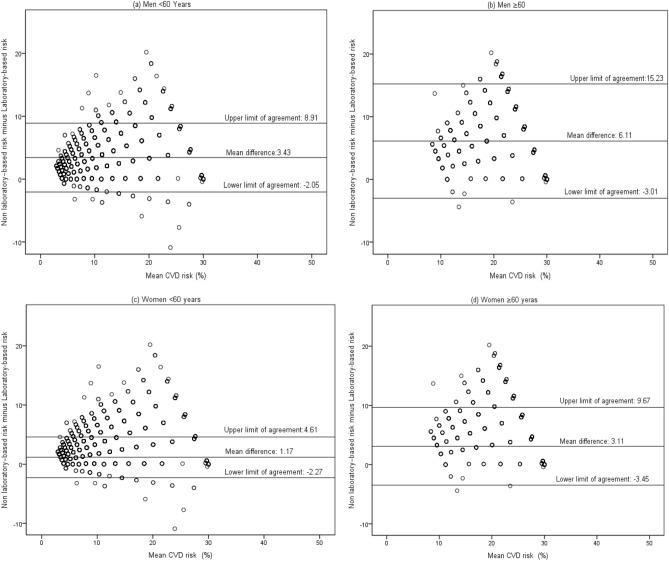
The Framingham 10-year cardiovascular disease risk is measured by laboratory-based and non-laboratory-based models. This study aimed to determine the agreement between these two models in a large population in Southern Iran. In this study, the baseline data of 8138 individuals participated in the Pars cohort study were used. The participants had no history of cardiovascular disease or stroke. For the laboratory-based risk model, scores were determined based on age, sex, current smoking, diabetes, systolic blood pressure (SBP) and treatment status, total cholesterol, and High-Density Lipoprotein. For the non-laboratory-based risk model, scores were determined based on age, sex, current smoking, diabetes, SBP and treatment status, and Body Mass Index. The agreement between these two models was determined by Bland Altman plots for agreement between the scores and kappa statistic for agreement across the risk groups. Bland Altman plots showed that the limits of agreement were reasonable for females < 60 years old (95% CI: -2.27-4.61%), but of concern for those ≥ 60 years old (95% CI: -3.45-9.67%), males < 60 years old (95% CI: -2.05-8.91%), and males ≥ 60 years old (95% CI: -3.01-15.23%). The limits of agreement were wider for males ≥ 60 years old in comparison to other age groups. According to the risk groups, the agreement was better in females than in males, which was moderate for females < 60 years old (kappa = 0.57) and those ≥ 60 years old (kappa = 0.51). The agreement was fair for the males < 60 years old (kappa = 0.39) and slight for those ≥ 60 years old (Kappa = 0.14). The results showed that in overall participants, the agreement between the two risk scores was moderate according to risk grouping. Therefore, our results suggest that the non-laboratory-based risk model can be used in resource-limited settings where individuals cannot afford laboratory tests and extensive laboratories are not available.
弗雷明汉心血管疾病 10 年风险通过基于实验室和非实验室的模型进行测量。本研究旨在确定这两种模型在伊朗南部的大量人群中的一致性。在这项研究中,使用了参加 Pars 队列研究的 8138 名个体的基线数据。参与者没有心血管疾病或中风病史。对于基于实验室的风险模型,根据年龄、性别、当前吸烟状况、糖尿病、收缩压(SBP)和治疗状态、总胆固醇和高密度脂蛋白(HDL)确定分数。对于基于非实验室的风险模型,根据年龄、性别、当前吸烟状况、糖尿病、SBP 和治疗状态以及体重指数(BMI)确定分数。通过 Bland-Altman 图确定这两种模型之间的一致性,并通过kappa 统计量确定风险组之间的一致性。Bland-Altman 图显示,对于年龄<60 岁的女性(95%置信区间:-2.27-4.61%),一致性的允许范围是合理的,但对于年龄≥60 岁的女性(95%置信区间:-3.45-9.67%)、年龄<60 岁的男性(95%置信区间:-2.05-8.91%)和年龄≥60 岁的男性(95%置信区间:-3.01-15.23%),允许范围令人担忧。与其他年龄组相比,年龄≥60 岁的男性允许范围更宽。根据风险组,女性的一致性优于男性,年龄<60 岁的女性(kappa=0.57)和年龄≥60 岁的女性(kappa=0.51)的一致性为中度。年龄<60 岁的男性(kappa=0.39)的一致性为适度,年龄≥60 岁的男性(kappa=0.14)的一致性为轻度。结果表明,根据风险分组,在所有参与者中,两种风险评分之间的一致性为中度。因此,我们的结果表明,在资源有限的环境中,无法进行实验室检查且没有广泛的实验室设施的情况下,可以使用非实验室风险模型。
 Zotero 插件