
抗逆转录病毒疗法患者的 HIV 病毒载量监测 - 2013-2018 年 8 个撒哈拉以南非洲国家。
HIV Viral Load Monitoring Among Patients Receiving Antiretroviral Therapy - Eight Sub-Saharan Africa Countries, 2013-2018.
出版信息
MMWR Morb Mortal Wkly Rep. 2021 May 28;70(21):775-778. doi: 10.15585/mmwr.mm7021a2.
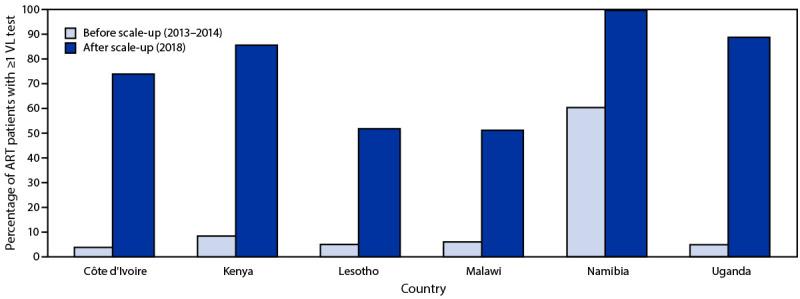
One component of the Joint United Nations Programme on HIV/AIDS (UNAIDS) goal to end the HIV/AIDS epidemic by 2030, is that 95% of all persons receiving antiretroviral therapy (ART) achieve viral suppression. Thus, testing all HIV-positive persons for viral load (number of copies of viral RNA per mL) is a global health priority (1). CDC and other U.S. government agencies, as part of the U.S. President's Emergency Plan for AIDS Relief (PEPFAR), together with other stakeholders, have provided technical assistance and supported the cost for multiple countries in sub-Saharan Africa to expand viral load testing as the preferred monitoring strategy for clinical response to ART. The individual and population-level benefits of ART are well understood (2). Persons receiving ART who achieve and sustain an undetectable viral load do not transmit HIV to their sex partners, thereby disrupting onward transmission (2,3). Viral load testing is a cost-effective and sustainable programmatic approach for monitoring treatment success, allowing reduced frequency of health care visits for patients who are virally suppressed (4). Viral load monitoring enables early and accurate detection of treatment failure before immunologic decline. This report describes progress on the scale-up of viral load testing in eight sub-Saharan African countries from 2013 to 2018 and examines the trajectory of improvement with viral load testing scale-up that has paralleled government commitments, sustained technical assistance, and financial resources from international donors. Viral load testing in low- and middle-income countries enables monitoring of viral load suppression at the individual and population level, which is necessary to achieve global epidemic control. Although there has been substantial achievement in improving viral load coverage for all patients receiving ART, continued engagement is needed to reach global targets.
联合国艾滋病规划署(UNAIDS)的目标之一是在 2030 年之前终结艾滋病疫情,其中一个组成部分是,所有接受抗逆转录病毒疗法(ART)的患者中,有 95%的人实现病毒抑制。因此,对所有 HIV 阳性者进行病毒载量(每毫升病毒 RNA 的拷贝数)检测是全球卫生的一个优先事项(1)。美国疾病控制与预防中心(CDC)和美国政府其他机构,作为美国总统艾滋病紧急救援计划(PEPFAR)的一部分,与其他利益攸关方一道,为撒哈拉以南非洲的多个国家提供了技术援助,并支持了这些国家扩大病毒载量检测,将其作为临床治疗反应的首选监测策略的费用。人们已经充分了解了接受 ART 的个人和人群所获得的益处(2)。接受 ART 的患者如果实现并维持不可检测的病毒载量,就不会将 HIV 传播给性伴侣,从而阻断了进一步传播(2,3)。病毒载量检测是监测治疗成功的一种具有成本效益且可持续的方案方法,可以减少病毒抑制患者的就诊频率(4)。病毒载量监测可在免疫功能下降之前及早、准确地发现治疗失败。本报告描述了 2013 年至 2018 年在撒哈拉以南非洲八个国家扩大病毒载量检测的进展情况,并分析了随着各国政府承诺、持续的技术援助以及国际捐助者的财政资源的投入,病毒载量检测的扩大与改善轨迹。在中低收入国家开展病毒载量检测,能够在个人和人群层面监测病毒载量的抑制情况,这对于实现全球疫情控制是必要的。尽管在提高所有接受 ART 的患者的病毒载量检测覆盖率方面已经取得了实质性进展,但仍需要继续努力以实现全球目标。

 Zotero 插件