
携带神经连蛋白-3 R451C 突变的自闭症相关小鼠在触摸屏注意任务中表现出谨慎但准确的反应模式。
Mice with an autism-associated R451C mutation in neuroligin-3 show a cautious but accurate response style in touchscreen attention tasks.
机构信息
Florey Institute of Neuroscience and Mental Health, University of Melbourne, Parkville, Victoria, Australia.
Florey Institute of Neuroscience and Mental Health, Heidelberg, Victoria, Australia.
出版信息
Genes Brain Behav. 2022 Jan;21(1):e12757. doi: 10.1111/gbb.12757. Epub 2021 Jul 2.
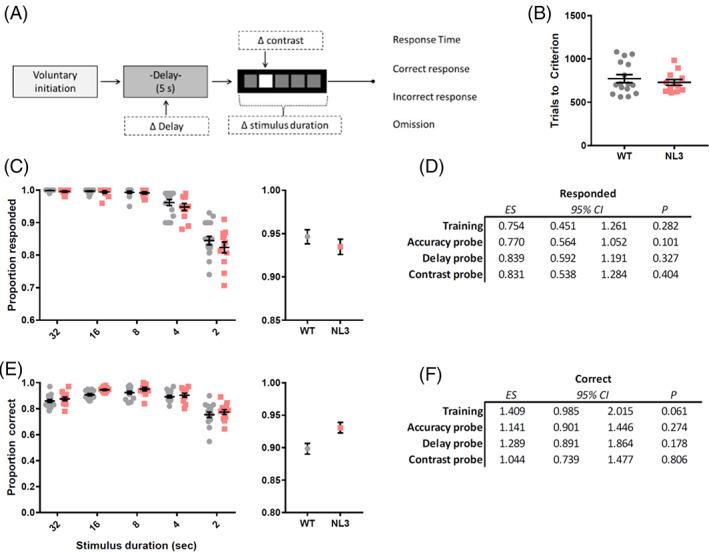
One of the earliest identifiable features of autism spectrum disorder (ASD) is altered attention. Mice expressing the ASD-associated R451C mutation in synaptic adhesion protein neuroligin-3 (NL3) exhibit impaired reciprocal social interactions and repetitive and restrictive behaviours. The role of this mutation in attentional abnormalities has not been established. We assessed attention in male NL3 mice using two well-established tasks in touchscreen chambers. In the 5-choice serial reaction task, rodents were trained to attend to light stimuli that appear in any one of five locations. While no differences between NL3 and WT mice were seen in accuracy or omissions, slower response times and quicker reward collection latencies were seen across all training and probe trials. In the rodent continuous-performance test, animals were required to discriminate, and identify a visual target pattern over multiple distractor stimuli. NL3 mice displayed enhanced ability to attend to stimuli when task-load was low during training and baseline but lost this advantage when difficulty was increased by altering task parameters in probe trials. NL3 mice made less responses to the distractor stimuli, exhibiting lower false alarm rates during all training stages and in probe trials. Slower response times and quicker reward latencies were consistently seen in NL3 mice in the rCPT. Slower response times are a major cognitive phenotype reported in ASD patients and are indicative of slower processing speed. Enhanced attention has been shown in a subset of ASD patients and we have demonstrated this phenotype also exists in the NL3 mouse model.
自闭症谱系障碍 (ASD) 的最早可识别特征之一是注意力改变。在突触黏附蛋白神经黏连蛋白-3 (NL3) 中表达与 ASD 相关的 R451C 突变的小鼠表现出受损的互惠社会互动以及重复和限制性行为。该突变在注意力异常中的作用尚未确定。我们使用触摸屏室中的两项成熟任务评估 NL3 小鼠的注意力。在 5 选择序列反应任务中,训练啮齿动物注意出现在五个位置之一的光刺激。虽然在准确性或遗漏方面,NL3 和 WT 小鼠之间没有差异,但在所有训练和探针试验中,反应时间较慢,奖励收集潜伏期较快。在啮齿动物连续表现测试中,要求动物在多个干扰刺激物上区分和识别视觉目标模式。当训练和基线期间任务负荷较低时,NL3 小鼠表现出对刺激物的增强注意力,但在探针试验中通过改变任务参数增加难度时,它们失去了这种优势。NL3 小鼠对干扰刺激物的反应较少,在所有训练阶段和探针试验中均表现出较低的错误警报率。NL3 小鼠在 rCPT 中始终表现出较慢的反应时间和较快的奖励潜伏期。较慢的反应时间是 ASD 患者报告的主要认知表型,表明处理速度较慢。在 ASD 患者的一部分中已经显示出增强的注意力,我们已经证明这种表型也存在于 NL3 小鼠模型中。



 Zotero 插件