
埃塞俄比亚 12 至 23 月龄儿童免疫接种中断的地理差异及其相关因素:利用 2016 年埃塞俄比亚人口与健康调查的空间和多层次分析
Geographical variations and associated factors of defaulting from immunization among children aged 12 to 23 months in Ethiopia: using spatial and multilevel analysis of 2016 Ethiopian Demographic and Health Survey.
机构信息
Department of Midwifery, College of Health Sciences, Salale University, Fitche, Ethiopia.
Department of Public Health, College of Health Sciences, Debre Markos University, Debre Markos, Ethiopia.
出版信息
Environ Health Prev Med. 2021 Jun 12;26(1):65. doi: 10.1186/s12199-021-00984-8.
BACKGROUND
In Ethiopia, despite the considerable improvement in immunization coverage, the burden of defaulting from immunization among children is still high with marked variation among regions. However, the geographical variation and contextual factors of defaulting from immunization were poorly understood. Hence, this study aimed to identify the spatial pattern and associated factors of defaulting from immunization.
METHODS
An in-depth analysis of the 2016 Ethiopian Demographic and Health Survey (EDHS 2016) data was used. A total of 1638 children nested in 552 enumeration areas (EAs) were included in the analysis. Global Moran's I statistic and Bernoulli purely spatial scan statistics were employed to identify geographical patterns and detect spatial clusters of defaulting immunization, respectively. Multilevel logistic regression models were fitted to identify factors associated with defaulting immunization. A p value < 0.05 was used to identify significantly associated factors with defaulting of child immunization.
RESULTS
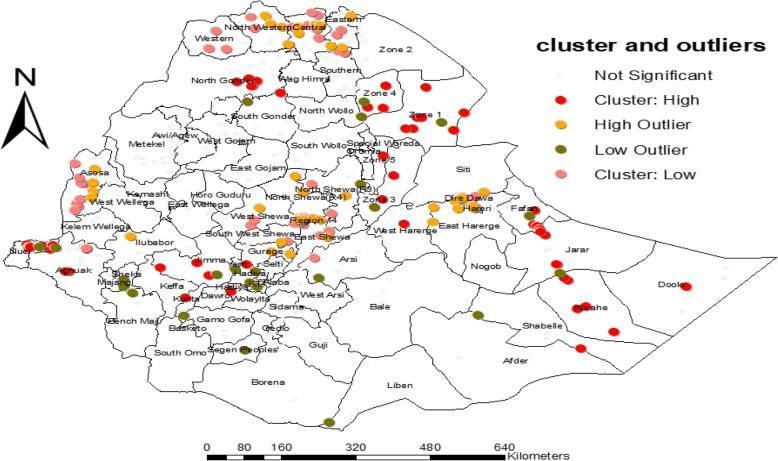
A spatial heterogeneity of defaulting from immunization was observed (Global Moran's I = 0.386379, p value < 0.001), and four significant SaTScan clusters of areas with high defaulting from immunization were detected. The most likely primary SaTScan cluster was seen in the Somali region, and secondary clusters were detected in (Afar, South Nation Nationality of people (SNNP), Oromiya, Amhara, and Gambella) regions. In the final model of the multilevel analysis, individual and community level factors accounted for 56.4% of the variance in the odds of defaulting immunization. Children from mothers who had no formal education (AOR = 4.23; 95% CI: 117, 15.78), and children living in Afar, Oromiya, Somali, SNNP, Gambella, and Harari regions had higher odds of having defaulted immunization from community level.
CONCLUSIONS
A clustered pattern of areas with high default of immunization was observed in Ethiopia. Both the individual and community-level characteristics were statistically significant factors of defaulting immunization. Therefore, the Federal Ethiopian Ministry of Health should prioritize the areas with defaulting of immunization and consider the identified factors for immunization interventions.
背景
在埃塞俄比亚,尽管免疫接种覆盖率有了相当大的提高,但儿童免疫接种中断的负担仍然很高,而且各地区差异显著。然而,免疫接种中断的地理差异和背景因素还没有得到很好的理解。因此,本研究旨在确定免疫接种中断的空间模式和相关因素。
方法
对 2016 年埃塞俄比亚人口与健康调查(EDHS 2016)数据进行深入分析。共纳入 1638 名嵌套在 552 个计数区(EA)的儿童进行分析。采用全局 Moran's I 统计量和 Bernoulli 纯粹空间扫描统计量分别识别免疫接种中断的地理模式和检测空间聚类。采用多水平逻辑回归模型来确定与免疫接种中断相关的因素。使用 p 值<0.05 来确定与儿童免疫接种中断显著相关的因素。
结果
观察到免疫接种中断存在空间异质性(全局 Moran's I = 0.386379,p 值<0.001),并检测到四个具有高免疫接种中断的显著 SaTScan 聚集区。最有可能的原发性 SaTScan 聚集区位于索马里地区,而次级聚集区则出现在(阿法尔、南埃塞俄比亚民族、奥罗莫、阿姆哈拉和甘贝拉)地区。在多水平分析的最终模型中,个体和社区层面的因素解释了免疫接种中断概率的 56.4%变异。母亲没有接受正规教育的儿童(优势比=4.23;95%置信区间:117,15.78)和居住在阿法尔、奥罗莫、索马里、南埃塞俄比亚民族、甘贝拉和哈拉里地区的儿童更有可能从社区层面中断免疫接种。
结论
在埃塞俄比亚观察到免疫接种中断的聚集模式。个体和社区层面的特征都是免疫接种中断的统计学显著因素。因此,联邦埃塞俄比亚卫生部应优先考虑免疫接种中断地区,并考虑针对免疫接种干预的已确定因素。



 Zotero 插件