
中国武汉湖泊和 WWTP-河口系统中针对 COVID-19 的药品和个人护理产品(PPCPs)的出现和风险评估。
Occurrence and risk assessment of pharmaceuticals and personal care products (PPCPs) against COVID-19 in lakes and WWTP-river-estuary system in Wuhan, China.
机构信息
State Key Laboratory of Freshwater Ecology and Biotechnology, Institute of Hydrobiology, Chinese Academy of Sciences, Wuhan 430072, PR China.
State Key Laboratory of Freshwater Ecology and Biotechnology, Institute of Hydrobiology, Chinese Academy of Sciences, Wuhan 430072, PR China; Ecological Environment Monitoring and Scientific Research Center, Changjiang River Basin Ecological Environment Administration, Ministry of Ecology and Environment, Wuhan 430014, PR China.
出版信息
Sci Total Environ. 2021 Oct 20;792:148352. doi: 10.1016/j.scitotenv.2021.148352. Epub 2021 Jun 12.
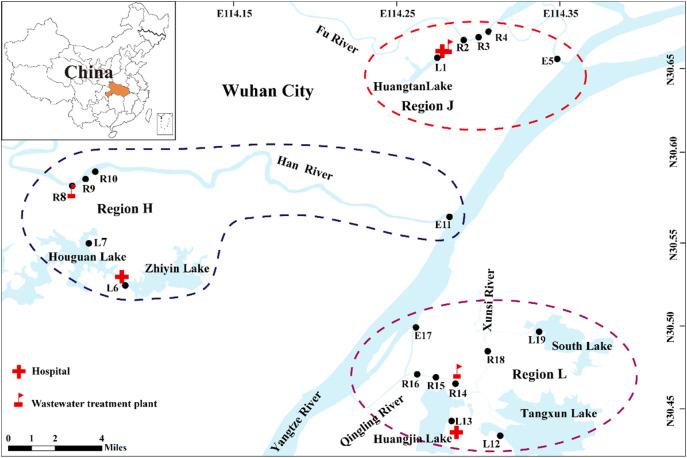
The consumption of pharmaceuticals and personal care products (PPCPs) for controlling and preventing the COVID-19 would have sharply increased during the pandemic. To evaluate their post-pandemic environmental impacts, five categories of drugs were detected in lakes and WWTP-river-estuary system near hospitals of Jinyintan, Huoshenshan and Leishenshan in the three regions (J, H and L) (Regions J, H and L) in Wuhan, China. The total amount of PPCPs (ranging from 2.61 to 1122 ng/L in water and 0.11 to 164 ng/g dry weight in sediments) were comparable to historical reports in Yangtze River basin, whereas the detection frequency and concentrations of ribavirin and azithromycin were higher than those of historical studies. The distribution of concerned drugs varied with space, season, media and water types: sampling sites located at WWTPs-river-estuary system around two hospitals (Regions L and J) usually had relatively high waterborne contamination levels, most of which declined in autumn; lakes had relatively low waterborne contamination levels in summer but increased in autumn. The potential risks of detected PPCPs were further evaluated using the multiple-level ecological risk assessment (MLERA): sulfamethoxazole and azithromycin were found to pose potential risks to aquatic organisms according to a semi-probabilistic approach and classified as priority pollutants based on an optimized risk assessment. In general, the COVID-19 pandemic did not cause serious pollution in lakes and WWTPs-river-estuary system in Wuhan City. However, the increased occurrence of certain drugs and their potential ecological risks need further attention. A strict source control policy and an advanced monitoring and risk warning system for emergency response and long-term risk control of PPCPs is urgent.
用于控制和预防 COVID-19 的药品和个人护理产品(PPCPs)的消费在大流行期间急剧增加。为了评估它们在大流行后的环境影响,在中国武汉金银潭、火神山和雷神山医院附近的湖泊和 WWTP-河口系统中检测了五类药物。PPCPs 的总量(水中范围为 2.61 至 1122ng/L,沉积物中为 0.11 至 164ng/g 干重)与长江流域的历史报告相当,而利巴韦林和阿奇霉素的检测频率和浓度高于历史研究。受关注药物的分布随空间、季节、介质和水类型而变化:位于两个医院附近 WWTP-河口系统的采样点(区域 L 和 J)通常具有相对较高的水环境污染水平,其中大部分在秋季下降;湖泊在夏季的水环境污染水平相对较低,但在秋季增加。使用多层次生态风险评估(MLERA)进一步评估了所检测到的 PPCPs 的潜在风险:磺胺甲恶唑和阿奇霉素根据半概率方法被发现对水生生物构成潜在风险,并根据优化风险评估将其归类为优先污染物。总体而言,COVID-19 大流行并未在武汉市湖泊和 WWTP-河口系统中造成严重污染。然而,某些药物的出现增加及其潜在的生态风险需要进一步关注。迫切需要严格的源头控制政策以及用于应急和长期风险控制的 PPCPs 先进监测和风险预警系统。




 Zotero 插件