
运动神经元回路在幼虫和成年期持续存在且功能相似。
A locomotor neural circuit persists and functions similarly in larvae and adult .
机构信息
Institute of Neuroscience, Howard Hughes Medical Institute, University of Oregon, Eugene, United States.
出版信息
Elife. 2021 Jul 14;10:e69767. doi: 10.7554/eLife.69767.
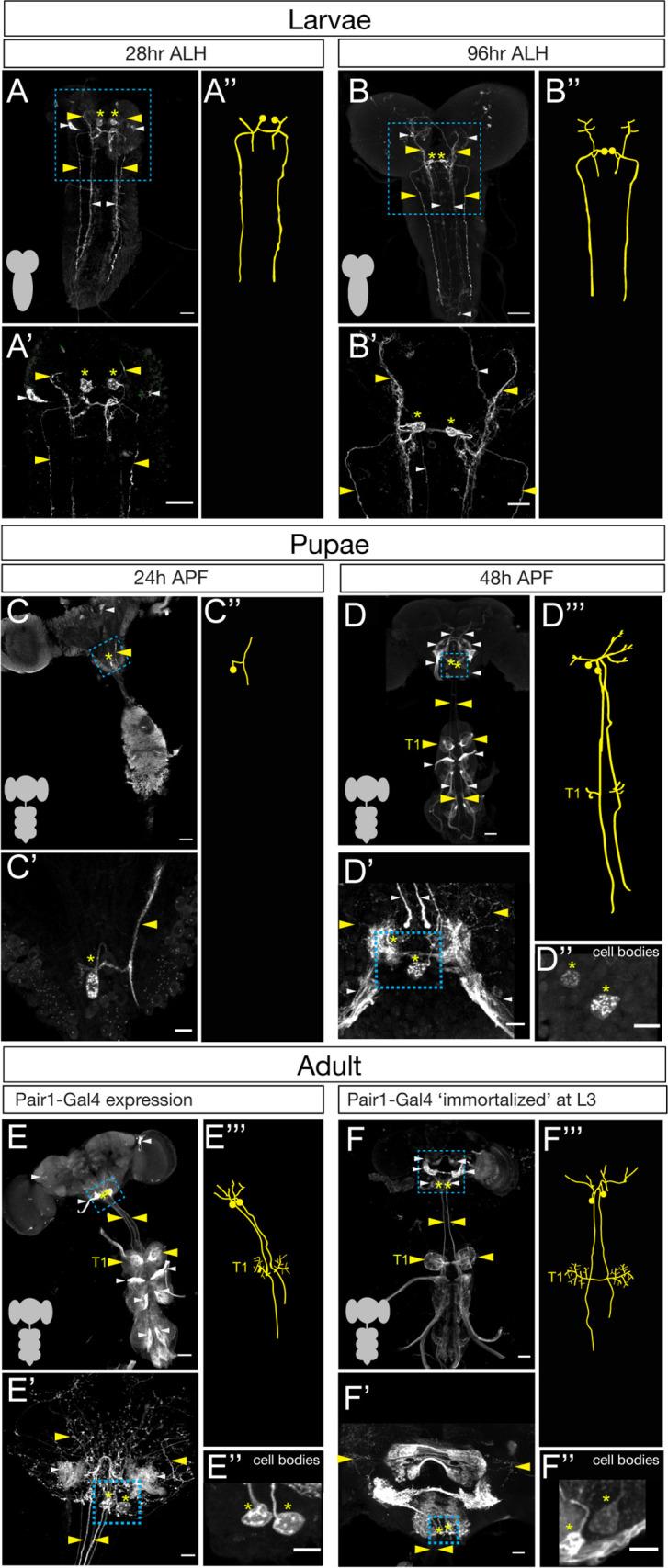
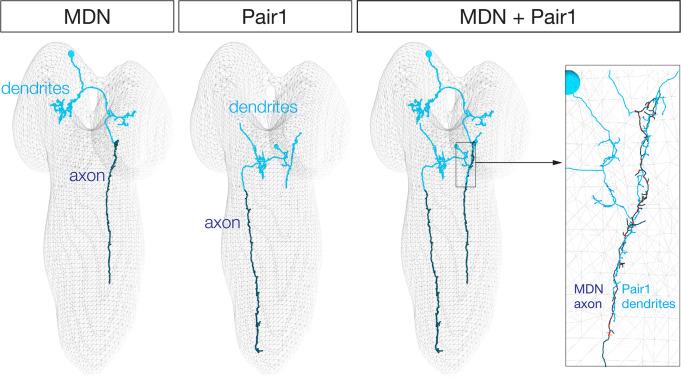
Individual neurons can undergo drastic structural changes, known as neuronal remodeling or structural plasticity. One example of this is in response to hormones, such as during puberty in mammals or metamorphosis in insects. However, in each of these examples, it remains unclear whether the remodeled neuron resumes prior patterns of connectivity, and if so, whether the persistent circuits drive similar behaviors. Here, we utilize a well-characterized neural circuit in the larva: the moonwalker descending neuron (MDN) circuit. We previously showed that larval MDN induces backward crawling, and synapses onto the Pair1 interneuron to inhibit forward crawling (Carreira-Rosario et al., 2018). MDN is remodeled during metamorphosis and regulates backward walking in the adult fly. We investigated whether Pair1 is remodeled during metamorphosis and functions within the MDN circuit during adulthood. We assayed morphology and molecular markers to demonstrate that Pair1 is remodeled during metamorphosis and persists in the adult fly. MDN-Pair1 connectivity is lost during early pupal stages, when both neurons are severely pruned back, but connectivity is re-established at mid-pupal stages and persist into the adult. In the adult, optogenetic activation of Pair1 resulted in arrest of forward locomotion, similar to what is observed in larvae. Thus, the MDN-Pair1 neurons are an interneuronal circuit - a pair of synaptically connected interneurons - that is re-established during metamorphosis, yet generates similar locomotor behavior at both larval and adult stages.
单个神经元可以经历剧烈的结构变化,称为神经元重塑或结构可塑性。例如,在哺乳动物的青春期或昆虫的变态期,激素会引发这种变化。然而,在这些例子中,仍不清楚重塑后的神经元是否会恢复之前的连接模式,如果是,那么持久的回路是否会驱动类似的行为。在这里,我们利用幼虫中一个特征明确的神经回路:月球漫步者下行神经元(MDN)回路。我们之前表明,幼虫 MDN 诱导向后爬行,并与 Pair1 中间神经元形成突触以抑制向前爬行(Carreira-Rosario 等人,2018)。MDN 在变态过程中被重塑,并调节成年果蝇的向后行走。我们研究了 Pair1 是否在变态过程中被重塑,并在成年期在 MDN 回路中发挥作用。我们通过形态学和分子标记物检测表明,Pair1 在变态过程中被重塑,并在成年果蝇中存在。MDN-Pair1 连接在早期蛹期丢失,此时两个神经元都严重回缩,但在中蛹期重新建立,并持续到成年期。在成年期,光遗传学激活 Pair1 导致向前运动停止,这与幼虫观察到的情况相似。因此,MDN-Pair1 神经元是一个中间神经元回路——一对突触连接的中间神经元——在变态过程中重新建立,但在幼虫和成年阶段产生类似的运动行为。



 Zotero 插件