
急性M1闭塞时机械取栓的首次通过再灌注:取栓装置的尺寸很重要。
First-Pass Reperfusion by Mechanical Thrombectomy in Acute M1 Occlusion: The Size of Retriever Matters.
作者信息
Serna Candel Carmen, Aguilar Pérez Marta, Bäzner Hansjörg, Henkes Hans, Hellstern Victoria
机构信息
Neuroradiologische Klinik, Klinikum Stuttgart, Stuttgart, Germany.
Neurologische Klinik, Klinikum Stuttgart, Stuttgart, Germany.
出版信息
Front Neurol. 2021 Jun 22;12:679402. doi: 10.3389/fneur.2021.679402. eCollection 2021.
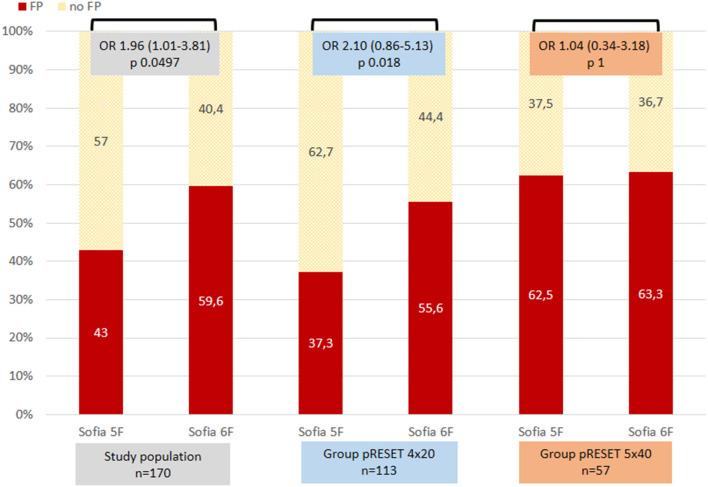
Single-pass complete reperfusion using stent retrievers has been shown to improve functional outcome in patients with large vessel occlusion strokes. The aim of this study was to investigate the optimal size of stent retrievers to achieve one-pass complete reperfusion by mechanical thrombectomy. The study evaluated the results of aspiration-assisted mechanical thrombectomy of acute isolated occlusion of the middle cerebral artery in the M1 segment with a novel 5 × 40-mm stent retriever compared to the usual 4 × 20-mm device. Reperfusion status was quantified using the Thrombolysis In Cerebral Infarction (TICI) scale. We hypothesized that thrombectomy of M1 occlusions with 5 × 40-mm stent retriever yields higher rates of complete first-pass reperfusion (FP) (TICI ≥2c after one pass) and successful or modified FP (mFP) (TICI ≥2b after one pass) than thrombectomy with 4 × 20. We included isolated M1 occlusions treated with pRESET 5 × 40 (phenox) as first-choice device for thrombectomy and compared with M1 occlusions treated with pRESET 4 × 20. We excluded patients with additional occlusions or tandem stenosis or who received an intracranial stent or angioplasty as a part of the endovascular treatment. One hundred thirteen patients were included in the 4 × 20 group and 57 patients in the 5 × 40 group. The 5 × 40 group achieved higher FP compared to 4 × 20 group [61.4% (35 of 57 patients) vs. 40.7% (46 of 113), respectively; adjusted odds ratio (OR) and 95% confidence interval (95% CI) = 2.20 (1.08-4.48), = 0.030] and a higher mFP [68.4%, 39 of 57 patients vs. 48.7%, 55 of 113; adjusted OR (95% CI) = 2.11 (1.04-4.28), = 0.037]. Frequency of successful reperfusion (TICI ≥2b) was similar in both groups (100 vs. 97.3%), but frequency of complete reperfusion (TICI ≥2c) was higher in the 5 × 40 group [82.5 vs. 61.9%, adjusted OR (95% CI) = 2.47 (1.01-6.04), = 0.047]. Number of passes to achieve reperfusion was lower in the 5 × 40 group than in the 4 × 20 group [1.6 ± 1.1 vs. 2 ± 1.4, = 0.033; adjusted incidence rate ratio (95% CI) = 0.84 (0.69-1.03), = 0.096]. Modified Rankin scale at 90 days was similar in 5 × 40 and 4 × 20 groups. The size of stent retriever matters in acute M1 occlusions treated with aspiration-assisted mechanical thrombectomy. A longer stent retriever with a larger nominal diameter achieves a higher complete and successful FP and higher successful reperfusion compared to a shorter stent retriever.
使用支架取栓器进行单次完全再灌注已被证明可改善大血管闭塞性中风患者的功能结局。本研究的目的是探讨通过机械取栓实现单次完全再灌注的支架取栓器的最佳尺寸。该研究评估了使用新型5×40毫米支架取栓器与常用的4×20毫米器械对大脑中动脉M1段急性孤立性闭塞进行抽吸辅助机械取栓的结果。使用脑梗死溶栓(TICI)量表对再灌注状态进行量化。我们假设,与使用4×20毫米支架取栓器进行取栓相比,使用5×40毫米支架取栓器对M1段闭塞进行取栓可产生更高的首次完全再灌注(FP)率(单次通过后TICI≥2c)和成功或改良FP(mFP)率(单次通过后TICI≥2b)。我们纳入了以pRESET 5×40(菲尼克斯)作为首选取栓器械治疗的孤立性M1段闭塞,并与以pRESET 4×20治疗的M1段闭塞进行比较。我们排除了有额外闭塞或串联狭窄的患者,或接受颅内支架或血管成形术作为血管内治疗一部分的患者。4×20组纳入了113例患者,5×40组纳入了57例患者。与4×20组相比,5×40组实现了更高的FP[分别为61.4%(57例患者中的35例)对40.7%(113例患者中的46例);调整后的优势比(OR)和95%置信区间(95%CI)=2.20(1.08 - 4.48),P = 0.030]和更高的mFP[68.4%,57例患者中的39例对48.7%,113例患者中的55例;调整后的OR(95%CI)=2.11(1.04 - 4.28),P = 0.037]。两组成功再灌注(TICI≥2b)的频率相似(100对97.3%),但5×40组的完全再灌注(TICI≥2c)频率更高[82.5%对61.9%,调整后的OR(95%CI)=2.47(1.01 - 6.04),P = 0.047]。5×40组实现再灌注的通过次数低于4×20组[1.6±1.1对2±1.4;P = 0.033;调整后的发病率比(95%CI)=0.84(0.69 - 1.03),P = 0.096]。90天时的改良Rankin量表在5×40组和4×20组中相似。在用抽吸辅助机械取栓治疗的急性M1段闭塞中,支架取栓器的尺寸很重要。与较短的支架取栓器相比,具有较大标称直径的较长支架取栓器可实现更高的完全和成功FP以及更高的成功再灌注。

 Zotero 插件