
通过问卷调查和建模研究城市环境中 SARS-CoV-2 的传播,以实现可持续的风险控制。
Study of SARS-CoV-2 transmission in urban environment by questionnaire and modeling for sustainable risk control.
机构信息
College of Environmental Science and Engineering, Nankai University, Tianjin 300350, PR China; Division of Water Resources Engineering, Lund University, Lund 22100, Sweden.
Department of Cardiology, Tianjin First Central Hospital, Tianjin 300190, PR China.
出版信息
J Hazard Mater. 2021 Oct 15;420:126621. doi: 10.1016/j.jhazmat.2021.126621. Epub 2021 Jul 10.
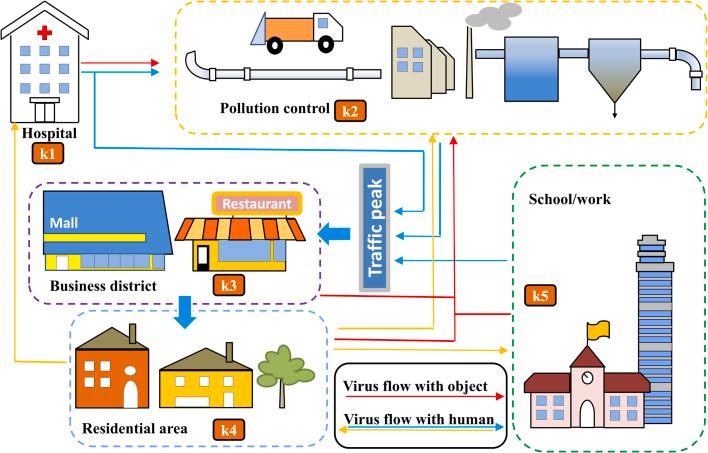
Caused by SARS-CoV-2, COVID-19 has become a severe threaten to society and human health, its epidemic control emerges as long-term issue. A sustainable epidemic and environmental transmission risk control (SEERC) in urban area is urgently needed. This work aims to conduct a new investigation on the transmission risk of SARS-COV-2 as virus/hazardous material through various environmental medias, routes and regions in the entirely urban area for guiding the SEERC. Specifically, 5 routes in 28 regions (totally 140 scenarios) are considered. For a new perspective, the risk evaluation is conducted by the quantification of frontline medicals staffs' valuable experience in this work. 207 specialists responsible for the treatment of over 9000 infected patients are involved. The result showed that degree of risk was in the order of breath>contact-to-object>contact-to-human>intake>unknown. The modeling suggested source control as the prior measure for epidemic control. The combination of source control & mask wearing showed high efficiency in SEERC. The homeworking policy needed to cooperate with activity limitation to perform its efficiency. Subsequently, a new plan for SEERC was discussed. This work delivered significant information to researchers and decision makers for the further development of sustainable control for SARS-COV-2 spreading and COVID-19 epidemic.
由 SARS-CoV-2 引起的 COVID-19 已成为对社会和人类健康的严重威胁,其疫情防控成为长期问题。城市地区急需可持续的疫情和环境传播风险控制(SEERC)。这项工作旨在对 SARS-COV-2 通过各种城市环境媒介、途径和区域的传播风险进行新的调查,以指导 SEERC。具体而言,考虑了 5 条途径和 28 个区域(共 140 种情况)。从一个新的角度来看,风险评估是通过量化前线医务人员在这项工作中的宝贵经验来进行的。有 207 名负责治疗 9000 多名感染患者的专家参与了这项研究。结果表明,风险程度的顺序为呼吸>接触物体>接触人>摄入>未知。建模表明,源头控制是疫情控制的首要措施。源头控制和佩戴口罩的结合在 SEERC 中显示出了高效性。在家工作政策需要与活动限制相配合以发挥其效率。随后,讨论了 SEERC 的新计划。这项工作为研究人员和决策者提供了重要信息,以进一步开发针对 SARS-COV-2 传播和 COVID-19 疫情的可持续控制措施。




 Zotero 插件