
根据生长进程按叶位对羽衣甘蓝中UV-B辐射截留量和生物活性化合物含量进行定量分析。
Quantitative Analysis of UV-B Radiation Interception and Bioactive Compound Contents in Kale by Leaf Position According to Growth Progress.
作者信息
Yoon Hyo In, Kim Hyun Young, Kim Jaewoo, Son Jung Eek
机构信息
Department of Agriculture, Forestry and Bioresources (Horticultural Science and Biotechnology), Seoul National University, Seoul, South Korea.
Research Institute of Agriculture and Life Sciences, Seoul National University, Seoul, South Korea.
出版信息
Front Plant Sci. 2021 Jul 8;12:667456. doi: 10.3389/fpls.2021.667456. eCollection 2021.
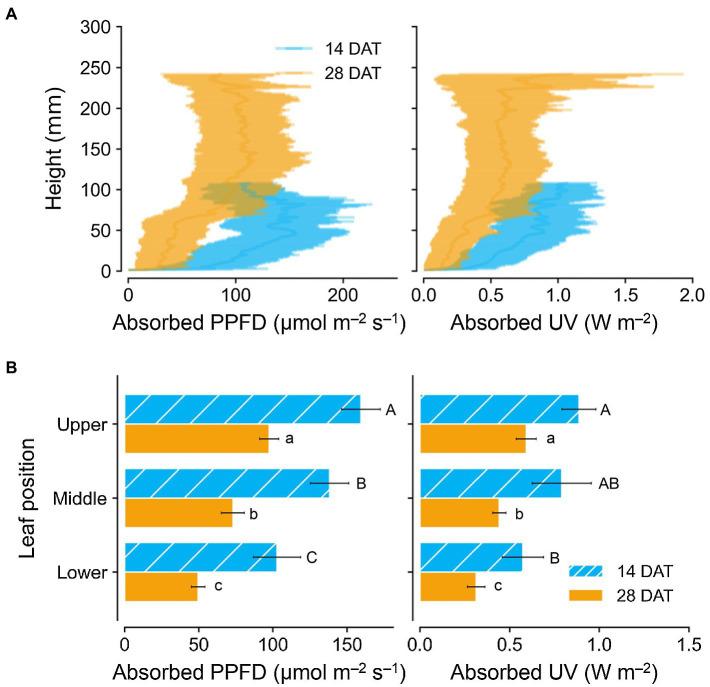
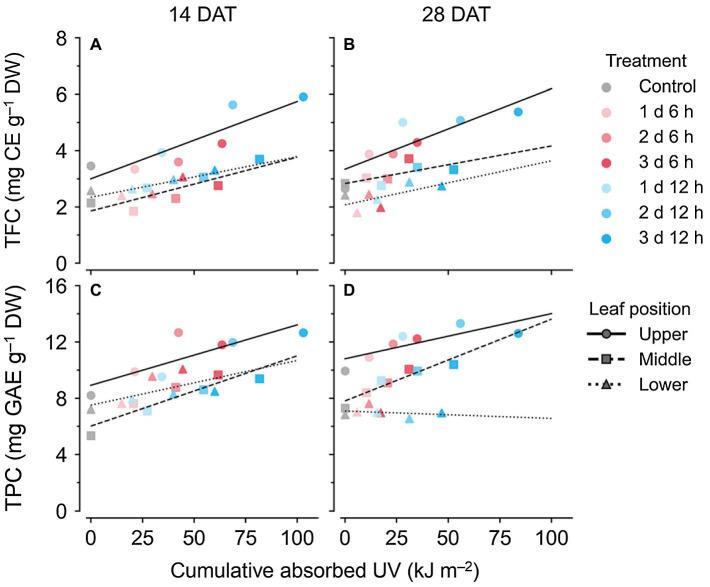
UV-B (280-315 nm) radiation has been used as an effective tool to improve bioactive compound contents in controlled environments, such as plant factories. However, plant structure changes with growth progress induce different positional distributions of UV-B radiation interception, which cause difficulty in accurately evaluating the effects of UV-B on biosynthesis of bioactive compounds. The objective of this study was to quantitatively analyze the positional distributions of UV-B radiation interception and bioactive compound contents of kales ( L. var. ) with growth progress and their relationships. Short-term moderate UV-B levels did not affect the plant growth and photosynthetic parameters. Spatial UV-B radiation interception was analyzed quantitatively by using 3D-scanned plant models and ray-tracing simulations. As growth progressed, the differences in absorbed UV-B energy between leaf positions were more pronounced. The concentrations of total phenolic compound (TPC) and total flavonoid compound (TFC) were higher with more cumulative absorbed UV-B energy. The cumulative UV energy yields for TFC were highest for the upper leaves of the older plants, while those for TPC were highest in the middle leaves of the younger plants. Despite the same UV-B levels, the UV-B radiation interception and UV-B susceptibility in the plants varied with leaf position and growth stage, which induced the different biosynthesis of TFC and TPC. This attempt to quantify the relationship between UV-B radiation interception and bioactive compound contents will contribute to the estimation and production of bioactive compounds in plant factories.
UV-B(280 - 315纳米)辐射已被用作一种有效工具,用于在可控环境(如植物工厂)中提高生物活性化合物的含量。然而,植物结构随生长进程的变化会导致UV-B辐射截留的位置分布不同,这使得准确评估UV-B对生物活性化合物生物合成的影响变得困难。本研究的目的是定量分析羽衣甘蓝(L. var.)在生长进程中UV-B辐射截留的位置分布、生物活性化合物含量及其相互关系。短期适度的UV-B水平不影响植物生长和光合参数。通过使用三维扫描的植物模型和光线追踪模拟对空间UV-B辐射截留进行了定量分析。随着生长的进行,叶片位置之间吸收的UV-B能量差异更加明显。总酚类化合物(TPC)和总黄酮类化合物(TFC)的浓度随着累积吸收的UV-B能量增加而升高。较老植株上部叶片的TFC累积UV能量产量最高,而较年轻植株中部叶片的TPC累积UV能量产量最高。尽管UV-B水平相同,但植物中UV-B辐射截留和UV-B敏感性随叶片位置和生长阶段而变化,这导致了TFC和TPC的生物合成不同。这种量化UV-B辐射截留与生物活性化合物含量之间关系的尝试将有助于植物工厂中生物活性化合物的估算和生产。



 Zotero 插件