
首次接触利妥昔单抗与系统性红斑狼疮中高抗药物抗体率相关,但与抗中性粒细胞胞质抗体相关性血管炎无关。
First exposure to rituximab is associated to high rate of anti-drug antibodies in systemic lupus erythematosus but not in ANCA-associated vasculitis.
机构信息
Department of Medicine Solna, Division of Rheumatology, Karolinska Institutet, Stockholm, Sweden.
Unit of Rheumatology, Karolinska University Hospital, Stockholm, Sweden.
出版信息
Arthritis Res Ther. 2021 Aug 13;23(1):211. doi: 10.1186/s13075-021-02589-6.
BACKGROUND
Anti-drug antibodies (ADAs) can impact on the efficacy and safety of biologicals, today used to treat several chronic inflammatory conditions. Specific patient groups may be more prone to develop ADAs. Rituximab is routinely used for ANCA-associated vasculitis (AAV) and as off-label therapy for systemic lupus erythematosus (SLE), but data on occurrence and predisposing factors to ADAs in these diseases is limited.
OBJECTIVES
To elucidate the rate of occurrence, and risk factors for ADAs against rituximab in SLE and AAV.
METHODS
ADAs were detected using a bridging electrochemiluminescent (ECL) immunoassay in sera from rituximab-naïve (AAV; n = 41 and SLE; n = 62) and rituximab-treated (AAV; n = 22 and SLE; n = 66) patients. Clinical data was retrieved from medical records. Disease activity was estimated by the SLE Disease Activity Index-2000 (SLEDAI-2 K) and the Birmingham Vasculitis Activity Score (BVAS).
RESULTS
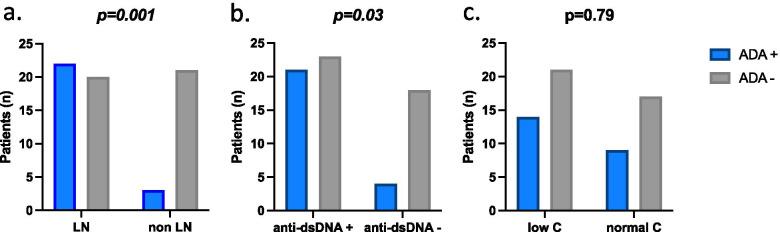
After first rituximab cycle, no AAV patients were ADA-positive compared to 37.8% of the SLE patients. Samples were obtained at a median (IQR) time of 5.5 (3.7-7.0) months (AAV), and 6.0 (5.0-7.0) months (SLE). ADA-positive SLE individuals were younger (34.0 (25.9-40.8) vs 44.3 (32.7-56.3) years, p = 0.002) and with more active disease (SLEDAI-2 K 14.0 (10.0-18.5) vs. 8.0 (6.0-14), p = 0.0017) and shorter disease duration (4.14 (1.18-10.08) vs 9.19 (5.71-16.93), p = 0.0097) compared to ADA-negative SLE. ADAs primarily occurred in nephritis patients, were associated with anti-dsDNA positivity but were not influenced by concomitant use of corticosteroids, cyclophosphamide or previous treatments. Despite overall reduction of SLEDAI-2 K (12.0 (7.0-16) to 4.0 (2.0-6.7), p < 0.0001), ADA-positive individuals still had higher SLEDAI-2 K (6.0 (4.0-9.0) vs 4.0 (2.0-6.0), p = 0.004) and their B cell count at 6 months follow-up was higher (CD19 + % 4.0 (0.5-10.0) vs 0.5 (0.4-1.0), p = 0.002). At retreatment, two ADA-positive SLE patients developed serum sickness (16.7%), and three had infusion reactions (25%) in contrast with one (5.2%) serum sickness in the ADA-negative group.
CONCLUSIONS
In contrast to AAV, ADAs were highly prevalent among rituximab-treated SLE patients already after the first course of treatment and were found to effect on both clinical and immunological responses. The high frequency in SLE may warrant implementations of ADA screening before retreatment and survey of immediate and late-onset infusion reactions.
背景
抗药物抗体 (ADA) 会影响生物制剂的疗效和安全性,目前这些生物制剂被用于治疗多种慢性炎症性疾病。某些特定的患者群体可能更容易产生 ADA。利妥昔单抗通常用于治疗抗中性粒细胞胞浆抗体相关性血管炎 (AAV) 和作为系统性红斑狼疮 (SLE) 的标签外治疗药物,但关于这些疾病中 ADA 的发生和易患因素的数据有限。
目的
阐明利妥昔单抗治疗的 SLE 和 AAV 患者中 ADA 的发生率和危险因素。
方法
采用桥接电化学发光 (ECL) 免疫分析法检测利妥昔单抗初治(AAV:n=41;SLE:n=62)和利妥昔单抗治疗(AAV:n=22;SLE:n=66)患者的血清中的 ADA。从病历中检索临床数据。采用 SLE 疾病活动指数-2000(SLEDAI-2K)和伯明翰血管炎活动评分(BVAS)评估疾病活动度。
结果
在第一个利妥昔单抗周期后,与 SLE 患者的 37.8%相比,没有 AAV 患者为 ADA 阳性。ADA 阳性的 SLE 患者更年轻(34.0(25.9-40.8)比 44.3(32.7-56.3)岁,p=0.002),疾病更活跃(SLEDAI-2K 14.0(10.0-18.5)比 8.0(6.0-14),p=0.0017),且疾病持续时间更短(4.14(1.18-10.08)比 9.19(5.71-16.93),p=0.0097)。与 ADA 阴性的 SLE 患者相比,ADA 主要发生在肾炎患者中,与抗 dsDNA 阳性相关,但不受同时使用皮质类固醇、环磷酰胺或既往治疗的影响。尽管 SLEDAI-2K 总体下降(12.0(7.0-16)至 4.0(2.0-6.7),p<0.0001),但 ADA 阳性患者的 SLEDAI-2K 仍较高(6.0(4.0-9.0)比 4.0(2.0-6.0),p=0.004),且他们在 6 个月随访时的 B 细胞计数更高(CD19+% 4.0(0.5-10.0)比 0.5(0.4-1.0),p=0.002)。在再次治疗时,两名 ADA 阳性的 SLE 患者出现血清病(16.7%),三名患者出现输液反应(25%),而 ADA 阴性组中只有一名(5.2%)患者出现血清病。
结论
与 AAV 相反,利妥昔单抗治疗的 SLE 患者在第一个疗程后就已经存在高度的 ADA,并且发现 ADA 会影响临床和免疫反应。SLE 中的高频率可能需要在再次治疗前进行 ADA 筛查,并调查即刻和迟发性输液反应。


 Zotero 插件