
用于心脏发育和先天性心脏病建模的自组装人心类器官。
Self-assembling human heart organoids for the modeling of cardiac development and congenital heart disease.
机构信息
Division of Developmental and Stem Cell Biology, Institute for Quantitative Health Science and Engineering, Michigan State University, East Lansing, MI, USA.
Department of Biomedical Engineering, College of Engineering, Michigan State University, East Lansing, MI, USA.
出版信息
Nat Commun. 2021 Aug 26;12(1):5142. doi: 10.1038/s41467-021-25329-5.
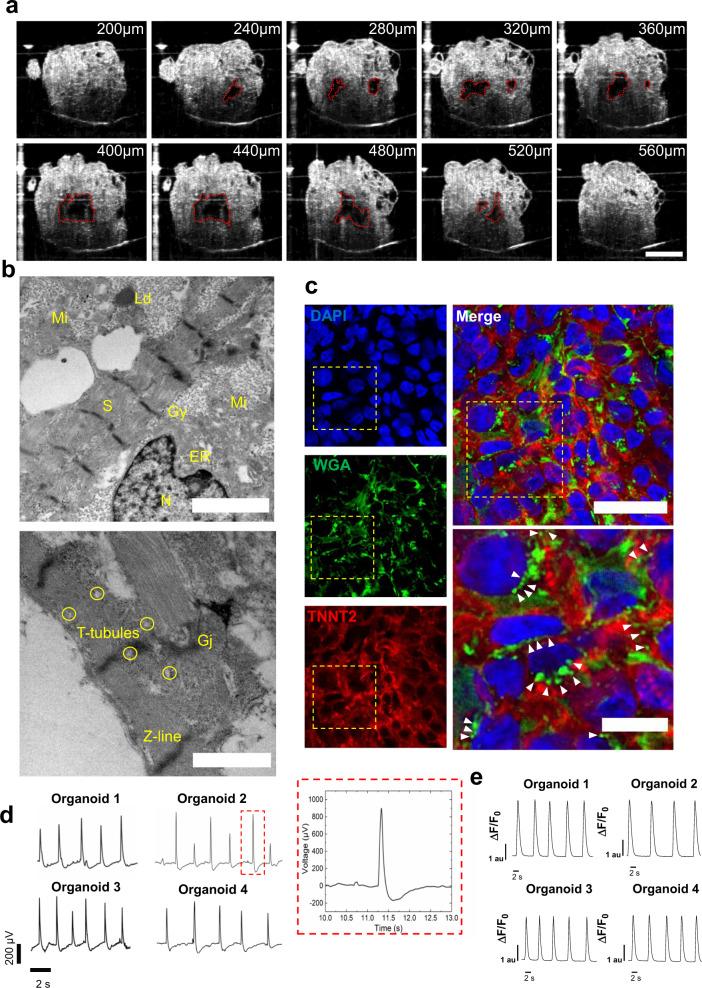
Congenital heart defects constitute the most common human birth defect, however understanding of how these disorders originate is limited by our ability to model the human heart accurately in vitro. Here we report a method to generate developmentally relevant human heart organoids by self-assembly using human pluripotent stem cells. Our procedure is fully defined, efficient, reproducible, and compatible with high-content approaches. Organoids are generated through a three-step Wnt signaling modulation strategy using chemical inhibitors and growth factors. Heart organoids are comparable to age-matched human fetal cardiac tissues at the transcriptomic, structural, and cellular level. They develop sophisticated internal chambers with well-organized multi-lineage cardiac cell types, recapitulate heart field formation and atrioventricular specification, develop a complex vasculature, and exhibit robust functional activity. We also show that our organoid platform can recreate complex metabolic disorders associated with congenital heart defects, as demonstrated by an in vitro model of pregestational diabetes-induced congenital heart defects.
先天性心脏缺陷是最常见的人类出生缺陷,但由于我们无法在体外准确模拟人类心脏,因此对这些疾病的发病机制了解有限。在这里,我们报告了一种使用人类多能干细胞通过自组装生成与发育相关的人心肌类器官的方法。我们的方法完全确定、高效、可重复,并且与高通量方法兼容。通过使用化学抑制剂和生长因子的三步 Wnt 信号调节策略来生成类器官。人心肌类器官在转录组、结构和细胞水平上与同龄的人胎心脏组织相当。它们形成具有组织有序的多能性心脏细胞类型的复杂内部腔室,重现心区形成和房室特化,发展出复杂的脉管系统,并表现出强大的功能活性。我们还表明,我们的类器官平台可以再现与先天性心脏缺陷相关的复杂代谢疾病,如体外模型所示,前糖尿病诱导的先天性心脏缺陷。


 Zotero 插件