
经导管主动脉瓣置换术后患者的原生主动脉瓣疾病进展和生物瓣衰败。
Native Aortic Valve Disease Progression and Bioprosthetic Valve Degeneration in Patients With Transcatheter Aortic Valve Implantation.
机构信息
Department of Interventional Cardiology and Angiology, Institute of Cardiology, Warsaw, Poland (J.K.).
Centre for Cardiovascular Science (E.T., T.R.G.C., A.F., M.K.D., R.B., N.L.C., A.K.B., N.G.U., M.C.W., E.J.R.v.B., D.E.N., M.R.D.), University of Edinburgh, UK.
出版信息
Circulation. 2021 Oct 26;144(17):1396-1408. doi: 10.1161/CIRCULATIONAHA.121.056891. Epub 2021 Aug 29.
BACKGROUND
Major uncertainties remain regarding disease activity within the retained native aortic valve, and regarding bioprosthetic valve durability, after transcatheter aortic valve implantation (TAVI). We aimed to assess native aortic valve disease activity and bioprosthetic valve durability in patients with TAVI in comparison with subjects with bioprosthetic surgical aortic valve replacement (SAVR).
METHODS
In a multicenter cross-sectional observational cohort study, patients with TAVI or bioprosthetic SAVR underwent baseline echocardiography, computed tomography angiography, and F-sodium fluoride (F-NaF) positron emission tomography. Participants (n=47) were imaged once with F-NaF positron emission tomography/computed tomography either at 1 month (n=9, 19%), 2 years (n=22, 47%), or 5 years (16, 34%) after valve implantation. Patients subsequently underwent serial echocardiography to assess for changes in valve hemodynamic performance (change in peak aortic velocity) and evidence of structural valve dysfunction. Comparisons were made with matched patients with bioprosthetic SAVR (n=51) who had undergone the same imaging protocol.
RESULTS
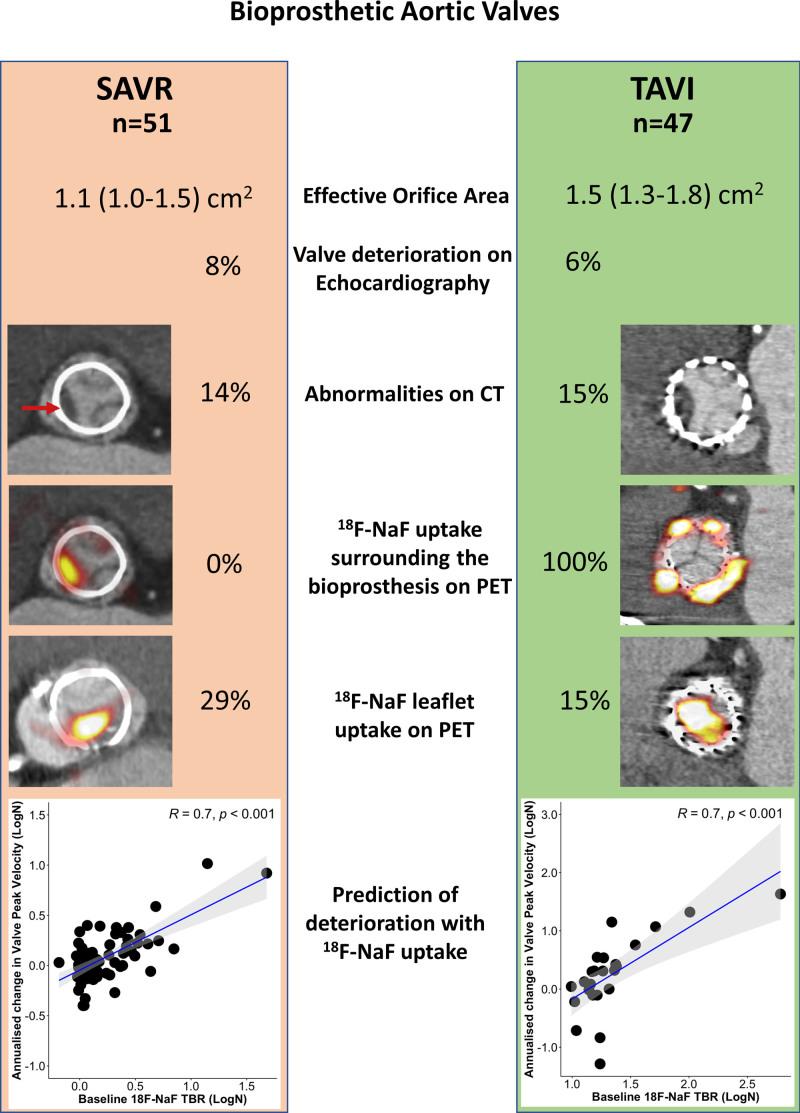
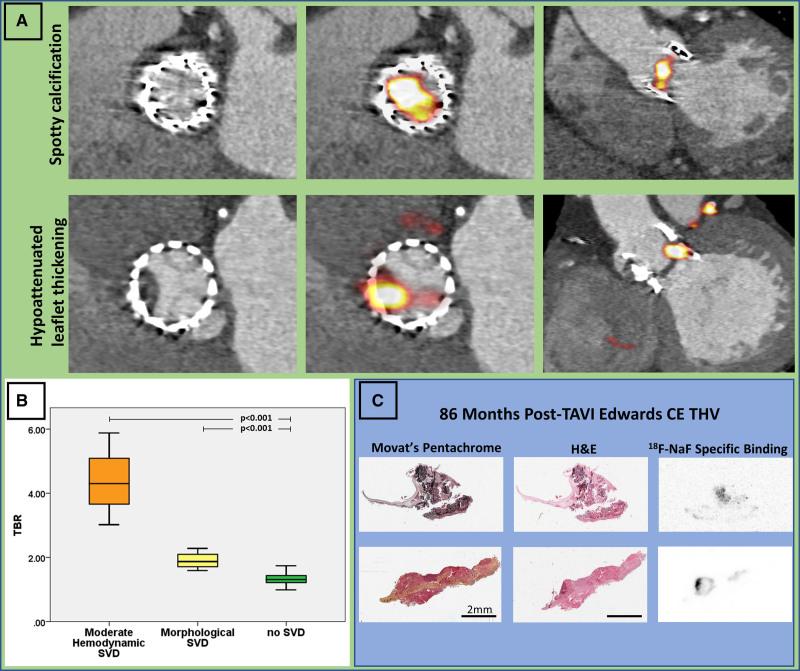
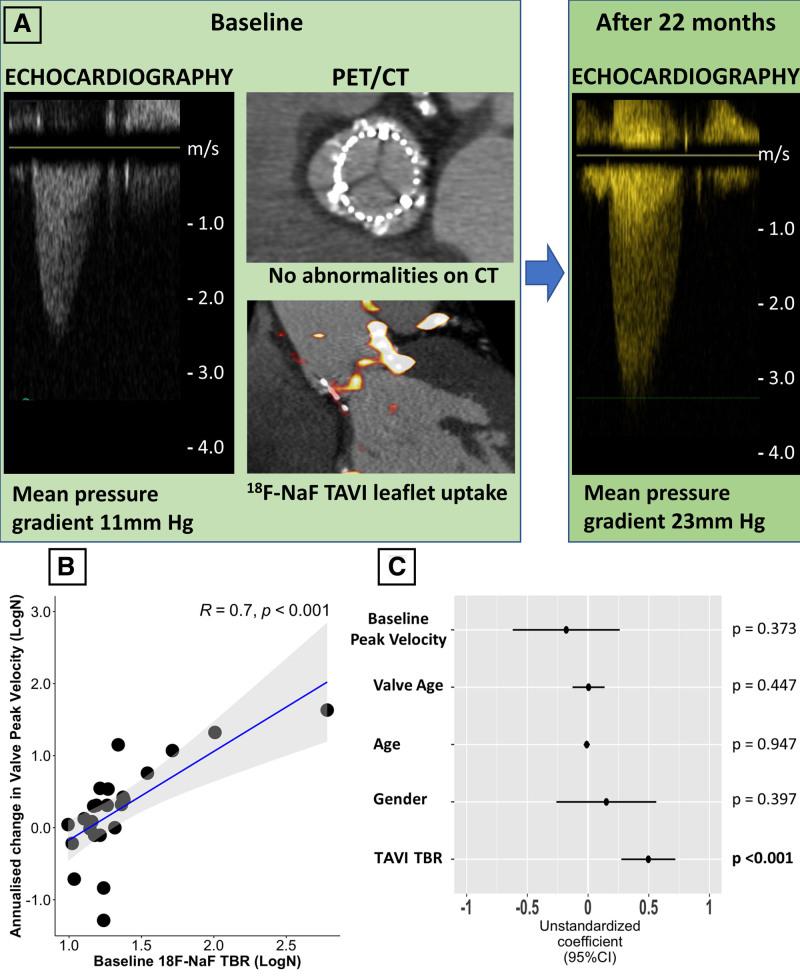
In patients with TAVI, native aortic valves demonstrated F-NaF uptake around the outside of the bioprostheses that showed a modest correlation with the time from TAVI (=0.36, =0.023). F-NaF uptake in the bioprosthetic leaflets was comparable between the SAVR and TAVI groups (target-to-background ratio, 1.3 [1.2-1.7] versus 1.3 [1.2-1.5], respectively; =0.27). The frequencies of imaging evidence of bioprosthetic valve degeneration at baseline were similar on echocardiography (6% versus 8%, respectively; =0.78), computed tomography (15% versus 14%, respectively; =0.87), and positron emission tomography (15% versus 29%, respectively; =0.09). Baseline F-NaF uptake was associated with a subsequent change in peak aortic velocity for both TAVI (=0.7, <0.001) and SAVR (=0.7, <0.001). On multivariable analysis, F-NaF uptake was the only predictor of peak velocity progression (<0.001).
CONCLUSIONS
In patients with TAVI, native aortic valves demonstrate evidence of ongoing active disease. Across imaging modalities, TAVI degeneration is of similar magnitude to bioprosthetic SAVR, suggesting comparable midterm durability. Registration: URL: https://www.clinicaltrials.gov; Unique identifier: NCT02304276.
背景
经导管主动脉瓣植入术(TAVI)后,对于保留的原生主动脉瓣内的疾病活动以及生物瓣耐久性仍存在重大不确定性。我们旨在比较 TAVI 患者与生物瓣外科主动脉瓣置换术(SAVR)患者的原生主动脉瓣疾病活动和生物瓣耐久性。
方法
在一项多中心横断面观察性队列研究中,TAVI 或生物瓣 SAVR 患者接受基线超声心动图、计算机断层扫描血管造影和 F-氟酸钠(F-NaF)正电子发射断层扫描。47 名参与者中有 9 名(19%)在 1 个月、22 名(47%)在 2 年或 16 名(34%)在 5 年后接受了 F-NaF 正电子发射断层扫描/计算机断层扫描的单次成像。随后,患者接受了连续超声心动图检查,以评估瓣膜血流动力学性能的变化(峰值主动脉速度的变化)和结构瓣膜功能障碍的证据。将这些结果与接受相同成像方案的 51 名生物瓣 SAVR 患者进行了比较。
结果
在 TAVI 患者中,原生主动脉瓣在生物瓣周围显示 F-NaF 摄取,其与 TAVI 后时间呈适度相关性(=0.36,=0.023)。生物瓣瓣叶的 F-NaF 摄取在 SAVR 和 TAVI 组之间相似(靶标与背景比值分别为 1.3[1.2-1.7]和 1.3[1.2-1.5];=0.27)。基线时超声心动图(分别为 6%和 8%;=0.78)、计算机断层扫描(分别为 15%和 14%;=0.87)和正电子发射断层扫描(分别为 15%和 29%;=0.09)的生物瓣退行性改变影像学证据的频率相似。F-NaF 摄取与 TAVI(=0.7,<0.001)和 SAVR(=0.7,<0.001)的峰值主动脉速度的后续变化相关。多变量分析显示,F-NaF 摄取是峰值速度进展的唯一预测因子(<0.001)。
结论
在 TAVI 患者中,原生主动脉瓣显示出持续存在的活跃疾病的证据。在各种成像方式中,TAVI 退行性变的程度与生物瓣 SAVR 相似,表明中期耐久性相当。注册:网址:https://www.clinicaltrials.gov;唯一标识符:NCT02304276。


 Zotero 插件