
放射科住院医师培训中引入总结性进展测试:从形成性进展测试过渡后,住院医师的测试结果变化不大。
Introducing Summative Progress Testing in Radiology Residency: Little Change in Residents' Test Results After Transitioning from Formative Progress Testing.
作者信息
Rutgers D R, van Schaik J P J, Kruitwagen C L J J, Haaring C, van Lankeren W, van Raamt A F, Ten Cate O
机构信息
Department of Radiology, University Medical Center, Utrecht University, Heidelberglaan 100, 3584 CX Utrecht, The Netherlands.
Examination Committee of the Radiological Society of the Netherlands, Utrecht, The Netherlands.
出版信息
Med Sci Educ. 2020 May 13;30(2):943-953. doi: 10.1007/s40670-020-00977-2. eCollection 2020 Jun.
INTRODUCTION
Educational effects of transitioning from formative to summative progress testing are unclear. Our purpose was to investigate whether such transitioning in radiology residency is associated with a change in progress test results.
METHODS
We investigated a national cohort of radiology residents ( > 300) who were semi-annually assessed through a mandatory progress test. Until 2014, this test was purely formative for all residents, but in 2014/2015, it was transitioned (as part of a national radiology residency program revision) to include a summative pass requirement for new residents. In 7 posttransitioning tests in 2015-2019, including summatively and formatively tested residents who followed the revised and pre-transitioning residency program, respectively, we assessed residents' relative test scores and percentage of residents that reached pass standards.
RESULTS
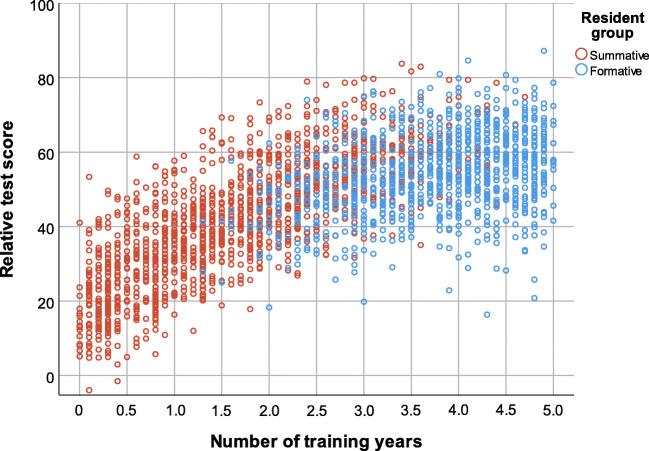
Due to our educational setting, most posttransitioning tests had no residents in the summative condition in postgraduate year 4-5, nor residents in the formative condition in year 0.5-2. Across the 7 tests, relative test scores in postgraduate year 1-3 of the summative resident group and year 3.5-4.5 of the formative group differed significantly ( < 0.01 and < 0.05, respectively, Kruskal-Wallis test). However, scores fluctuated without consistent time trends and without consistent differences between both resident groups. Percentage of residents reaching the pass standard did not differ significantly across tests or between groups.
DISCUSSION
Transitioning from formative to summative progress testing was associated with overall steady test results of the whole resident group in 4 post-transitioning years. We do not exclude that transitioning may have positive educational effects for resident subgroups.
引言
从形成性进步测试过渡到总结性进步测试的教育效果尚不清楚。我们的目的是调查放射科住院医师培训中的这种过渡是否与进步测试结果的变化相关。
方法
我们调查了一组全国性的放射科住院医师(超过300人),他们通过强制性进步测试进行半年一次的评估。直到2014年,该测试对所有住院医师来说纯粹是形成性的,但在2014/2015年,它被过渡(作为全国放射科住院医师培训计划修订的一部分),对新住院医师包括总结性通过要求。在2015 - 2019年的7次过渡后测试中,分别包括遵循修订后的和过渡前住院医师培训计划的接受总结性和形成性测试的住院医师,我们评估了住院医师的相对测试分数以及达到通过标准的住院医师百分比。
结果
由于我们的教育环境,在过渡后,大多数测试在研究生4 - 5年级没有处于总结性状态的住院医师,在0.5 - 2年级也没有处于形成性状态的住院医师。在这7次测试中,总结性住院医师组研究生1 - 3年级和形成性住院医师组3.5 - 4.5年级的相对测试分数有显著差异(分别为<0.01和<0.05,Kruskal - Wallis检验)。然而,分数波动,没有一致的时间趋势,两组住院医师之间也没有一致的差异。达到通过标准的住院医师百分比在各测试之间或组间没有显著差异。
讨论
从形成性进步测试过渡到总结性进步测试与过渡后4年整个住院医师组的总体稳定测试结果相关。我们不排除这种过渡可能对住院医师亚组有积极的教育效果。


 Zotero 插件