
丛枝菌根真菌对缺锌土壤中玉米生理功能的影响。
Effect of arbuscular mycorrhizal fungi on the physiological functioning of maize under zinc-deficient soils.
机构信息
Department of Soil Science, Faculty of Agricultural Sciences and Technology, Bahauddin Zakariya University, Multan, 60800, Pakistan.
Department of Geology and Pedology, Faculty of Forestry and Wood Technology, Mendel University in Brno, Zemedelska1, 61300, Brno, Czech Republic.
出版信息
Sci Rep. 2021 Sep 16;11(1):18468. doi: 10.1038/s41598-021-97742-1.
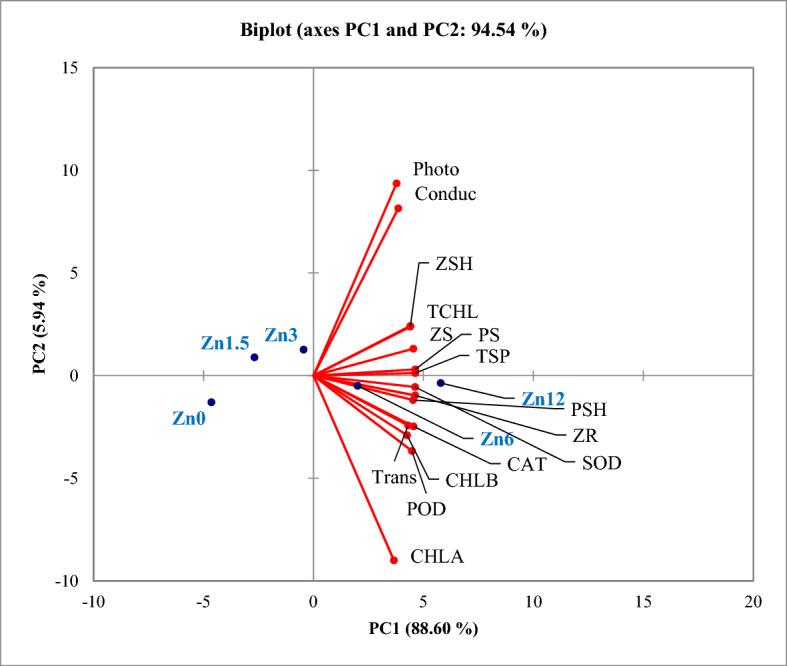
Zinc (Zn) deficiency can severely inhibit plant growth, yield, and enzymatic activities. Zn plays a vital role in various enzymatic activities in plants. Arbuscular mycorrhizal fungi (AMF) play a crucial role in improving the plant's Zn nutrition and mitigating Zn stress effects on plants. The current study was conducted to compare the response of inoculated and non-inoculated maize (YH 1898) in the presence of different levels of zinc under greenhouse conditions under a Zn deficient condition. There were two mycorrhizal levels (i.e., M + with mycorrhizae, M- without mycorrhizae) and five Zn levels (i.e., 0, 1.5, 3, 6, and 12 mg kg), with three replicates following completely randomized design. At the vegetative stage (before tillering), biochemical, physiological, and agronomic attributes were measured. The results showed that maize plants previously inoculated with AMF had higher gaseous exchange traits, i.e., a higher stomatal conductance rate, favoring an increased photosynthetic rate. Improvement in antioxidant enzyme activity was also observed in inoculated compared to non-inoculated maize plants. Moreover, AMF inoculation also played a beneficial role in nutrients availability and its uptake by plants. Higher Zn12 (12 mg Zn kg soil) treatment accumulated a higher Zn concentration in soil, root, and shoot in AMF-inoculated than in non-inoculated maize plants. These results are consistent with mycorrhizal symbiosis beneficial role for maize physiological functioning in Zn deficient soil conditions. Additionally, AMF inoculation mitigated the stress conditions and assisted nutrient uptake by maize.
锌(Zn)缺乏会严重抑制植物的生长、产量和酶活性。Zn 在植物的各种酶活性中起着至关重要的作用。丛枝菌根真菌(AMF)在改善植物的 Zn 营养和减轻 Zn 胁迫对植物的影响方面起着关键作用。本研究旨在比较在温室条件下,缺 Zn 条件下,不同 Zn 水平下接种和未接种玉米(YH 1898)的响应。有两个菌根水平(即 M+有菌根,M-没有菌根)和五个 Zn 水平(即 0、1.5、3、6 和 12 mg kg),采用完全随机设计,每个处理重复 3 次。在营养生长阶段(分蘖前)测量了生化、生理和农艺性状。结果表明,先前接种 AMF 的玉米植株具有更高的气体交换特性,即更高的气孔导度,有利于提高光合速率。与未接种的玉米植株相比,接种 AMF 的玉米植株的抗氧化酶活性也得到了改善。此外,AMF 接种也对植物的养分有效性及其吸收起到了有益的作用。在更高的 Zn12(12 mg Zn kg 土壤)处理中,接种 AMF 的玉米植株在土壤、根和茎中积累了更高浓度的 Zn,而非接种 AMF 的玉米植株则没有。这些结果与 AMF 共生在缺 Zn 土壤条件下对玉米生理功能的有益作用一致。此外,AMF 接种减轻了玉米的胁迫条件并协助其吸收养分。


 Zotero 插件