
根治性放疗与前列腺切除术对特定就业状况局限性前列腺癌患者年收入变化的影响:一项基于网络的初步研究。
Effects on annual income changes after radical radiotherapy versus after prostatectomy in patients with localized prostate cancer with a specific employment status: A web-based pilot study.
机构信息
Department of Radiology, The University of Tokyo Hospital, Tokyo, Japan.
Graduate Schools for Law and Politics, The University of Tokyo, Tokyo, Japan.
出版信息
PLoS One. 2021 Sep 30;16(9):e0258116. doi: 10.1371/journal.pone.0258116. eCollection 2021.
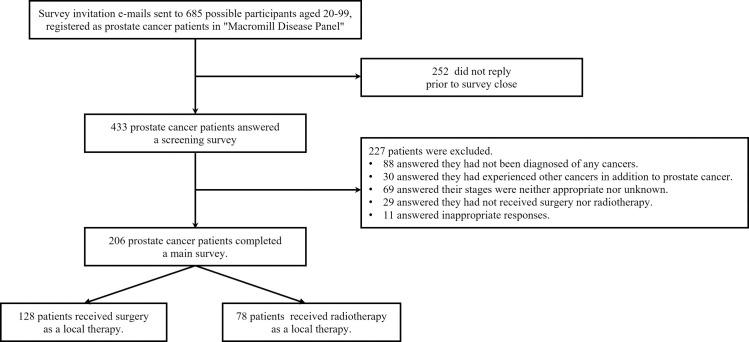
Men with localized prostate cancers are insured for undergoing radical radiotherapy or prostatectomy. However, limited information is available on the influence of cancer treatments on patients' employment status in Japan. Therefore, in this web-based survey, we aimed to compare the effects of post-treatment changes on the annual income of patients with prostate cancer after undergoing radical radiotherapy and prostatectomy and to identify the risk factors associated with the decrease in annual income. We investigated the clinical characteristics and demographics including pre-treatment working status, self-employment, non-regular employment, working for wage or salary, and joblessness of patients with localized prostate cancer. Multivariable logistic regression was performed to analyze the effects of various factors on the change in the annual income of self-employed and non-regularly employed workers. Seventy-eight eligible patients with localized prostate cancer had undergone radiotherapy, and 128 patients had undergone prostatectomy. Among self-employed and non-regularly employed workers, post-treatment income decline rates in those who underwent radiotherapy were smaller but not significant (12% vs. 42%, P = 0.074). Multivariable logistic regression analysis revealed that initial treatment for prostate cancer was the only significant risk factor for the post-treatment income decline among self-employed and non-regularly employed workers. Radiotherapy was associated with a smaller decrease in income (odds ratio, 0.22; 95% confidence interval, 0.052-0.95; P = 0.042). Our novel results implied the effectiveness of radiotherapy in preventing post-treatment income decline among patients with prostate cancer based on specific employment status: self-employed or non-regularly employed.
患有局限性前列腺癌的男性可通过保险接受根治性放疗或前列腺切除术。然而,关于癌症治疗对日本患者就业状况的影响,信息有限。因此,在这项基于网络的调查中,我们旨在比较根治性放疗和前列腺切除术治疗后对患者前列腺癌年度收入的影响,并确定与年度收入下降相关的风险因素。我们调查了包括治疗前工作状态、个体经营、非正规就业、受薪或领薪工作和失业在内的临床特征和人口统计学特征。多变量逻辑回归分析用于分析各种因素对个体经营和非正规就业者年收入变化的影响。78 名符合条件的局限性前列腺癌患者接受了放疗,128 名患者接受了前列腺切除术。在个体经营者和非正规就业者中,接受放疗者治疗后收入下降率较小,但无统计学意义(12%对 42%,P=0.074)。多变量逻辑回归分析显示,前列腺癌的初始治疗是个体经营和非正规就业者治疗后收入下降的唯一显著风险因素。放疗与收入下降幅度较小相关(比值比,0.22;95%置信区间,0.052-0.95;P=0.042)。我们的新结果表明,基于特定就业状况:个体经营或非正规就业,放疗可有效预防前列腺癌患者治疗后收入下降。

 Zotero 插件