
妊娠期间贫血、凝血参数与分娩产后出血的关系:一项前瞻性队列研究。
Relationship between anaemia, coagulation parameters during pregnancy and postpartum haemorrhage at childbirth: a prospective cohort study.
机构信息
NPEU, Nuffield Department of Population Health, Oxford University, Oxford, Oxfordshire, UK
Department of Obstetrics and Gynaecology, Mahatma Gandhi Institute of Medical Sciences, Sevagram, Maharashtra, India.
出版信息
BMJ Open. 2021 Oct 4;11(10):e050815. doi: 10.1136/bmjopen-2021-050815.
OBJECTIVES
To investigate the association between coagulation parameters and severity of anaemia (moderate anaemia: haemoglobin (Hb) 7-9.9 g/dL and severe anaemia: Hb <7 g/dL) during pregnancy and relate these to postpartum haemorrhage (PPH) at childbirth.
DESIGN
A prospective cohort study of pregnant women recruited in the third trimester and followed-up after childbirth.
SETTING
Ten hospitals across four states in India.
PARTICIPANTS
1342 pregnant women.
INTERVENTION
Not applicable.
METHODS
Hb and coagulation parameters: fibrinogen, D-dimer, D-dimer/fibrinogen ratio, platelets and international normalised ratio (INR) were measured at baseline. Participants were followed-up to measure blood loss within 2 hours after childbirth and PPH was defined based on blood loss and clinical assessment. Associations between coagulation parameters, Hb, anaemia and PPH were examined using multivariable logistic regression models.
OUTCOMES MEASURES
Adjusted OR with 95% CI.
RESULTS
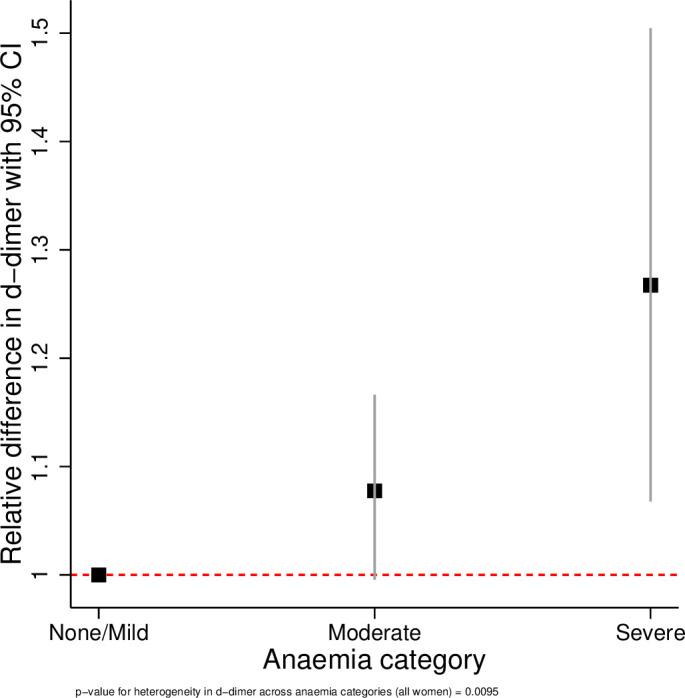
In women with severe anaemia during the third trimester, the D-dimer was 27% higher, mean fibrinogen 117 mg/dL lower, D-dimer/fibrinogen ratio 69% higher and INR 12% higher compared with women with no/mild anaemia. Mean platelets in severe anaemia was 37.8×10/L lower compared with women with moderate anaemia. Similar relationships with smaller effect sizes were identified for women with moderate anaemia compared with women with no/mild anaemia. Low Hb and high INR at third trimester of pregnancy independently increased the odds of PPH at childbirth, but the other coagulation parameters were not found to be significantly associated with PPH.
CONCLUSION
Altered blood coagulation profile in pregnant women with severe anaemia could be a risk factor for PPH and requires further evaluation.
目的
探讨妊娠期间凝血参数与贫血严重程度(中度贫血:血红蛋白(Hb)7-9.9 g/dL 和重度贫血:Hb<7 g/dL)的关系,并将其与分娩时产后出血(PPH)相关联。
设计
一项前瞻性队列研究,纳入了妊娠晚期的孕妇,并在产后进行随访。
地点
印度四个邦的十家医院。
参与者
1342 名孕妇。
干预措施
无。
方法
在基线时测量 Hb 和凝血参数:纤维蛋白原、D-二聚体、D-二聚体/纤维蛋白原比值、血小板和国际标准化比值(INR)。对参与者进行随访,以测量产后 2 小时内的出血量,并根据出血量和临床评估定义 PPH。使用多变量逻辑回归模型检查凝血参数、Hb、贫血与 PPH 之间的关系。
结局测量
调整后的比值比(OR)及其 95%置信区间(CI)。
结果
在妊娠晚期患有严重贫血的女性中,D-二聚体高 27%,平均纤维蛋白原低 117 mg/dL,D-二聚体/纤维蛋白原比值高 69%,INR 高 12%,与无/轻度贫血的女性相比。与中度贫血的女性相比,严重贫血的女性平均血小板低 37.8×10/L。与无/轻度贫血的女性相比,中度贫血的女性也存在类似的关系,但效应大小较小。妊娠晚期 Hb 低和 INR 高独立增加了分娩时 PPH 的几率,但其他凝血参数与 PPH 无明显相关性。
结论
妊娠严重贫血女性的血液凝血谱改变可能是 PPH 的危险因素,需要进一步评估。




 Zotero 插件