
义齿基托用聚酰胺材料的线性尺寸变化和极限拉伸强度
Linear Dimensional Change and Ultimate Tensile Strength of Polyamide Materials for Denture Bases.
作者信息
Chuchulska Bozhana, Zlatev Stefan
机构信息
Department of Prosthetic Dental Medicine, Faculty of Dental Medicine, Medical University of Plovdiv, 4000 Plovdiv, Bulgaria.
CAD/CAM Center of Dental Medicine, Research Institute at the Medical University of Plovdiv, 4000 Plovdiv, Bulgaria.
出版信息
Polymers (Basel). 2021 Oct 8;13(19):3446. doi: 10.3390/polym13193446.
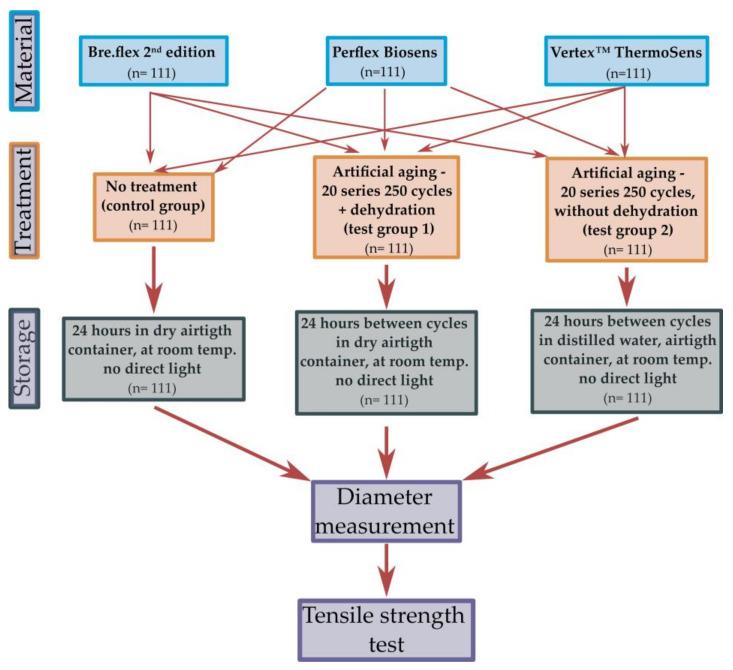
The aim of the current study was to evaluate the dimensional changes and ultimate tensile strength in three polyamide materials for denture bases fabrication through injection molding, subjected to artificial aging and different storage conditions. A total of 333 test specimens fabricated from Biosens (BS; Perflex, Netanya, Israel), Bre.flex 2nd edition (BF; Bredent, Senden, Germany) and ThermoSens (TS; Vertex Dental B.V., Soesterberg, The Netherlands)- = 111 per material-were equally divided into three groups ( = 37) based on different treatments and storage conditions. Test samples allocated to the "Control group" were not artificially aged and stored in water for 24 h. Both "Treatment 1 group" and "Treatment 2 group" were subjected to thermocycling, the former dehydrated and the latter stored in water between cycle-sets. Linear changes and ultimate tensile strength were measured and analyzed for storage condition and material influence on the outcome variables. A Welch ANOVA test with Games-Howell post-hoc analysis was used to compare the influence of treatments across different materials. Significant differences were found for all three included materials with values ranging from <0.05 to <0.001 for linear dimensional changes. The magnitude of alterations varied and was large for BS (Perflex, Israel) (ω = 0.62) and BF (Bredent, Germany) (ω = 0.47) and small but significant for TS (Vertex Dental B.V., The Netherlands) (ω = 0.05). However, results seem to fall into clinically acceptable range. Significant differences were also observed for the ultimate tensile strength test with the same range of -values. All three materials showed different initial ultimate tensile strengths and varying reaction to artificial aging and storage with the lowest alterations observed for BF (Bredent, Germany) (ω = 0.05). Within the limitation of this study, it can be concluded that all three materials show different dimensional and mechanical properties when subjected to artificial aging and different storage. Although linear dimensions show significant changes, they seem to be clinically irrelevant, whereas the change in ultimate tensile strength after only 6-month equivalent clinical use was substantial for BS (Perflex, Israel) and TS (Vertex Dental B.V., The Netherlands).
本研究的目的是评估三种用于义齿基托制作的聚酰胺材料在注塑成型后,经过人工老化和不同储存条件下的尺寸变化和极限拉伸强度。总共333个测试样本由Biosens(BS;Perflex,以色列内坦亚)、Bre.flex第二版(BF;Bredent,德国森登)和ThermoSens(TS;Vertex Dental B.V.,荷兰索斯特贝赫)制成——每种材料111个——根据不同的处理和储存条件平均分为三组(每组37个)。分配到“对照组”的测试样本未进行人工老化,而是在水中储存24小时。“处理1组”和“处理2组”均进行热循环处理,前者脱水,后者在每组循环之间储存在水中。测量并分析了线性变化和极限拉伸强度,以研究储存条件和材料对结果变量的影响。采用带有Games-Howell事后分析的Welch方差分析来比较不同材料间处理的影响。对于所有三种纳入的材料,线性尺寸变化的p值范围为<0.05至<0.001,均发现了显著差异。变化幅度各不相同,BS(Perflex,以色列)(ω = 0.62)和BF(Bredent,德国)(ω = 0.47)的变化幅度较大,而TS(Vertex Dental B.V.,荷兰)(ω = 0.05)的变化幅度较小但显著。然而,结果似乎落在临床可接受范围内。极限拉伸强度测试也观察到了相同p值范围内的显著差异。所有三种材料显示出不同的初始极限拉伸强度,并且对人工老化和储存的反应各不相同,BF(Bredent,德国)观察到的变化最小(ω = 0.05)。在本研究的局限性内,可以得出结论,所有三种材料在经过人工老化和不同储存后,显示出不同的尺寸和机械性能。尽管线性尺寸显示出显著变化,但它们似乎在临床上无关紧要,而仅经过相当于6个月临床使用后,BS(Perflex,以色列)和TS(Vertex Dental B.V.,荷兰)的极限拉伸强度变化很大。



 Zotero 插件