
代谢通量采样预测了商业葡萄酒酵母中与香气产生相关的菌株依赖性差异。
Metabolic flux sampling predicts strain-dependent differences related to aroma production among commercial wine yeasts.
机构信息
Department of Chemical Engineering, University of California, Davis, CA, USA.
Food Microbiology, Wageningen University & Research, Wageningen, The Netherlands.
出版信息
Microb Cell Fact. 2021 Oct 21;20(1):204. doi: 10.1186/s12934-021-01694-0.
BACKGROUND
Metabolomics coupled with genome-scale metabolic modeling approaches have been employed recently to quantitatively analyze the physiological states of various organisms, including Saccharomyces cerevisiae. Although yeast physiology in laboratory strains is well-studied, the metabolic states under industrially relevant scenarios such as winemaking are still not sufficiently understood, especially as there is considerable variation in metabolism between commercial strains. To study the potential causes of strain-dependent variation in the production of volatile compounds during enological conditions, random flux sampling and statistical methods were used, along with experimental extracellular metabolite flux data to characterize the differences in predicted intracellular metabolic states between strains.
RESULTS
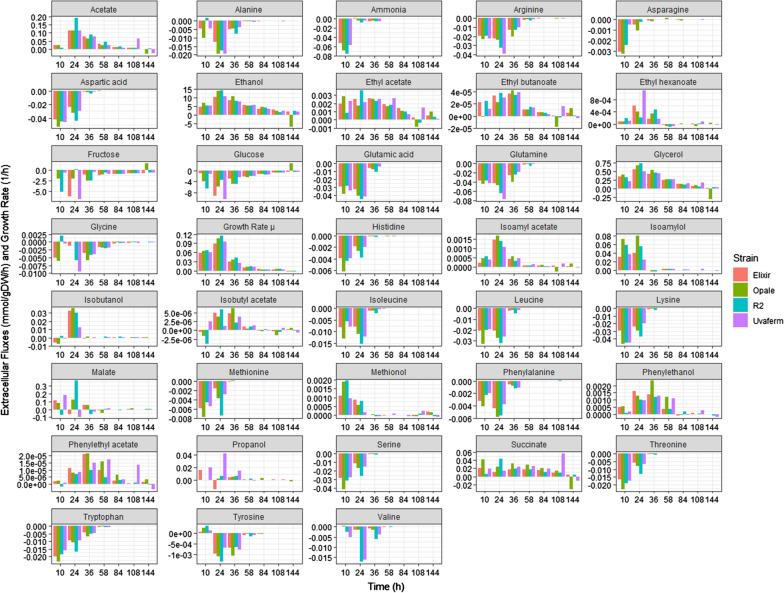
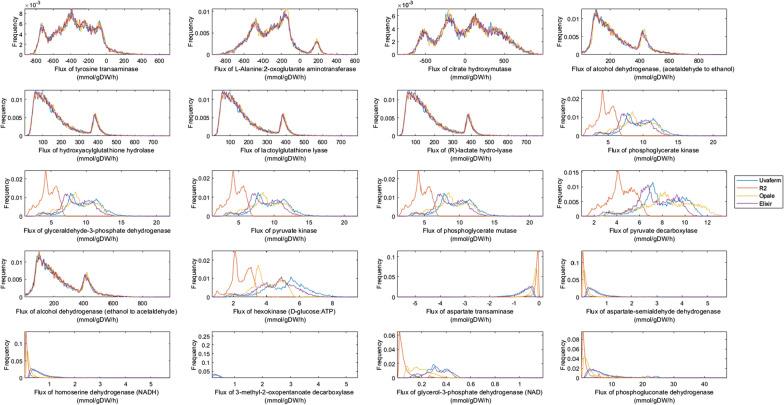
It was observed that four selected commercial wine yeast strains (Elixir, Opale, R2, and Uvaferm) produced variable amounts of key volatile organic compounds (VOCs). Principal component analysis was performed on extracellular metabolite data from the strains at three time points of cell cultivation (24, 58, and 144 h). Separation of the strains was observed at all three time points. Furthermore, Uvaferm at 24 h, for instance, was most associated with propanol and ethyl hexanoate. R2 was found to be associated with ethyl acetate and Opale could be associated with isobutanol while Elixir was most associated with phenylethanol and phenylethyl acetate. Constraint-based modeling (CBM) was employed using the latest genome-scale metabolic model of yeast (Yeast8) and random flux sampling was performed with experimentally derived fluxes at various stages of growth as constraints for the model. The flux sampling simulations allowed us to characterize intracellular metabolic flux states and illustrate the key parts of metabolism that likely determine the observed strain differences. Flux sampling determined that Uvaferm and Elixir are similar while R2 and Opale exhibited the highest degree of differences in the Ehrlich pathway and carbon metabolism, thereby causing strain-specific variation in VOC production. The model predictions also established the top 20 fluxes that relate to phenotypic strain variation (e.g. at 24 h). These fluxes indicated that Opale had a higher median flux for pyruvate decarboxylase reactions compared with the other strains. Conversely, R2 which was lower in all VOCs, had higher median fluxes going toward central metabolism. For Elixir and Uvaferm, the differences in metabolism were most evident in fluxes pertaining to transaminase and hexokinase associated reactions. The applied analysis of metabolic divergence unveiled strain-specific differences in yeast metabolism linked to fusel alcohol and ester production.
CONCLUSIONS
Overall, this approach proved useful in elucidating key reactions in amino acid, carbon, and glycerophospholipid metabolism which suggest genetic divergence in activity in metabolic subsystems among these wine strains related to the observed differences in VOC formation. The findings in this study could steer more focused research endeavors in developing or selecting optimal aroma-producing yeast stains for winemaking and other types of alcoholic fermentations.
背景
代谢组学与基因组尺度代谢建模方法的结合最近已被用于定量分析各种生物体的生理状态,包括酿酒酵母。尽管实验室菌株的酵母生理学研究得很好,但在酿酒等工业相关情况下的代谢状态仍未得到充分理解,特别是商业菌株之间的代谢存在很大差异。为了研究在葡萄酒酿造条件下,挥发性化合物产生的菌株依赖性变化的潜在原因,采用随机通量采样和统计方法,以及实验细胞外代谢通量数据,来描述菌株间预测的细胞内代谢状态的差异。
结果
观察到四种选定的商业葡萄酒酵母菌株(Elixir、Opale、R2 和 Uvaferm)产生了不同数量的关键挥发性有机化合物(VOC)。对三个细胞培养时间点(24、58 和 144 小时)的菌株细胞外代谢物数据进行主成分分析。在所有三个时间点都观察到菌株的分离。此外,例如,24 小时时的 Uvaferm 与丙醇和己酸乙酯的关系最为密切。R2 与乙酸乙酯有关,Opale 与异丁醇有关,而 Elixir 与苯乙醇和苯乙基乙酸酯的关系最为密切。使用最新的酵母基因组尺度代谢模型(Yeast8)进行基于约束的建模(CBM),并以不同生长阶段的实验衍生通量作为模型的约束进行随机通量采样。通量采样模拟使我们能够描述细胞内代谢通量状态,并说明可能导致观察到的菌株差异的关键代谢部分。通量采样确定 Uvaferm 和 Elixir 相似,而 R2 和 Opale 在 Ehrlich 途径和碳代谢方面表现出最大的差异,从而导致 VOC 产生的菌株特异性差异。模型预测还确定了与表型菌株变化相关的前 20 个通量(例如在 24 小时时)。这些通量表明,与其他菌株相比,Opale 的丙酮酸脱羧酶反应的中值通量更高。相反,在所有 VOC 中含量较低的 R2,其流向中心代谢的中值通量更高。对于 Elixir 和 Uvaferm,与转氨基和己糖激酶相关反应有关的代谢差异最为明显。代谢差异的分析揭示了与酒用酵母代谢相关的氨基酸、碳和甘油磷酸脂代谢中的菌株特异性差异,这表明这些葡萄酒菌株在代谢亚系统中的遗传分化与观察到的 VOC 形成差异有关。本研究的结果可以指导更有针对性的研究,以开发或选择用于酿酒和其他类型酒精发酵的最佳香气产生酵母菌株。




 Zotero 插件