
从多光谱无人机图像中检测高粱植株和穗部特征。
Detecting Sorghum Plant and Head Features from Multispectral UAV Imagery.
作者信息
Zhao Yan, Zheng Bangyou, Chapman Scott C, Laws Kenneth, George-Jaeggli Barbara, Hammer Graeme L, Jordan David R, Potgieter Andries B
机构信息
The University of Queensland, Queensland Alliance for Agriculture and Food Innovation, Centre for Crop Science, Gatton, Queensland 4343, Australia.
CSIRO Agriculture and Food, St. Lucia, Queensland 4072, Australia.
出版信息
Plant Phenomics. 2021 Oct 1;2021:9874650. doi: 10.34133/2021/9874650. eCollection 2021.
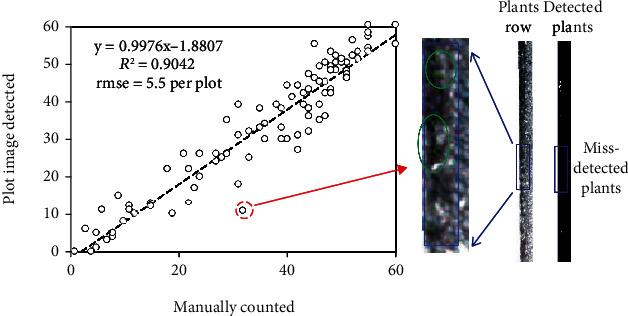
In plant breeding, unmanned aerial vehicles (UAVs) carrying multispectral cameras have demonstrated increasing utility for high-throughput phenotyping (HTP) to aid the interpretation of genotype and environment effects on morphological, biochemical, and physiological traits. A key constraint remains the reduced resolution and quality extracted from "stitched" mosaics generated from UAV missions across large areas. This can be addressed by generating high-quality reflectance data from a single nadir image per plot. In this study, a pipeline was developed to derive reflectance data from raw multispectral UAV images that preserve the original high spatial and spectral resolutions and to use these for phenotyping applications. Sequential steps involved (i) imagery calibration, (ii) spectral band alignment, (iii) backward calculation, (iv) plot segmentation, and (v) application. Each step was designed and optimised to estimate the number of plants and count sorghum heads within each breeding plot. Using a derived nadir image of each plot, the coefficients of determination were 0.90 and 0.86 for estimates of the number of sorghum plants and heads, respectively. Furthermore, the reflectance information acquired from the different spectral bands showed appreciably high discriminative ability for sorghum head colours (i.e., red and white). Deployment of this pipeline allowed accurate segmentation of crop organs at the canopy level across many diverse field plots with minimal training needed from machine learning approaches.
在植物育种中,搭载多光谱相机的无人机已在高通量表型分析(HTP)中展现出越来越高的实用性,有助于解读基因型和环境对形态、生化及生理性状的影响。一个关键限制仍然是从大面积无人机任务生成的“拼接”镶嵌图中提取的分辨率和质量有所降低。这可以通过为每个地块生成高质量的单幅天底图像反射率数据来解决。在本研究中,开发了一种流程,从原始多光谱无人机图像中获取反射率数据,该数据保留了原始的高空间和光谱分辨率,并将其用于表型分析应用。连续步骤包括:(i)图像校准,(ii)光谱带对齐,(iii)反向计算,(iv)地块分割,以及(v)应用。每个步骤都经过设计和优化,以估计每个育种地块内的植株数量和计数高粱穗数。使用每个地块的派生天底图像,高粱植株数和穗数估计的决定系数分别为0.90和0.86。此外,从不同光谱带获取的反射率信息对高粱穗颜色(即红色和白色)具有明显的高辨别能力。该流程的应用能够在许多不同的田间地块上,以最少的机器学习方法训练,在冠层水平上准确分割作物器官。




 Zotero 插件