
番茄果实腐烂病空间分布及相关风险评估
Assessment of the Spatial Distribution and Risk Associated with Fruit Rot Disease in L.
作者信息
Balanagouda Patil, Sridhara Shankarappa, Shil Sandip, Hegde Vinayaka, Naik Manjunatha K, Narayanaswamy Hanumappa, Balasundram Siva K
机构信息
Department of Plant Pathology, University of Agricultural and Horticultural Sciences, Shivamogga, Karnataka 577255, India.
Division of Crop Protection, ICAR-Central Plantation Crops Research Institute, Kasaragod, Kerala 671124, India.
出版信息
J Fungi (Basel). 2021 Sep 24;7(10):797. doi: 10.3390/jof7100797.
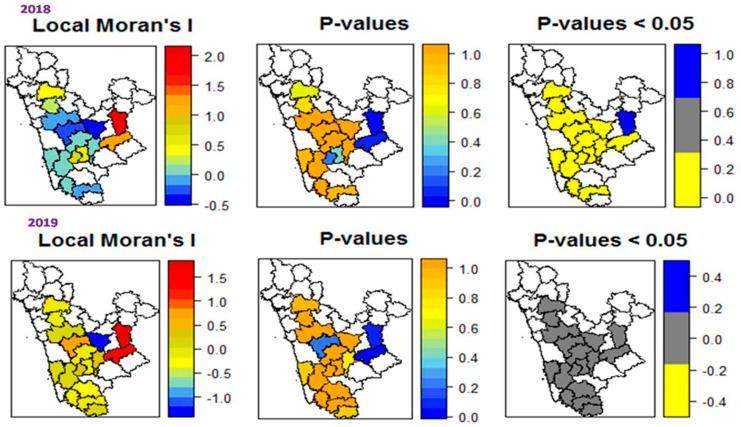
(McRae) is a hemibiotrophic oomycete fungus that infects tender nuts, growing buds, and crown regions, resulting in fruit, bud, and crown rot diseases in arecanut ( L.), respectively. Among them, fruit rot disease (FRD) causes serious economic losses that are borne by the growers, making it the greatest yield-limiting factor in arecanut crops. FRD has been known to occur in traditional growing areas since 1910, particularly in Malnad and coastal tracts of Karnataka. Systemic surveys were conducted on the disease several decades ago. The design of appropriate management approaches to curtail the impacts of the disease requires information on the spatial distribution of the risks posed by the disease. In this study, we used exploratory survey data to determine areas that are most at risk. Point pattern (spatial autocorrelation and Ripley's K function) analyses confirmed the existence of moderate clustering across sampling points and optimized hotspots of FRD were determined. Geospatial techniques such as inverse distance weighting (IDW), ordinary kriging (OK), and indicator kriging (IK) were performed to predict the percent severity rates at unsampled sites. IDW and OK generated identical maps, whereby the FRD severity rates were higher in areas adjacent to the Western Ghats and the seashore. Additionally, IK was used to identify both disease-prone and disease-free areas in Karnataka. After fitting the semivariograms with different models, the exponential model showed the best fit with the semivariogram. Using this model information, OK and IK maps were generated. The identified FRD risk areas in our study, which showed higher disease probability rates (>20%) exceeding the threshold level, need to be monitored with the utmost care to contain and reduce the further spread of the disease in Karnataka.
麦克雷氏菌是一种半活体营养型卵菌纲真菌,会感染嫩果、生长芽和树冠区域,分别导致槟榔果(槟榔属)出现果实、芽和树冠腐烂病。其中,果实腐烂病(FRD)造成严重的经济损失,由种植者承担,这使其成为槟榔作物产量的最大限制因素。自1910年以来,已知果实腐烂病在传统种植区发生,特别是在卡纳塔克邦的马尔纳德和沿海地区。几十年前对该病进行了系统调查。设计适当的管理方法以减少该病的影响需要有关该病所带来风险的空间分布信息。在本研究中,我们使用探索性调查数据来确定风险最高的区域。点模式(空间自相关和里普利K函数)分析证实了采样点之间存在适度聚类,并确定了果实腐烂病的优化热点区域。采用反距离加权法(IDW)、普通克里金法(OK)和指示克里金法(IK)等地理空间技术来预测未采样地点的病情严重率百分比。IDW和OK生成了相同的地图,据此,西高止山脉和海岸附近地区的果实腐烂病严重率较高。此外,IK被用于识别卡纳塔克邦的易发病区和无病区。用不同模型拟合半变异函数后,指数模型与半变异函数拟合效果最佳。利用该模型信息,生成了OK和IK地图。我们研究中确定的果实腐烂病风险区域,其疾病概率率较高(>20%)超过阈值水平,需要极其谨慎地进行监测,以控制和减少该病在卡纳塔克邦的进一步传播。




 Zotero 插件