
核小体的组装与拆卸受化学动力学原理支配。
Nucleosome Assembly and Disassembly Are Governed by Chemical Kinetic Principles.
作者信息
Zhao Hongyu, Guo Mingxin, Zhang Fenghui, Shao Xueqin, Liu Guoqing, Xing Yongqiang, Zhao Xiujuan, Luo Liaofu, Cai Lu
机构信息
School of Life Science and Technology, Inner Mongolia University of Science and Technology, Baotou, China.
Inner Mongolia Key Laboratory of Functional Genome Bioinformatics, Inner Mongolia University of Science and Technology, Baotou, China.
出版信息
Front Cell Dev Biol. 2021 Oct 7;9:762571. doi: 10.3389/fcell.2021.762571. eCollection 2021.
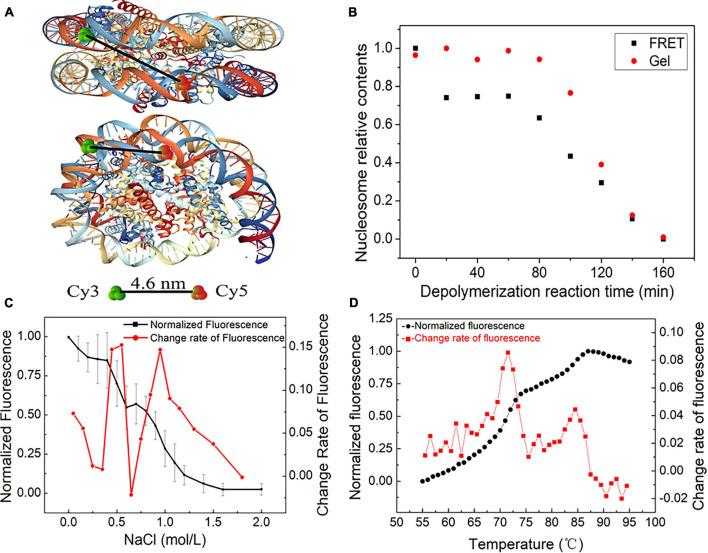
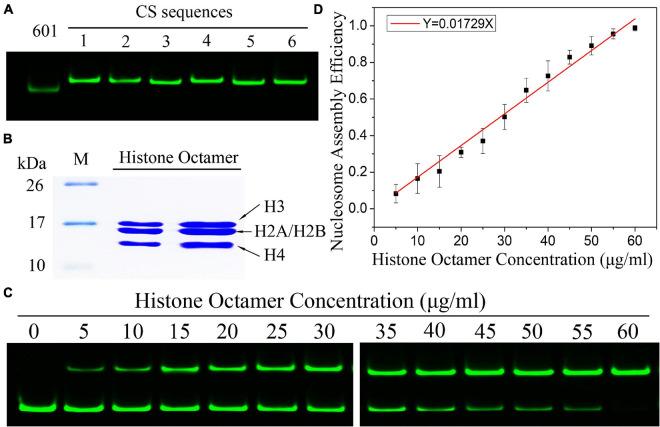
As the elementary unit of eukaryotic chromatin, nucleosomes are highly dynamic in many biological processes, such as DNA replication, repair, recombination, or transcription, to allow the necessary factors to gain access to their substrate. The dynamic mechanism of nucleosome assembly and disassembly has not been well described thus far. We proposed a chemical kinetic model of nucleosome assembly and disassembly . In the model, the efficiency of nucleosome assembly was positively correlated with the total concentration of histone octamer, reaction rate constant and reaction time. All the corollaries of the model were well verified for the Widom 601 sequence and the six artificially synthesized DNA sequences, named CS1-CS6, by using the salt dialysis method . The reaction rate constant in the model may be used as a new parameter to evaluate the nucleosome reconstitution ability with DNAs. Nucleosome disassembly experiments for the Widom 601 sequence detected by Förster resonance energy transfer (FRET) and fluorescence thermal shift (FTS) assays demonstrated that nucleosome disassembly is the inverse process of assembly and can be described as three distinct stages: opening phase of the (H2A-H2B) dimer/(H3-H4) tetramer interface, release phase of the H2A-H2B dimers from (H3-H4) tetramer/DNA and removal phase of the (H3-H4) tetramer from DNA. Our kinetic model of nucleosome assembly and disassembly allows to confirm that nucleosome assembly and disassembly are governed by chemical kinetic principles.
作为真核染色质的基本单位,核小体在许多生物学过程中高度动态变化,如DNA复制、修复、重组或转录,以允许必要的因子接近其底物。到目前为止,核小体组装和解聚的动态机制尚未得到很好的描述。我们提出了一个核小体组装和解聚的化学动力学模型。在该模型中,核小体组装效率与组蛋白八聚体的总浓度、反应速率常数和反应时间呈正相关。通过盐透析法,该模型的所有推论都在Widom 601序列和6条人工合成的名为CS1 - CS6的DNA序列中得到了很好的验证。模型中的反应速率常数可作为评估DNA核小体重组能力的一个新参数。通过Förster共振能量转移(FRET)和荧光热位移(FTS)测定法对Widom 601序列进行的核小体解聚实验表明,核小体解聚是组装的逆过程,可描述为三个不同阶段:(H2A - H2B)二聚体/(H3 - H4)四聚体界面的打开阶段、H2A - H2B二聚体从(H3 - H4)四聚体/DNA的释放阶段以及(H3 - H4)四聚体从DNA的去除阶段。我们的核小体组装和解聚动力学模型证实了核小体组装和解聚受化学动力学原理支配。


 Zotero 插件