
不对称的党派选民投票率博弈
Asymmetric Partisan Voter Turnout Games.
作者信息
Guage Cameron, Fu Feng
机构信息
Dartmouth College, Hanover, NH 03755 USA.
出版信息
Dyn Games Appl. 2021;11(4):738-758. doi: 10.1007/s13235-021-00384-1. Epub 2021 Apr 16.
UNLABELLED
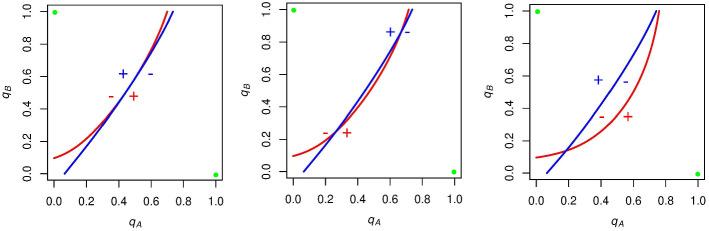
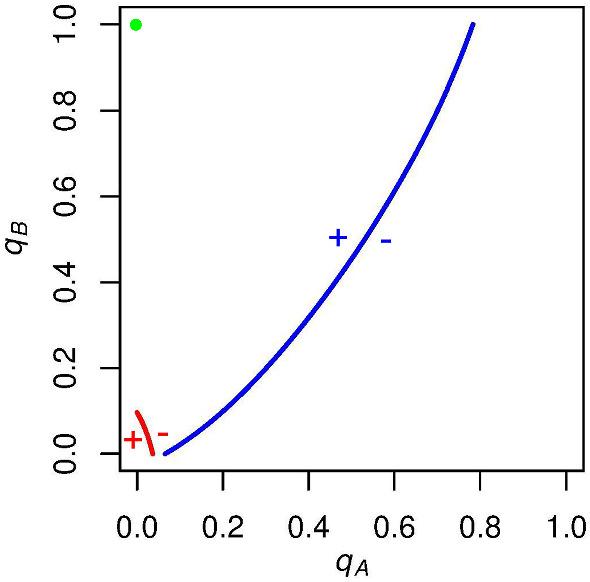
Since Downs proposed that the act of voting is irrational in 1957, myriad models have been proposed to explain voting and account for observed turnout patterns. We propose a model in which partisans consider both the instrumental and expressive benefits of their vote when deciding whether or not to abstain in an election, introducing an asymmetry that most other models do not consider. Allowing learning processes within our electorate, we analyze what evolutionarily stable strategies are rationalizable under various conditions. Upon varying electorate size, the partisan split of the electorate, and the degree to which an electorate takes underdog considerations into account in its payoff structure, we find that different equilibria arise. Our model predicts comparative statics that are consistent with voter behavior, specifically affirming a "size effect," in which turnout decreases as electorate size increases. Furthermore, relaxing some of our preliminary assumptions eliminates some of the discrepancies between the predictions of our model and empirical voter behavior. In particular, our work demonstrates that misperceptions about the partisan split of an electorate may account for high turnout behavior .
SUPPLEMENTARY INFORMATION
The online version supplementary material available at 10.1007/s13235-021-00384-1.
未标注
自唐斯在1957年提出投票行为是非理性的以来,人们提出了无数模型来解释投票行为并说明观察到的投票率模式。我们提出了一个模型,在该模型中,党派人士在决定是否在选举中弃权时会同时考虑投票的工具性利益和表达性利益,引入了大多数其他模型未考虑的不对称性。考虑到选民内部的学习过程,我们分析了在各种条件下哪些进化稳定策略是合理的。在改变选民规模、选民的党派分裂以及选民在其收益结构中考虑劣势因素的程度后,我们发现出现了不同的均衡。我们的模型预测的比较静态结果与选民行为一致,具体证实了一种“规模效应”,即随着选民规模的增加,投票率会下降。此外,放宽我们的一些初步假设消除了我们模型的预测与实证选民行为之间的一些差异。特别是,我们的研究表明,对选民党派分裂的误解可能解释了高投票率行为。
补充信息
在线版本的补充材料可在10.1007/s13235-021-00384-1获取。






 Zotero 插件