
健身追踪器信息与隐私管理:实证研究。
Fitness Tracker Information and Privacy Management: Empirical Study.
机构信息
Department of Information Systems, California State University, Long Beach, Long Beach, CA, United States.
出版信息
J Med Internet Res. 2021 Nov 16;23(11):e23059. doi: 10.2196/23059.
BACKGROUND
Fitness trackers allow users to collect, manage, track, and monitor fitness-related activities, such as distance walked, calorie intake, sleep quality, and heart rate. Fitness trackers have become increasingly popular in the past decade. One in five Americans use a device or an app to track their fitness-related activities. These devices generate massive and important data that could help physicians make better assessments of their patients' health if shared with health providers. This ultimately could lead to better health outcomes and perhaps even lower costs for patients. However, sharing personal fitness information with health care providers has drawbacks, mainly related to the risk of privacy loss and information misuse.
OBJECTIVE
This study investigates the influence of granting users granular privacy control on their willingness to share fitness information.
METHODS
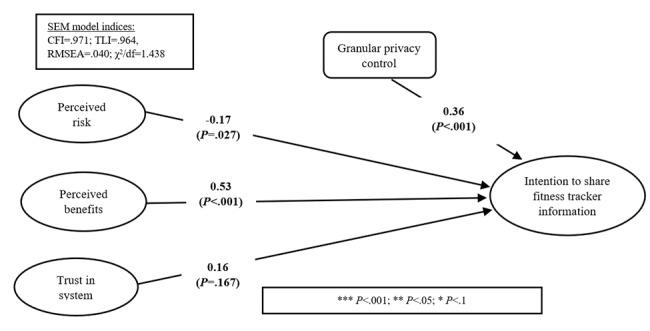
The study used 270 valid responses collected from Mtrurkers through Amazon Mechanical Turk (MTurk). Participants were randomly assigned to one of two groups. The conceptual model was tested using structural equation modeling (SEM). The dependent variable was the intention to share fitness information. The independent variables were perceived risk, perceived benefits, and trust in the system.
RESULTS
SEM explained about 60% of the variance in the dependent variable. Three of the four hypotheses were supported. Perceived risk and trust in the system had a significant relationship with the dependent variable, while trust in the system was not significant.
CONCLUSIONS
The findings show that people are willing to share their fitness information if they have granular privacy control. This study has practical and theoretical implications. It integrates communication privacy management (CPM) theory with the privacy calculus model.
背景
健身追踪器允许用户收集、管理、跟踪和监测与健身相关的活动,例如步行距离、卡路里摄入量、睡眠质量和心率。在过去的十年中,健身追踪器变得越来越流行。五分之一的美国人使用设备或应用程序来跟踪他们的健身相关活动。这些设备生成了大量重要的数据,如果与医疗保健提供者共享,医生可以更好地评估患者的健康状况。这最终可能会带来更好的健康结果,甚至可能降低患者的成本。然而,与医疗保健提供者共享个人健身信息有其缺点,主要与隐私泄露和信息滥用的风险有关。
目的
本研究调查了赋予用户细粒度隐私控制对他们分享健身信息意愿的影响。
方法
该研究通过亚马逊 Mechanical Turk(MTurk)从 Mtrurkers 收集了 270 份有效回复。参与者被随机分配到两个组之一。使用结构方程建模(SEM)测试概念模型。因变量是分享健身信息的意图。自变量是感知风险、感知收益和对系统的信任。
结果
SEM 解释了因变量约 60%的方差。四个假设中有三个得到了支持。感知风险和对系统的信任与因变量有显著关系,而对系统的信任则不显著。
结论
研究结果表明,如果人们拥有细粒度的隐私控制,他们愿意分享他们的健身信息。本研究具有实际和理论意义。它将沟通隐私管理(CPM)理论与隐私计算模型相结合。

 Zotero 插件