
Gasdermin D 缺乏可减轻创伤性损伤引起的关节炎,但不能减轻自身抗体组装的免疫复合物引起的关节炎。
Gasdermin D deficiency attenuates arthritis induced by traumatic injury but not autoantibody-assembled immune complexes.
机构信息
Xi'an Jiaotong University Health Science Center, Xi'an, Shaanxi, China.
Division of Bone and Mineral Diseases, Washington University School of Medicine, 660 South Euclid Avenue, Campus Box 8301, St. Louis, MO, 63110, USA.
出版信息
Arthritis Res Ther. 2021 Nov 16;23(1):286. doi: 10.1186/s13075-021-02668-8.
BACKGROUND
Gasdermin D (GSDMD) is cleaved by several proteases including by caspase-1, a component of intracellular protein complexes called inflammasomes. Caspase-1 also converts pro-interleukin-1β (pro-IL-1β) and pro-IL-18 into bioactive IL-1β and IL-18, respectively. GSDMD amino-terminal fragments form plasma membrane pores, which mediate the secretion of IL-1β and IL-18 and cause the inflammatory form of cell death pyroptosis. Here, we tested the hypothesis that GSDMD contributes to joint degeneration in the K/BxN serum transfer-induced arthritis (STIA) model in which autoantibodies against glucose-6-phosphate isomerase promote the formation of pathogenic immune complexes on the surface of myeloid cells, which highly express the inflammasomes. The unexpected outcomes with the STIA model prompted us to determine the role of GSDMD in the post-traumatic osteoarthritis (PTOA) model caused by meniscus ligamentous injury (MLI) based on the hypothesis that this pore-forming protein is activated by signals released from damaged joint tissues.
METHODS
Gsdmd and Gsdmd mice were injected with K/BxN mouse serum or subjected to MLI to cause STIA or PTOA, respectively. Paw and ankle swelling and DXA scanning were used to assess the outcomes in the STIA model whereas histopathology and micro-computed tomography (μCT) were utilized to monitor joints in the PTOA model. Murine and human joint tissues were also examined for GSDMD, IL-1β, and IL-18 expression by qPCR, immunohistochemistry, or immunoblotting.
RESULTS
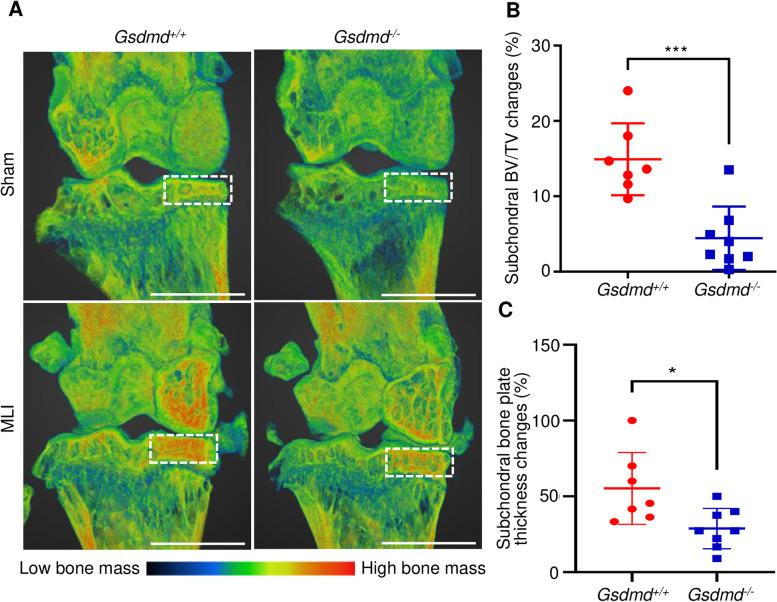
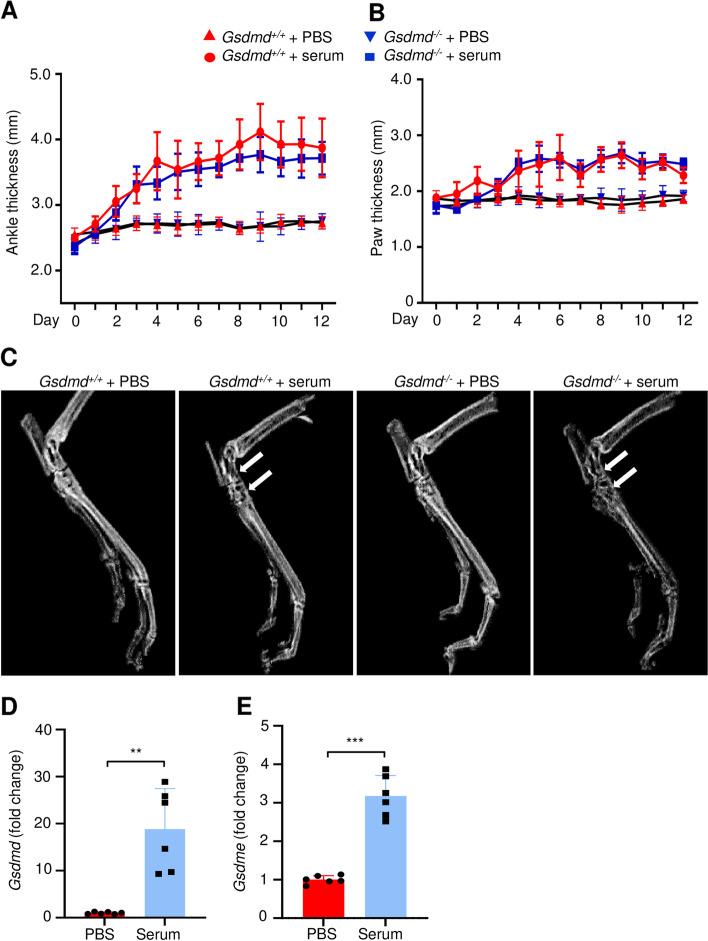
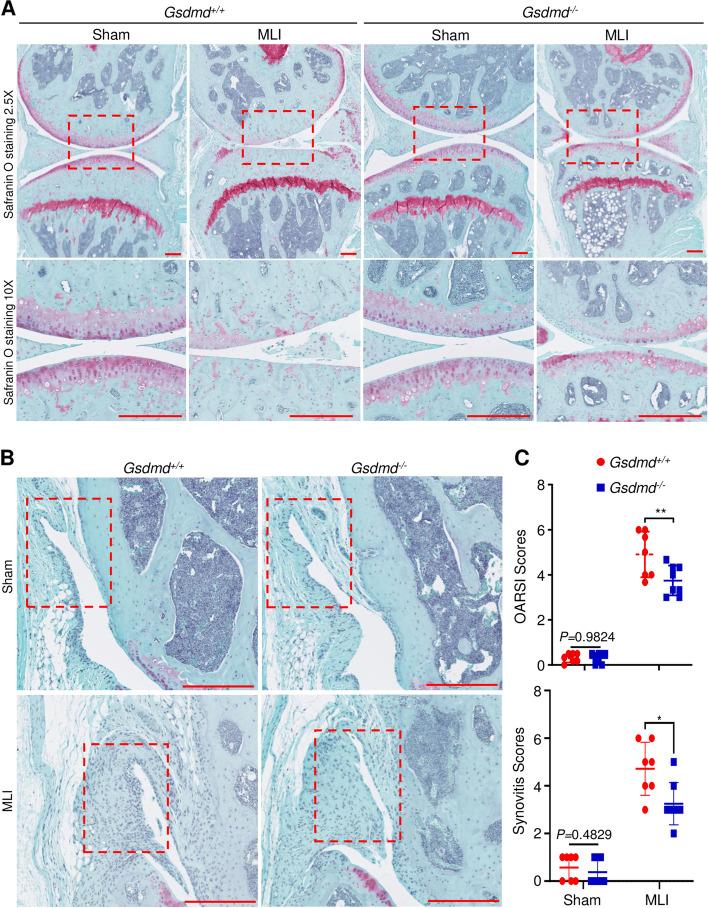
GSDMD levels were higher in serum-inoculated paws compared to PBS-injected paws. Unexpectedly, ablation of GSDMD failed to reduce joint swelling and osteolysis, suggesting that GSDMD was dispensable for the pathogenesis of STIA. GSDMD levels were also higher in MLI compared to sham-operated joints. Importantly, ablation of GSDMD attenuated MLI-associated cartilage degradation (p = 0.0097), synovitis (p = 0.014), subchondral bone sclerosis (p = 0.0006), and subchondral bone plate thickness (p = 0.0174) based on histopathological and μCT analyses.
CONCLUSION
GSDMD plays a key role in the pathogenesis of PTOA, but not STIA, suggesting that its actions in experimental arthropathy are tissue context-specific.
背景
Gasdermin D(GSDMD)可被包括半胱天冬酶-1(caspase-1)在内的多种蛋白酶切割,caspase-1 是细胞内蛋白复合物炎症小体的组成部分。半胱天冬酶-1 还分别将前白细胞介素-1β(pro-IL-1β)和前白细胞介素-18(pro-IL-18)转化为有生物活性的白细胞介素-1β(IL-1β)和白细胞介素-18(IL-18)。GSDMD 氨基末端片段形成质膜孔,介导 IL-1β 和 IL-18 的分泌,并导致炎症形式的细胞死亡细胞焦亡。在这里,我们检验了这样一种假说,即 GSDMD 有助于葡萄糖-6-磷酸异构酶自身抗体促进在髓样细胞表面形成致病性免疫复合物的 K/BxN 血清转移诱导关节炎(STIA)模型中的关节退化,这些复合物高度表达炎症小体。STIA 模型的意外结果促使我们基于这样一种假设来确定 GSDMD 在半月板韧带损伤(MLI)引起的创伤后骨关节炎(PTOA)模型中的作用,即这种形成孔的蛋白被受损关节组织释放的信号激活。
方法
Gsdmd 和 Gsdmd 小鼠分别用 K/BxN 鼠血清注射或进行 MLI,以分别诱导 STIA 或 PTOA。爪和踝关节肿胀和 DXA 扫描用于评估 STIA 模型的结果,而组织病理学和微计算机断层扫描(μCT)用于监测 PTOA 模型中的关节。通过 qPCR、免疫组织化学或免疫印迹法检测小鼠和人关节组织中 GSDMD、白细胞介素-1β 和白细胞介素-18 的表达。
结果
与 PBS 注射的爪子相比,血清接种的爪子中的 GSDMD 水平更高。出乎意料的是,GSDMD 缺失并没有减少关节肿胀和骨质溶解,这表明 GSDMD 对于 STIA 的发病机制是可有可无的。与假手术关节相比,MLI 后 GSDMD 水平也更高。重要的是,GSDMD 缺失减轻了与 MLI 相关的软骨降解(p = 0.0097)、滑膜炎(p = 0.014)、软骨下骨硬化(p = 0.0006)和软骨下骨板厚度(p = 0.0174),这些结果基于组织病理学和 μCT 分析。
结论
GSDMD 在 PTOA 的发病机制中起关键作用,但在 STIA 中不起作用,这表明其在实验性关节病中的作用是组织特异性的。


 Zotero 插件