
对肥胖症手术候选者的肝脂肪变性分级及非酒精性脂肪性肝炎检测中瞬时弹性成像、磁共振成像和血清评分的前瞻性比较
Prospective comparison of transient elastography, MRI and serum scores for grading steatosis and detecting non-alcoholic steatohepatitis in bariatric surgery candidates.
作者信息
Garteiser Philippe, Castera Laurent, Coupaye Muriel, Doblas Sabrina, Calabrese Daniela, Dioguardi Burgio Marco, Ledoux Séverine, Bedossa Pierre, Esposito-Farèse Marina, Msika Simon, Van Beers Bernard E, Jouët Pauline
机构信息
Centre de recherche sur l'Inflammation, Inserm U1149, Université de Paris, F-75018 Paris, France.
Service d'Hépatologie, Hôpital Beaujon, Assistance Publique-Hôpitaux de Paris, F-92110 Clichy, France.
出版信息
JHEP Rep. 2021 Sep 30;3(6):100381. doi: 10.1016/j.jhepr.2021.100381. eCollection 2021 Dec.
BACKGROUND & AIMS: Tools for the non-invasive diagnosis of non-alcoholic steatohepatitis (NASH) in morbidly obese patients with suspected non-alcoholic fatty liver disease (NAFLD) are an unmet clinical need. We prospectively compared the performance of transient elastography, MRI, and 3 serum scores for the diagnosis of NAFLD, grading of steatosis and detection of NASH in bariatric surgery candidates.
METHODS
Of 186 patients screened, 152 underwent liver biopsy, which was used as a reference for NAFLD (steatosis [S]>5%), steatosis grading and NASH diagnosis. Biopsies were read by a single expert pathologist. MRI-based proton density fat fraction (MRI-PDFF) was measured in an open-bore, vertical field 1.0T scanner and controlled attenuation parameter (CAP) was measured by transient elastography, using the XL probe. Serum scores (SteatoTest, hepatic steatosis index and fatty liver index) were also calculated.
RESULTS
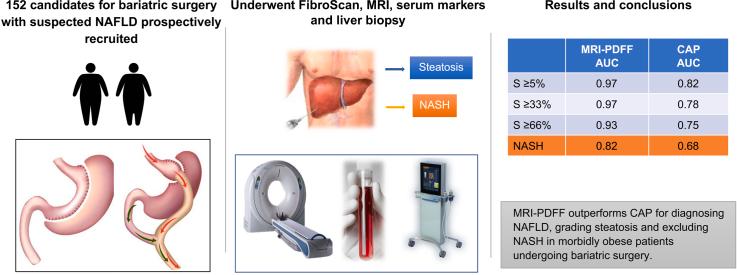
The applicability of MRI was better than that of FibroScan (98% 79%; <0.0001). CAP had AUROCs of 0.83, 0.79, 0.73 and 0.69 for S>5%, S>33%, S>66% and NASH, respectively. Transient elastography had an AUROC of 0.80 for significant fibrosis (F0-F1 F2-F3). MRI-PDFF had AUROCs of 0.97, 0.95, 0.92 and 0.84 for S>5%, S>33%, S>66% and NASH, respectively. When compared head-to-head in the 97 patients with all valid tests available, MRI-PDFF outperformed CAP for grading steatosis (S>33%, AUROC 0.97 0.78; 0.0003 and S>66%, AUROC 0.93 0.75; 0.0015) and diagnosing NASH (AUROC 0.82 0.68; 0.0056). When compared in "intention to diagnose" analysis, MRI-PDFF outperformed CAP, hepatic steatosis index and fatty liver index for grading steatosis (S>5%, S>33% and S>66%).
CONCLUSION
MRI-PDFF outperforms CAP for diagnosing NAFLD, grading steatosis and excluding NASH in morbidly obese patients undergoing bariatric surgery.
LAY SUMMARY
Non-invasive tests for detecting fatty liver and steatohepatitis, the active form of the disease, have not been well studied in obese patients who are candidates for bariatric surgery. The most popular tests for this purpose are Fibroscan, which can be used to measure the controlled attenuation parameter (CAP), and magnetic resonance imaging, which can be used to measure the proton density fat fraction (MRI-PDFF). We found that, when taking liver biopsy as a reference, MRI-PDFF performed better than CAP for detecting and grading fatty liver as well as excluding steatohepatitis in morbidly obese patients undergoing bariatric surgery.
背景与目的
对于疑似非酒精性脂肪性肝病(NAFLD)的病态肥胖患者,非侵入性诊断非酒精性脂肪性肝炎(NASH)的工具是一项尚未满足的临床需求。我们前瞻性地比较了瞬时弹性成像、MRI和3种血清评分在肥胖症手术候选者中诊断NAFLD、评估脂肪变性程度以及检测NASH的性能。
方法
在186例接受筛查的患者中,152例接受了肝活检,肝活检用作NAFLD(脂肪变性[S]>5%)、脂肪变性分级和NASH诊断的参考。活检由一名专业病理学家解读。在开放式垂直场1.0T扫描仪中测量基于MRI的质子密度脂肪分数(MRI-PDFF),并使用XL探头通过瞬时弹性成像测量受控衰减参数(CAP)。还计算了血清评分(SteatoTest、肝脂肪变性指数和脂肪肝指数)。
结果
MRI的适用性优于FibroScan(98%对79%;P<0.0001)。CAP对于S>5%、S>33%、S>66%和NASH的受试者工作特征曲线下面积(AUROC)分别为0.83、0.79、0.73和0.69。瞬时弹性成像对于显著纤维化(F0-F1对F2-F3)的AUROC为0.80。MRI-PDFF对于S>5%、S>33%、S>66%和NASH的AUROC分别为0.97、0.95、0.92和0.84。在所有有效检测均可用的97例患者中进行直接比较时,MRI-PDFF在评估脂肪变性(S>33%,AUROC 0.97对0.78;P=0.0003;S>66%,AUROC 0.93对0.75;P=0.0015)和诊断NASH(AUROC 0.82对0.68;P=0.0056)方面优于CAP。在“意向性诊断”分析中进行比较时,MRI-PDFF在评估脂肪变性(S>5%、S>33%和S>66%)方面优于CAP、肝脂肪变性指数和脂肪肝指数。
结论
在接受肥胖症手术的病态肥胖患者中,MRI-PDFF在诊断NAFLD,评估脂肪变性程度以及排除NASH方面优于CAP。
简要概述
对于肥胖症手术候选的肥胖患者,用于检测脂肪肝和脂肪性肝炎(该疾病的活跃形式)的非侵入性检查尚未得到充分研究。为此目的最常用的检查是Fibroscan,可用于测量受控衰减参数(CAP),以及磁共振成像,可用于测量质子密度脂肪分数(MRI-PDFF)。我们发现,以肝活检为参考时,在接受肥胖症手术的病态肥胖患者中,MRI-PDFF在检测和评估脂肪肝以及排除脂肪性肝炎方面比CAP表现更好。


 Zotero 插件