
基于酵母汉逊德巴利酵母和杀虫剂多杀菌素的引诱-杀灭制剂在田间和温室条件下防治葡萄果实蝇的应用。
Field and greenhouse application of an attract-and-kill formulation based on the yeast Hanseniaspora uvarum and the insecticide spinosad to control Drosophila suzukii in grapes.
机构信息
Entomology Group, Institute for Plant Health, Laimburg Research Centre, South Tyrol, Italy.
Institute of Plant Protection, Department of Crop Sciences, University of Natural Resources and Life Sciences, Vienna, Austria.
出版信息
Pest Manag Sci. 2022 Mar;78(3):1287-1295. doi: 10.1002/ps.6748. Epub 2021 Dec 15.
BACKGROUND
The invasive insect Drosophila suzukii (Matsumura) is an important pest of several red grape varieties. The yeast Hanseniaspora uvarum (Niehaus), which is associated with D. suzukii, strongly attracts flies and stimulates them to feed on yeast-laden food. In the present study, a formulation based on H. uvarum culture with spinosad insecticide was applied to the foliage of vineyards and control of D. suzukii was compared to applying spinosad to the whole plant. After successful H. uvarum and insecticide application in the vineyard, we tested additional H. uvarum-based formulations with spinosad in a greenhouse to determine their capacity to control D. suzukii.
RESULTS
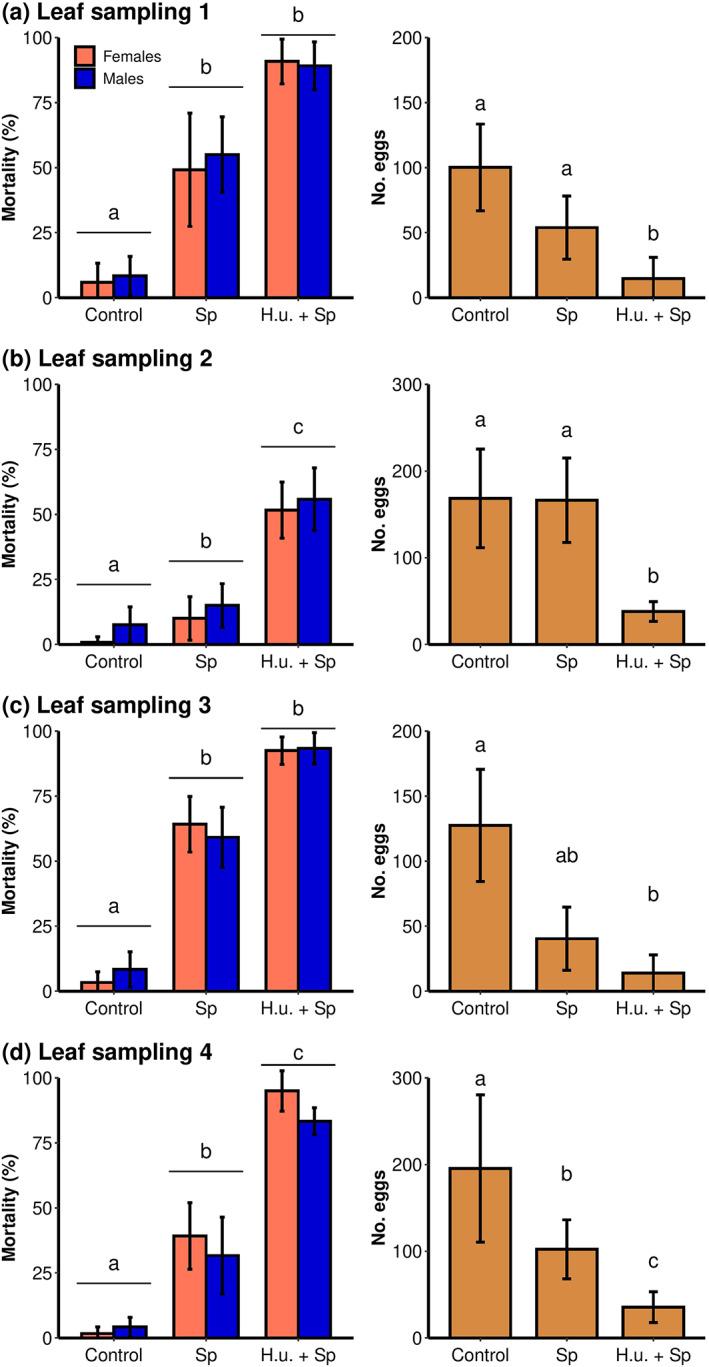
Application of the H. uvarum-spinosad formulation at 36.4 g of spinosad per hectare reduced the D. suzukii field infestation at the same rate as applying 120 g of spinosad per hectare and prevented spinosad residues on grapes. Leaves treated with H. uvarum and spinosad in the field and transferred to a laboratory assay caused high mortality to flies and reduced the number of eggs laid on fruits. Formulations with spinosad applied in the greenhouse showed that both H. uvarum culture and the yeast cell-free supernatant of a centrifuged culture increased fly mortality and reduced the number of eggs laid compared to the unsprayed control.
CONCLUSION
In comparison to typical spinosad spray applications, the use of H. uvarum in combination with spinosad as an attract-and-kill formulation against D. suzukii reduces pesticide residues on the fruits by targeting the treatment to the canopy and decreasing the amount of insecticide per hectare without compromising control efficacy.
背景
入侵昆虫铃木氏果蝇(Matsumura)是几种红葡萄品种的重要害虫。与 D. suzukii 相关的酵母汉逊德巴利酵母(Niehaus)强烈吸引苍蝇,并刺激它们以含有酵母的食物为食。在本研究中,将基于汉逊德巴利酵母培养物与多杀菌素杀虫剂的制剂施用于葡萄园的枝叶上,并将其与将多杀菌素施用于整个植物上的控制效果进行了比较。在葡萄园成功施用汉逊德巴利酵母和杀虫剂后,我们在温室中用含有多杀菌素的其他汉逊德巴利酵母制剂进行了测试,以确定它们控制 D. suzukii 的能力。
结果
以每公顷 36.4 克多杀菌素的剂量施用汉逊德巴利酵母-多杀菌素制剂,可将田间 D. suzukii 的侵染率降低到与每公顷施用 120 克多杀菌素相同的水平,并防止多杀菌素在葡萄上残留。在田间用汉逊德巴利酵母和多杀菌素处理的叶片并转移到实验室测定中,可导致苍蝇死亡率高,并减少在果实上产卵的数量。在温室中用多杀菌素施用的制剂表明,与未喷洒对照相比,汉逊德巴利酵母培养物和离心培养的酵母无细胞上清液均能提高苍蝇死亡率并减少产卵数量。
结论
与典型的多杀菌素喷雾应用相比,汉逊德巴利酵母与多杀菌素联合使用作为一种针对 D. suzukii 的诱捕-杀灭制剂,通过将处理目标对准树冠并减少每公顷的杀虫剂用量,从而减少了水果上的农药残留,而不会影响控制效果。


 Zotero 插件