
用于航空结构应用的添加陶瓷纳米颗粒的混杂纤维增强聚合物的合成与表征
Synthesis and Characterization of Hybrid Fiber-Reinforced Polymer by Adding Ceramic Nanoparticles for Aeronautical Structural Applications.
作者信息
Bafakeeh Omar Talal, Shewakh Walid Mahmoud, Abu-Oqail Ahmed, Abd-Elaziem Walaa, Abdel Ghafaar Metwally, Abu-Okail Mohamed
机构信息
Industrial Engineering Department, Faculty of Engineering, Jazan University, Jazan P.O. Box 114, Saudi Arabia.
Mechanical Production Department, Faculty of Technology Education, Beni-Suef University, Beni-Suef P.O. Box 62521, Egypt.
出版信息
Polymers (Basel). 2021 Nov 26;13(23):4116. doi: 10.3390/polym13234116.
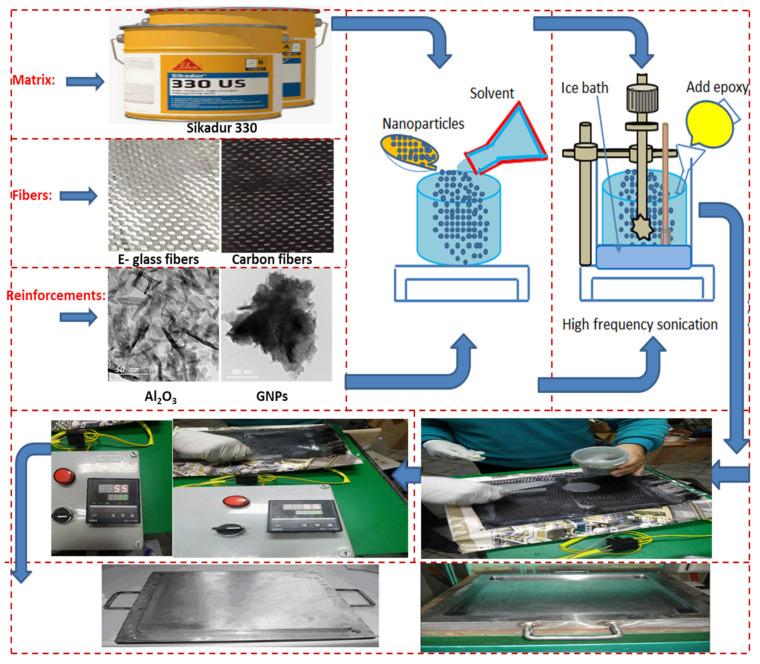
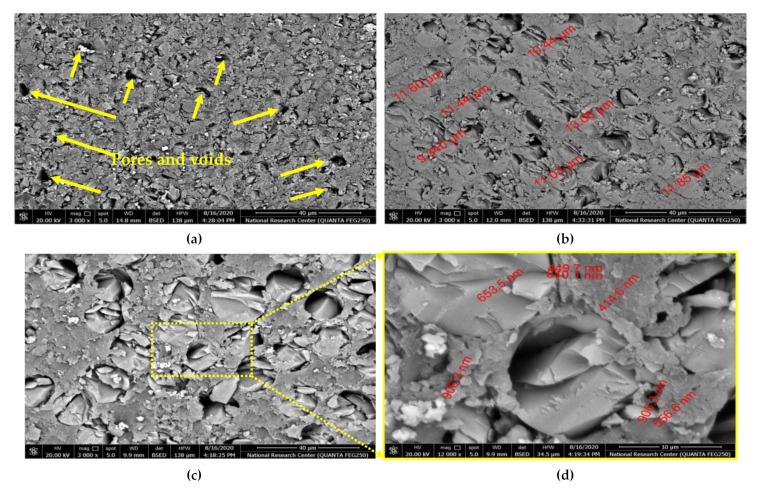
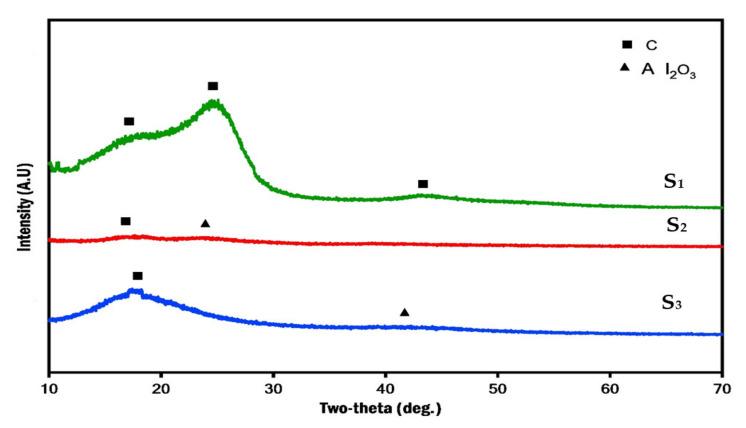
The multiscale hybridization of ceramic nanoparticles incorporated into polymer matrices reinforced with hybrid fibers offers a new opportunity to develop high-performance, multifunctional composites, especially for applications in aeronautical structures. In this study, two different kinds of hybrid fibers were selected, woven carbon and glass fiber, while two different ceramic nanoparticles, alumina (AlO) and graphene nanoplatelets (GNPs), were chosen to incorporate into a polymer matrix (epoxy resin). To obtain good dispersion of additive nanoparticles within the resin matrix, the ultrasonication technique was implemented. The microstructure, XRD patterns, hardness, and tensile properties of the fabricated composites were investigated here. Microstructural characterization demonstrated a good dispersion of ceramic nanoparticles of AlO and GNPs in the fabricated composites. The addition of GNPs/AlO nanoparticles as additive reinforcements to the fiber-reinforced polymers (FRPs) induced a significant increase in the hardness and tensile strength. Generally, the FRPs with 3 wt.% nano-AlO enhanced composites exhibit higher tensile strength as compared with all other sets of composites. Particularly, the tensile strength was improved from 133 MPa in the unreinforced specimen to 230 MPa in the reinforced specimen with 3 wt.% AlO. This can be attributed to the better distribution of nanoparticles in the resin polymer, which, in turn, induces proper stress transfer from the matrix to the fiber phase. The hybrid mode mechanism depends on the interaction among the mechanical properties of fiber, the physical and chemical evolution of resin, the bonding properties of the fiber/resin interface, and the service environment. Therefore, the hybrid mode of woven carbon and glass fibers at a volume fraction of 64% with additive nanoparticles of GNPs/AlO within the resin was appropriate to produce aeronautical structures with extraordinary properties.
将陶瓷纳米颗粒与混杂纤维增强的聚合物基体进行多尺度杂交,为开发高性能、多功能复合材料提供了新机遇,尤其适用于航空结构应用。在本研究中,选择了两种不同的混杂纤维,即编织碳纤维和玻璃纤维,同时选择了两种不同的陶瓷纳米颗粒,氧化铝(AlO)和石墨烯纳米片(GNPs),将其掺入聚合物基体(环氧树脂)中。为了使添加剂纳米颗粒在树脂基体中良好分散,采用了超声技术。在此研究了所制备复合材料的微观结构、XRD图谱、硬度和拉伸性能。微观结构表征表明,AlO和GNPs陶瓷纳米颗粒在所制备的复合材料中分散良好。将GNPs/AlO纳米颗粒作为添加剂增强剂添加到纤维增强聚合物(FRP)中,显著提高了硬度和拉伸强度。一般来说,与所有其他复合材料相比,含有3 wt.%纳米AlO的FRP增强复合材料具有更高的拉伸强度。特别是,拉伸强度从未增强试样的133 MPa提高到含3 wt.% AlO的增强试样的230 MPa。这可归因于纳米颗粒在树脂聚合物中的更好分布,进而导致从基体到纤维相的适当应力传递。混杂模式机制取决于纤维力学性能、树脂的物理和化学演变、纤维/树脂界面的粘结性能以及服役环境之间的相互作用。因此,体积分数为64%的编织碳纤维和玻璃纤维与树脂中GNPs/AlO添加剂纳米颗粒的混杂模式适合生产具有非凡性能的航空结构。







 Zotero 插件