
基于机器学习的植物检测算法,利用 3D 树冠扫描实现自动计数任务。
Machine Learning-Based Plant Detection Algorithms to Automate Counting Tasks Using 3D Canopy Scans.
机构信息
Department of Computer Engineering, Faculty of Engineering, Cukurova University, Adana 01330, Turkey.
System Analysis for Climate Smart Agriculture (SACSA), ISD, International Crops Research Institute for the Semi-Arid Tropics, Patancheru 5023204, Telangana, India.
出版信息
Sensors (Basel). 2021 Dec 1;21(23):8022. doi: 10.3390/s21238022.
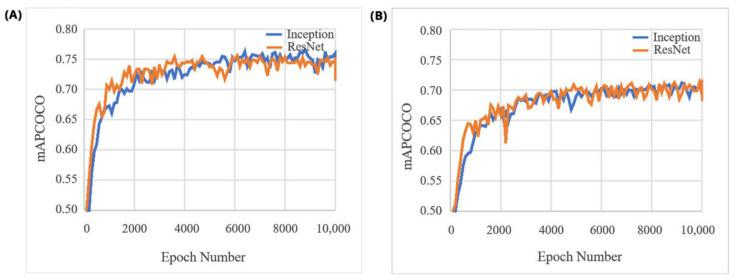
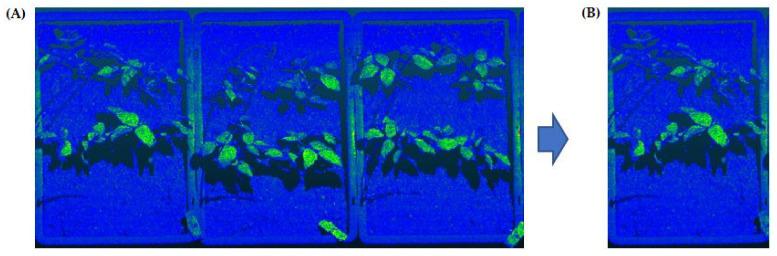
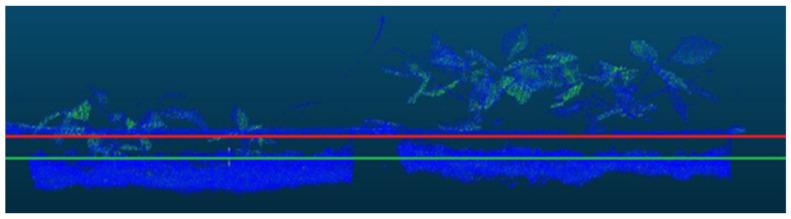
This study tested whether machine learning (ML) methods can effectively separate individual plants from complex 3D canopy laser scans as a prerequisite to analyzing particular plant features. For this, we scanned mung bean and chickpea crops with PlantEye (R) laser scanners. Firstly, we segmented the crop canopies from the background in 3D space using the Region Growing Segmentation algorithm. Then, Convolutional Neural Network (CNN) based ML algorithms were fine-tuned for plant counting. Application of the CNN-based (Convolutional Neural Network) processing architecture was possible only after we reduced the dimensionality of the data to 2D. This allowed for the identification of individual plants and their counting with an accuracy of 93.18% and 92.87% for mung bean and chickpea plants, respectively. These steps were connected to the phenotyping pipeline, which can now replace manual counting operations that are inefficient, costly, and error-prone. The use of CNN in this study was innovatively solved with dimensionality reduction, addition of height information as color, and consequent application of a 2D CNN-based approach. We found there to be a wide gap in the use of ML on 3D information. This gap will have to be addressed, especially for more complex plant feature extractions, which we intend to implement through further research.
本研究旨在测试机器学习 (ML) 方法是否能够有效地从复杂的三维冠层激光扫描中分离出单个植物,这是分析特定植物特征的前提。为此,我们使用 PlantEye(R)激光扫描仪扫描了绿豆和鹰嘴豆作物。首先,我们使用区域生长分割算法在三维空间中从背景中分割出作物冠层。然后,对基于卷积神经网络(CNN)的 ML 算法进行微调以进行植物计数。仅在我们将数据的维度降低到 2D 后,才可以应用基于 CNN 的(卷积神经网络)处理架构。这使得能够识别单个植物并对其进行计数,绿豆和鹰嘴豆植物的准确率分别达到 93.18%和 92.87%。这些步骤与表型分析管道相连,现在可以替代效率低下、成本高且容易出错的手动计数操作。本研究中创新性地使用了降维和添加高度信息作为颜色的方法,并应用了基于二维 CNN 的方法来解决 CNN 的使用问题。我们发现,在三维信息上使用 ML 还存在很大的差距。这一差距将不得不得到解决,特别是对于更复杂的植物特征提取,我们打算通过进一步的研究来实现。




 Zotero 插件