
使用全自动深度学习方法从胃癌组织病理学图像预测基因改变。
Prediction of genetic alterations from gastric cancer histopathology images using a fully automated deep learning approach.
机构信息
Catholic Big Data Integration Center, Department of Physiology, College of Medicine, The Catholic University of Korea, Seoul 06591, South Korea.
Department of Hospital Pathology, Seoul St. Mary's Hospital, College of Medicine, The Catholic University of Korea, Seoul 06591, South Korea.
出版信息
World J Gastroenterol. 2021 Nov 28;27(44):7687-7704. doi: 10.3748/wjg.v27.i44.7687.
BACKGROUND
Studies correlating specific genetic mutations and treatment response are ongoing to establish an effective treatment strategy for gastric cancer (GC). To facilitate this research, a cost- and time-effective method to analyze the mutational status is necessary. Deep learning (DL) has been successfully applied to analyze hematoxylin and eosin (H and E)-stained tissue slide images.
AIM
To test the feasibility of DL-based classifiers for the frequently occurring mutations from the H and E-stained GC tissue whole slide images (WSIs).
METHODS
From the GC dataset of The Cancer Genome Atlas (TCGA-STAD), wild-type/mutation classifiers for CDH1, ERBB2, KRAS, PIK3CA, and TP53 genes were trained on 360 × 360-pixel patches of tissue images.
RESULTS
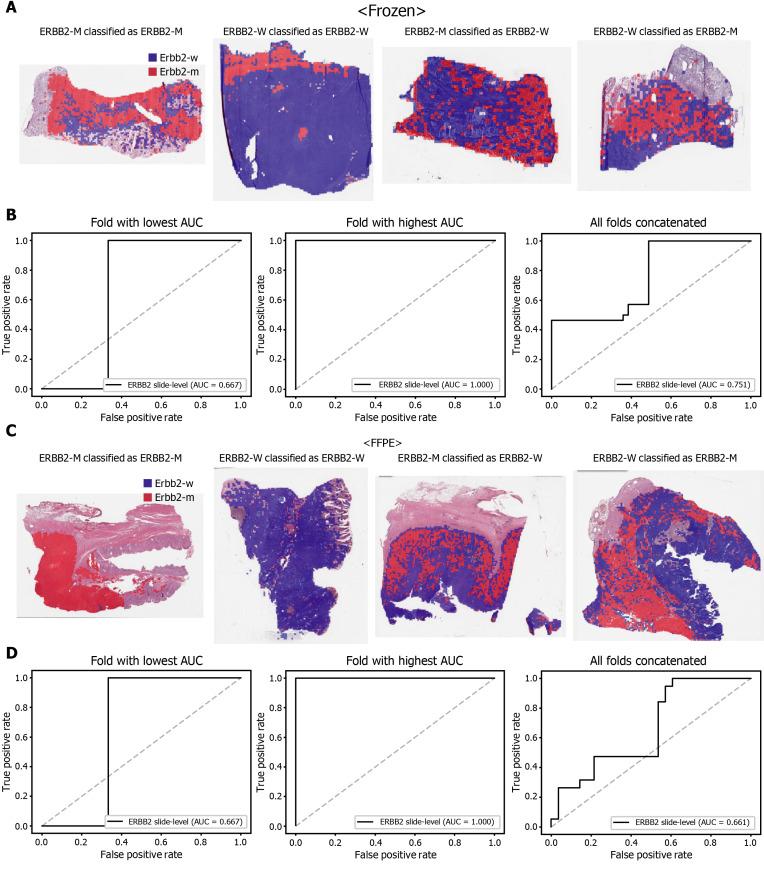
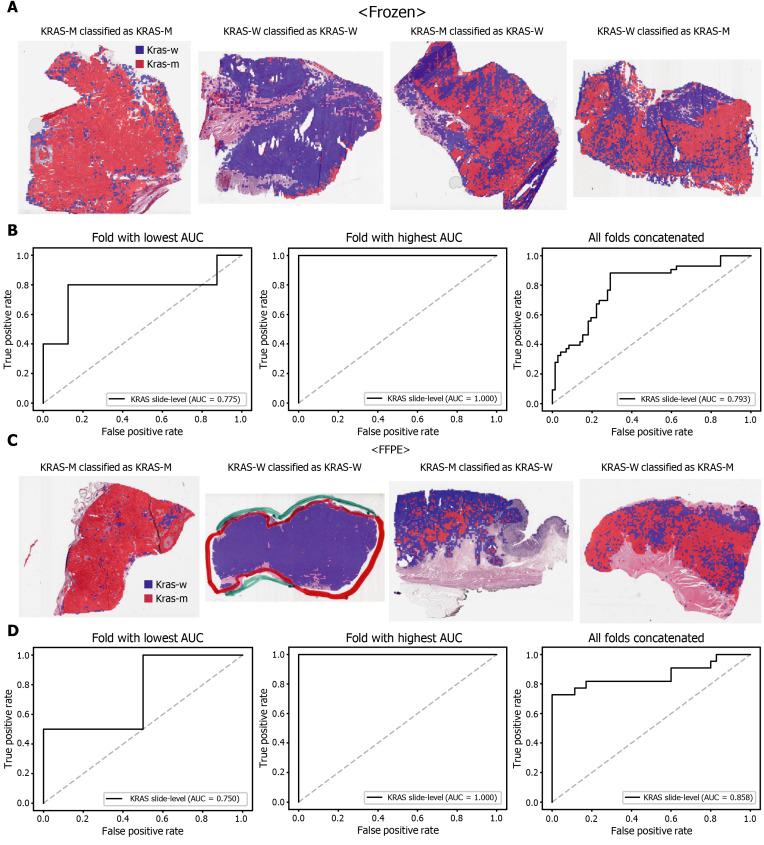
The area under the curve (AUC) for the receiver operating characteristic (ROC) curves ranged from 0.727 to 0.862 for the TCGA frozen WSIs and 0.661 to 0.858 for the TCGA formalin-fixed paraffin-embedded (FFPE) WSIs. The performance of the classifier can be improved by adding new FFPE WSI training dataset from our institute. The classifiers trained for mutation prediction in colorectal cancer completely failed to predict the mutational status in GC, indicating that DL-based mutation classifiers are incompatible between different cancers.
CONCLUSION
This study concluded that DL could predict genetic mutations in H and E-stained tissue slides when they are trained with appropriate tissue data.
背景
目前正在进行将特定基因突变与治疗反应相关联的研究,以建立有效的胃癌(GC)治疗策略。为了促进这项研究,有必要开发一种具有成本效益和时间效益的方法来分析突变状态。深度学习(DL)已成功应用于分析苏木精和伊红(H&E)染色的组织切片图像。
目的
测试基于 DL 的分类器在 H&E 染色的 GC 组织全切片图像(WSI)中常见突变的可行性。
方法
从 TCGA-STAD 的 GC 数据集,针对 CDH1、ERBB2、KRAS、PIK3CA 和 TP53 基因,在 360×360 像素的组织图像块上训练野生型/突变分类器。
结果
TCGA 冷冻 WSI 的接收器操作特征(ROC)曲线的 AUC 范围为 0.727 至 0.862,TCGA 福尔马林固定石蜡包埋(FFPE)WSI 的 AUC 范围为 0.661 至 0.858。通过添加来自我们研究所的新 FFPE WSI 训练数据集,可以提高分类器的性能。针对结直肠癌突变预测而训练的分类器完全无法预测 GC 中的突变状态,这表明基于 DL 的突变分类器在不同癌症之间不兼容。
结论
本研究得出结论,当使用适当的组织数据进行训练时,DL 可以预测 H&E 染色组织切片中的遗传突变。




 Zotero 插件