
智力障碍者多感官注意线索的自上而下、自下而上和由历史驱动的处理:虚拟现实中的实验研究。
Top-down, bottom-up, and history-driven processing of multisensory attentional cues in intellectual disability: An experimental study in virtual reality.
机构信息
Graduate School of Culture Technology, Korea Advanced Institute of Science and Technology, Daejeon, South Korea.
Electronics and Telecommunications Research Institute, Daejeon, South Korea.
出版信息
PLoS One. 2021 Dec 21;16(12):e0261298. doi: 10.1371/journal.pone.0261298. eCollection 2021.
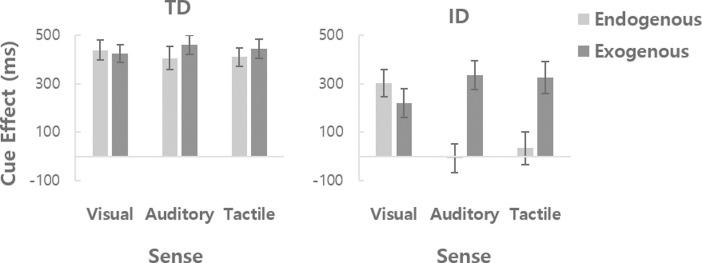
Models of attention demonstrated the existence of top-down, bottom-up, and history-driven attentional mechanisms, controlled by partially segregated networks of brain areas. However, few studies have examined the specific deficits in those attentional mechanisms in intellectual disability within the same experimental setting. The aim of the current study was to specify the attentional deficits in intellectual disability in top-down, bottom-up, and history-driven processing of multisensory stimuli, and gain insight into effective attentional cues that could be utilized in cognitive training programs for intellectual disability. The performance of adults with mild to moderate intellectual disability (n = 20) was compared with that of typically developing controls (n = 20) in a virtual reality visual search task. The type of a spatial cue that could aid search performance was manipulated to be either endogenous or exogenous in different sensory modalities (visual, auditory, tactile). The results identified that attentional deficits in intellectual disability are overall more pronounced in top-down rather than in bottom-up processing, but with different magnitudes across cue types: The auditory or tactile endogenous cues were much less effective than the visual endogenous cue in the intellectual disability group. Moreover, the history-driven processing in intellectual disability was altered, such that a reversed priming effect was observed for immediate repetitions of the same cue type. These results suggest that the impact of intellectual disability on attentional processing is specific to attentional mechanisms and cue types, which has theoretical as well as practical implications for developing effective cognitive training programs for the target population.
注意模型表明,存在自上而下、自下而上和由历史驱动的注意机制,这些机制由大脑区域的部分分离网络控制。然而,很少有研究在相同的实验环境中检查智力障碍中这些注意机制的特定缺陷。本研究旨在明确智力障碍在多感官刺激的自上而下、自下而上和由历史驱动的处理中的注意缺陷,并深入了解可用于智力障碍认知训练计划的有效注意线索。在虚拟现实视觉搜索任务中,比较了轻度至中度智力障碍成年人(n=20)和正常发育对照组(n=20)的表现。可以帮助搜索表现的空间线索的类型被操纵为不同感觉模态(视觉、听觉、触觉)中的内源性或外源性。结果表明,智力障碍中的注意缺陷总体上在自上而下的处理中比在自下而上的处理中更为明显,但在不同的线索类型之间有不同的程度:听觉或触觉内源性线索在智力障碍组中比视觉内源性线索的效果要差得多。此外,智力障碍中的由历史驱动的处理发生了改变,因此观察到相同线索类型的即时重复出现了反向启动效应。这些结果表明,智力障碍对注意处理的影响是特定于注意机制和线索类型的,这对为目标人群开发有效的认知训练计划具有理论和实践意义。



 Zotero 插件