
在双质粒系统中提高 sp. FA1 木聚糖酶的产量。
Improved Production of sp. FA1 Xylanase in a Dual-Plasmid System.
机构信息
State Key Laboratory of Food Science and Technology, Jiangnan University, Wuxi 214122, China.
Key Laboratory of Industrial Biotechnology, School of Biotechnology, Ministry of Education, Jiangnan University, Wuxi 214122, China.
出版信息
Curr Issues Mol Biol. 2021 Dec 18;43(3):2289-2304. doi: 10.3390/cimb43030161.
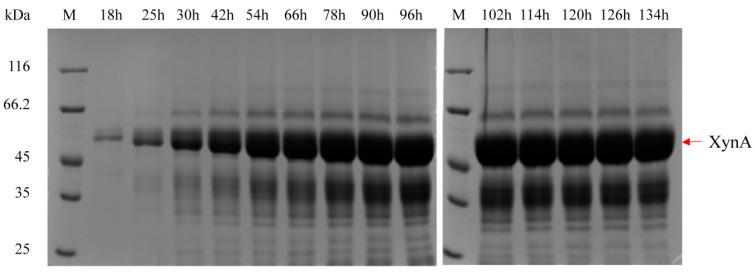
Methanol is considered as a potential hazard in the methanol-induced yeast expression of food-related enzymes. To increase the production efficiency of recombinant proteins in without methanol induction, a novel dual-plasmid system was constructed, for the first time, by a combining the strategies of genomic integration and episomal expression. To obtain a high copy number of the target gene, the autonomously replicating sequence derived from (PARS) was used to construct episomal vectors carrying the constitutive promoters P and P. In addition, an integrative vector carrying the P promoter was constructed by replacing the P promoter sequence with a partial P promoter. Next, using xylanase XynA from sp. FA1 as the model enzyme, recombination strains were transformed with different combinations of integrating and episomal vectors that were constructed to investigate the changes in the protein yield. Results in shake flasks indicated that the highest enzyme yield was achieved when integrated P and episomal P were simultaneously transformed into the host strain. Meanwhile, the copy number of increased from 1.14 ± 0.46 to 3.06 ± 0.35. The yield of XynA was successfully increased to 3925 U·mL after 102 h of fermentation in a 3.6 L fermenter, which was 16.7-fold and 2.86-fold of the yields that were previously reported for the constitutive expression and methanol-induced expression of the identical protein, respectively. Furthermore, the high-cell-density fermentation period was shortened from 132 h to 102 h compared to that of methanol-induced system. Since the risk of methanol toxicity is removed, this novel expression system would be suitable for the production of proteins related to the food and pharmaceutical industries.
甲醇被认为是甲醇诱导的食品相关酶酵母表达中的潜在危害。为了提高重组蛋白在没有甲醇诱导时的生产效率,首次构建了一种新型双质粒系统,该系统结合了基因组整合和附加体表达的策略。为了获得目的基因的高拷贝数,使用源自 的自主复制序列(PARS)构建了携带组成型启动子 P 和 P 的附加体载体。此外,通过用部分 P 启动子序列替换 P 启动子序列,构建了携带 P 启动子的整合载体。接下来,使用来自 的木聚糖酶 XynA 作为模型酶,用不同组合的整合和附加体载体转化重组菌株,以研究蛋白产量的变化。摇瓶结果表明,当同时将整合的 P 和附加体的 P 转化到宿主菌株中时,酶产量最高。同时, 的拷贝数从 1.14 ± 0.46 增加到 3.06 ± 0.35。在 3.6 L 发酵罐中发酵 102 h 后,XynA 的产量成功提高到 3925 U·mL,分别是相同蛋白组成型表达和甲醇诱导表达的产量的 16.7 倍和 2.86 倍。此外,与甲醇诱导系统相比,高细胞密度发酵期从 132 h 缩短到 102 h。由于消除了甲醇毒性的风险,这种新型表达系统将适用于生产与食品和制药行业相关的蛋白质。


 Zotero 插件