
果提取物对碘酸钠诱导的大鼠视网膜损伤的保护作用。
Protection of Fruit Extract from Sodium-Iodate-Induced Damages in Rat Retina.
机构信息
Guangdong Provincial Key Lab of Biotechnology for Plant Development, School of Life Sciences, South China Normal University, Guangzhou 510631, China.
Key Laboratory of Microbial Physiological and Metabolic Engineering, Institute of Microbiology, Chinese Academy of Sciences, Beijing 100101, China.
出版信息
Nutrients. 2021 Dec 9;13(12):4411. doi: 10.3390/nu13124411.
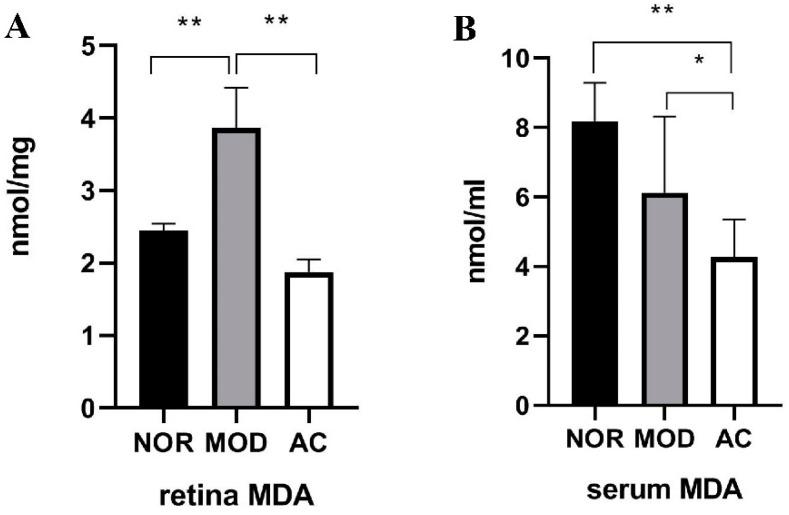
Age-related macular degeneration (AMD) is one of the major causes of blindness in elderly populations. However, the dry form of AMD has lack of effective treatments. The fruits of are rich in anthocyanins. In this study, the protective effects of aronia fruit extract on rat retina were investigated using a NaIO-induced dry AMD model. Full-field electroretinograms (ERGs) showed that b-wave amplitudes were significantly decreased and the retina structures were disordered in the model. The extract treatment alleviated the injuries. The b-wave amplitudes increased 61.5% in Scotopic 0.01ERG, 122.0% in Photopic 3.0ERG, and 106.8% in Photopic 3.0 flicker; the retina structure disorder was improved with the thickness of outer nuclear layer increasing by 44.1%; and the malonaldehyde level was significantly reduced in extract-treated rat retinas compared to the model. The proteomics analysis showed the expressions of five crystallin proteins, α-crystallin A chain, β-crystallin B2, β-crystallin A3, α-crystallin B chain, and γ-crystallin S, which protect retina ganglion cells, were increased by 7.38-, 7.74-, 15.30-, 4.86-, and 9.14-fold, respectively, in the extract treatment compared to the control, which was also confirmed by immunoblotting. The results suggest that aronia fruit extract, probably due to its anthocyanins, could protect the rat retina by alleviating oxidative damages and by upregulating the crystallin proteins to protect its nerve system.
年龄相关性黄斑变性(AMD)是老年人失明的主要原因之一。然而,AMD 的干性形式缺乏有效的治疗方法。 的果实富含花青素。在这项研究中,使用 NaIO 诱导的干性 AMD 模型研究了黑果腺肋花楸提取物对大鼠视网膜的保护作用。全视野视网膜电图(ERG)显示,模型中 b 波幅度显著降低,视网膜结构紊乱。提取物处理缓解了损伤。在暗视 0.01ERG 中,b 波幅度增加了 61.5%;在明视 3.0ERG 中,b 波幅度增加了 122.0%;在明视 3.0 闪烁中,b 波幅度增加了 106.8%;外核层厚度增加了 44.1%;与模型相比,提取物处理的大鼠视网膜中丙二醛水平显著降低。蛋白质组学分析显示,五种晶状蛋白的表达增加,分别为α-晶体蛋白 A 链、β-晶体蛋白 B2、β-晶体蛋白 A3、α-晶体蛋白 B 链和γ-晶体蛋白 S,它们保护视网膜神经节细胞,在提取物处理中分别增加了 7.38 倍、7.74 倍、15.30 倍、4.86 倍和 9.14 倍,免疫印迹也证实了这一点。结果表明,黑果腺肋花楸提取物可能由于其花青素,通过缓解氧化损伤和上调晶体蛋白来保护大鼠视网膜及其神经系统。


 Zotero 插件