
通过数学建模探讨新冠疫情的未来影响。
Future implications of COVID-19 through Mathematical modeling.
作者信息
Zamir Muhammad, Nadeem Fawad, Alqudah Manar A, Abdeljawad Thabet
机构信息
Department of Mathematics, University of Science and Technology, Bannu, Khyber Pakhtunkhwa, Pakistan.
Department Mathematical Sciences, Faculty of Sciences, Princess Nourah Bint, Abdulrahman University, P.O. Box 84428, Riyadh 11671, Saudi Arabia.
出版信息
Results Phys. 2022 Feb;33:105097. doi: 10.1016/j.rinp.2021.105097. Epub 2021 Dec 25.
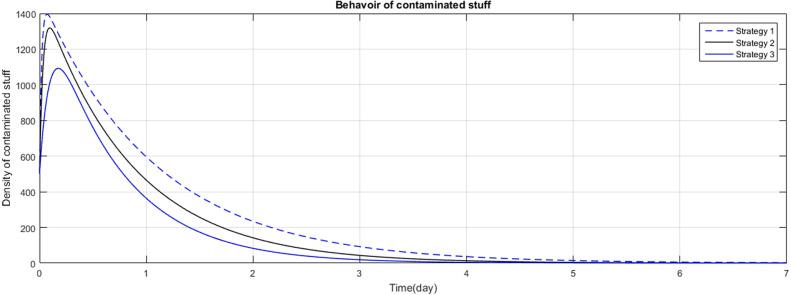
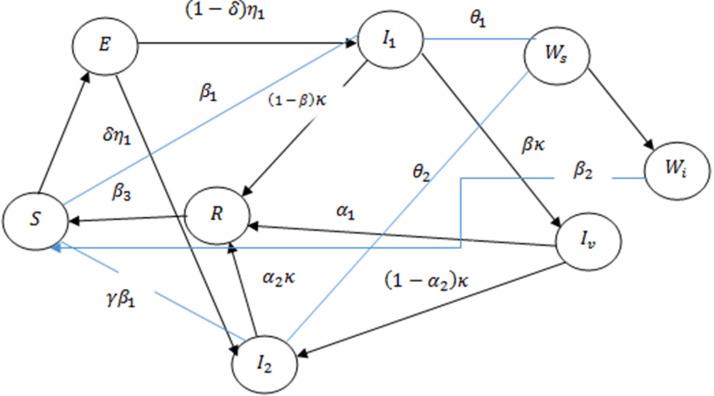
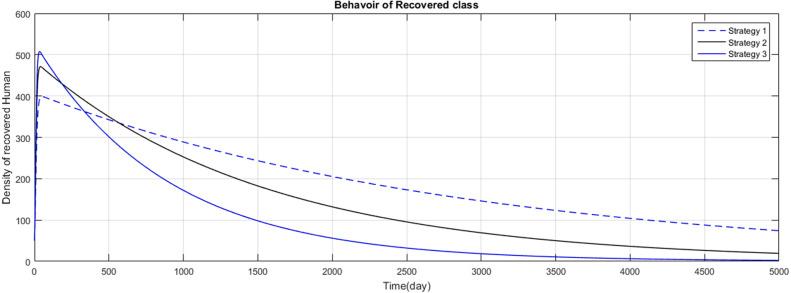
COVID-19 is a pandemic respiratory illness. The disease spreads from human to human and is caused by a novel coronavirus SARS-CoV-2. In this study, we formulate a mathematical model of COVID-19 and discuss the disease free state and endemic equilibrium of the model. Based on the sensitivity indexes of the parameters, control strategies are designed. The strategies reduce the densities of the infected classes but do not satisfy the criteria/threshold condition of the global stability of disease free equilibrium. On the other hand, the endemic equilibrium of the disease is globally asymptotically stable. Therefore it is concluded that the disease cannot be eradicated with present resources and the human population needs to learn how to live with corona. For validation of the results, numerical simulations are obtained using fourth order Runge-Kutta method.
新冠病毒病(COVID-19)是一种大流行性呼吸道疾病。该疾病通过人际传播,由一种新型冠状病毒严重急性呼吸综合征冠状病毒2(SARS-CoV-2)引起。在本研究中,我们构建了一个新冠病毒病(COVID-19)的数学模型,并讨论了该模型的无病状态和地方病平衡点。基于参数的敏感性指标,设计了控制策略。这些策略降低了感染类别的密度,但不满足无病平衡点全局稳定性的标准/阈值条件。另一方面,该疾病的地方病平衡点是全局渐近稳定的。因此得出结论,用目前的资源无法根除该疾病,人类需要学会如何与新冠病毒共存。为了验证结果,使用四阶龙格 - 库塔方法进行了数值模拟。


 Zotero 插件