
不同类型的媒体对幸福感没有影响。
No effect of different types of media on well-being.
机构信息
Oxford Internet Institute, University of Oxford, Oxford, UK.
University of Vienna, Vienna, Austria.
出版信息
Sci Rep. 2022 Jan 6;12(1):61. doi: 10.1038/s41598-021-03218-7.
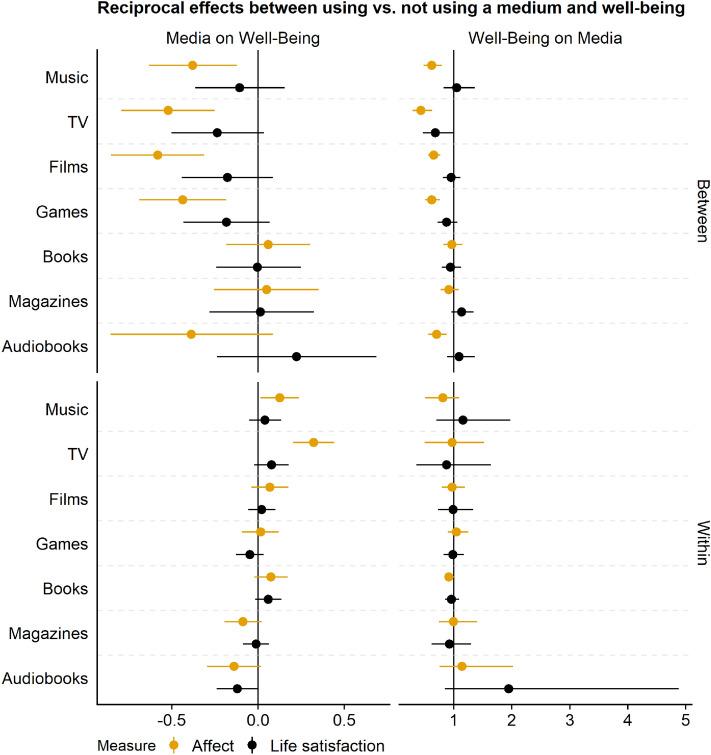
It is often assumed that traditional forms of media such as books enhance well-being, whereas new media do not. However, we lack evidence for such claims and media research is mainly focused on how much time people spend with a medium, but not whether someone used a medium or not. We explored the effect of media use during one week on well-being at the end of the week, differentiating time spent with a medium and use versus nonuse, over a wide range of different media types: music, TV, films, video games, (e-)books, (digital) magazines, and audiobooks. Results from a six-week longitudinal study representative of the UK population 16 years and older (N = 2159) showed that effects were generally small; between-person relations but rarely within-person effects; mostly for use versus nonuse and not time spent with a medium; and on affective well-being, not life satisfaction.
人们通常认为,像书籍这样的传统媒体形式可以增强幸福感,而新媒体则不会。然而,我们缺乏这样的证据,而且媒体研究主要集中在人们花在一种媒体上的时间上,而不是某人是否使用了一种媒体。我们在一周内使用各种不同类型的媒体(音乐、电视、电影、视频游戏、电子书、(数字)杂志和有声读物),探索了一周结束时使用媒体对幸福感的影响,区分了使用媒体的时间与不使用媒体的时间。这项为期六周的纵向研究代表了英国 16 岁及以上的人群(N=2159),结果表明,影响通常很小;更多的是个体间关系,而很少是个体内关系;主要是使用与不使用媒体之间的关系,而不是使用媒体的时间;而且主要影响的是情感幸福感,而不是生活满意度。



 Zotero 插件